Impact Measurement Frameworks Overview
AI visibility now matters more than search rankings as discovery shifts to generative answers.

Search discovery is breaking in half, and most measurement dashboards haven't noticed. AI-generated answers now sit between a user's question and the moment they'd normally click through to a website, and that layer is growing fast enough to make rankings and organic traffic an incomplete story on their own.
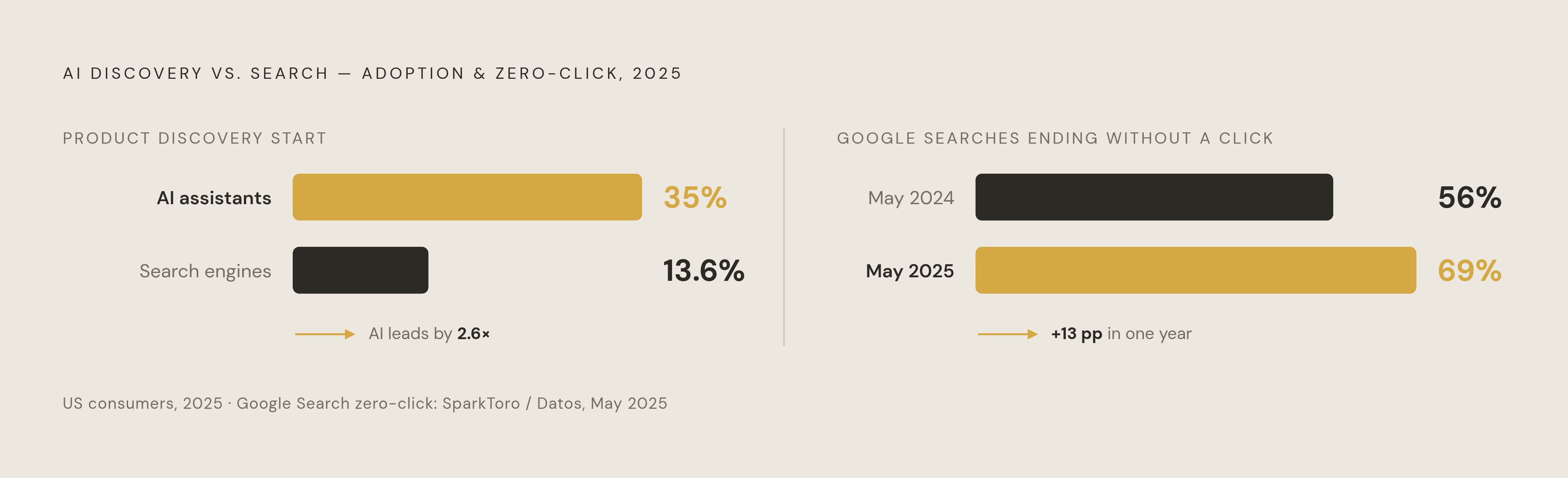
The numbers make the shift concrete. Similarweb's zero-click research found that 69% of news-related Google searches in May 2025 ended without a single click, up from 56% a year earlier, a 13-point jump in twelve months. That's a 13-point jump in twelve months. Similarweb's Generative AI Brand Visibility Index found something even sharper upstream: 35% of US consumers now use AI at the product discovery stage, compared with 13.6% who start at a search engine. The shortlist gets built before the search bar ever opens.
Scale explains why this matters. Google AI Overviews reaches more than 2.5 billion monthly active users. Google AI Mode passed 1 billion monthly users within a year of launch. ChatGPT has over 700 million weekly users. A brand can hold the top organic spot on Google and still be invisible in the one answer a ChatGPT or Perplexity user actually reads, with no click, no impression, and no awareness registered anywhere. Teams still reporting on rankings and organic sessions alone are describing a shrinking slice of the discovery process and calling it the whole picture.
What GEO and AEO measure, and why the terminology matters
Generative Engine Optimization, or GEO, is the practice of shaping content, brand entity signals, and technical setup so that generative AI engines cite and recommend a brand when someone asks a relevant question. The term comes out of academic research, specifically the Princeton and IIT Delhi paper by Aggarwal and colleagues, presented at KDD 2024. Answer Engine Optimization, or AEO, predates GEO and covers a related but narrower goal: getting extracted directly as the answer, whether that's a featured snippet, a People Also Ask box, or a voice response. In practice the two converge on the same objective, being cited inside an AI-generated answer, and GEO has become the more common term in both academic and enterprise settings.
The mechanism matters here because it explains what the metrics are actually tracking. Most AI search surfaces run on retrieval-augmented generation, or RAG: the system retrieves a set of candidate documents, then synthesizes them into one composed answer. Being indexed by a search engine is a precondition. Content also has to be structured clearly enough, and carry enough authority, for the model to choose it over competing sources when it writes that answer. The pool an LLM actually draws from is narrower than the top ten blue links on a results page, and getting into that smaller pool is the entire GEO objective.
A framework from LLM Pulse's 2026 research states that SEO ranks a brand, AEO selects it, and GEO gets it cited and recommended. Mature strategies now do all three at once, though budget allocation across them is shifting quickly. Google Analytics and Search Console's legacy reporting don't capture any of this because they weren't built to track it. Citation frequency, mention share, and presence across AI surfaces sit outside the instrumentation most marketing teams already have running. Measuring GEO requires building a new layer rather than repurposing an old one.
Share of Model: the primary metric for AI visibility
Share of Model, or SoM, measures how often a brand shows up in AI-generated responses relative to its competitors, across a defined set of queries that matter to the category. It's the headline number in GEO measurement because it does for AI visibility what rank position used to do for search.
Similarweb's 2026 toolkit includes a benchmark that makes the concept concrete. A travel brand tracked 180 AI-generated responses spread across six topic clusters and appeared in just 13 of them, a Share of Model of 7.2%. For query clusters covering luxury hotels, business travel, and rewards programs, categories the brand should reasonably own, the AI response left it out. That 7.2% is the exact kind of number GEO work exists to move.
What SoM exposes is a gap that traditional reporting can't see: a brand can dominate organic search results and still register almost no presence in the conversational answers its buyers are actually receiving. Building a SoM measurement means defining the query set relevant to the brand's category and competitive set, running those prompts systematically across the AI surfaces that matter to the audience, and counting appearances, citations, and mentions against both the total response pool and named competitors. A single SoM reading is a diagnostic, not a scoreboard. The number only becomes useful once it's tracked over time against a fixed competitor set, the same way a single day's stock price tells a reader almost nothing without a chart behind it.
The full measurement framework: citation rate, mention share, sentiment, and platform-level reporting
Similarweb's framework breaks working GEO measurement into four components. Citation with a source link means the AI names a specific URL as evidence. Brand mention means the name shows up in the response, linked or not. Positive sentiment means the mention is framed neutrally or favorably rather than negatively. Share of voice means the brand shows up consistently across the range of relevant prompts. None of these four appear in Google Analytics, so tracking them requires a dedicated measurement layer built for the purpose.
A few supporting metrics round out the picture: which competing domains get cited instead, and how often; AI-search impressions and referral traffic actually landing on the site from those surfaces; and conversions attributable to that AI-sourced traffic. Google gave this discipline a real infrastructure boost in June 2026 by adding dedicated generative AI performance reporting inside Search Console, a meaningful step for teams trying to measure AI Overviews performance directly rather than inferring it.
Executives tend to want one number, and the field has converged on formulas that translate AI visibility metrics into financial terms leadership actually asks for in budget meetings.
The stakes of getting this right go beyond reporting hygiene. Adobe's AI and Digital Trends report found that 39% of executives cite unclear measurement of AI's value or ROI as a top driver of misalignment between senior executives and the practitioners doing the work. The framework above is a direct answer to that gap, not an academic nicety layered on top of it.
What drives AI citation: the content and authority signals research has identified
Knowing what to measure doesn't tell a team what to change. The Princeton GEO-Bench study, from Aggarwal and colleagues at KDD 2024, found that content with added statistics and quotations achieved 30 to 40% higher visibility in AI-generated responses compared to unmodified content. Keyword stuffing, the old SEO reflex, performed below baseline. The structure that earns an AI citation looks nothing like the structure built to chase keyword density for a decade.
Freshness turns out to be its own independent lever. AirOps' 2026 State of AI Search Report, analyzing citation patterns across ChatGPT, Perplexity, Google AI Overview, and Gemini, found that 83% of AI citations for commercial and evaluation-stage queries come from pages updated within the past 12 months. Pages that don't get refreshed quarterly are three times more likely to lose their citations over time. Authority signals carry weight too: an analysis by Jack Limebear found a 0.65 linear correlation between domain authority and AI citation frequency, a relationship strong enough to make authority-building a core line item in a GEO budget rather than a secondary concern.
Third-party presence is a citation driver as well: listicle placements, branded mentions across the web, brand co-occurrence with category terms, presence on Reddit, and visibility on review platforms all rank among the biggest factors behind ChatGPT mentions and recommendations. That has a direct implication for PR teams. The Muck Rack study found that 50% of a brand's AI citations trace back to just 20 media outlets, yet the overlap between typical PR outreach lists and those specific 20 outlets runs only 2%. That's a targeting gap most communications teams haven't noticed yet, let alone closed.
Timing compounds all of this. RevvGrowth's 2026 AEO analysis found early adopters capture several times more AI visibility than brands that start late, and as of September 2025, a survey of 250 marketing teams found only 37.2% actively optimizing for AI search. The majority of the field hasn't started. That's an opening.
Platform divergence: why a single measurement number obscures what is happening across surfaces
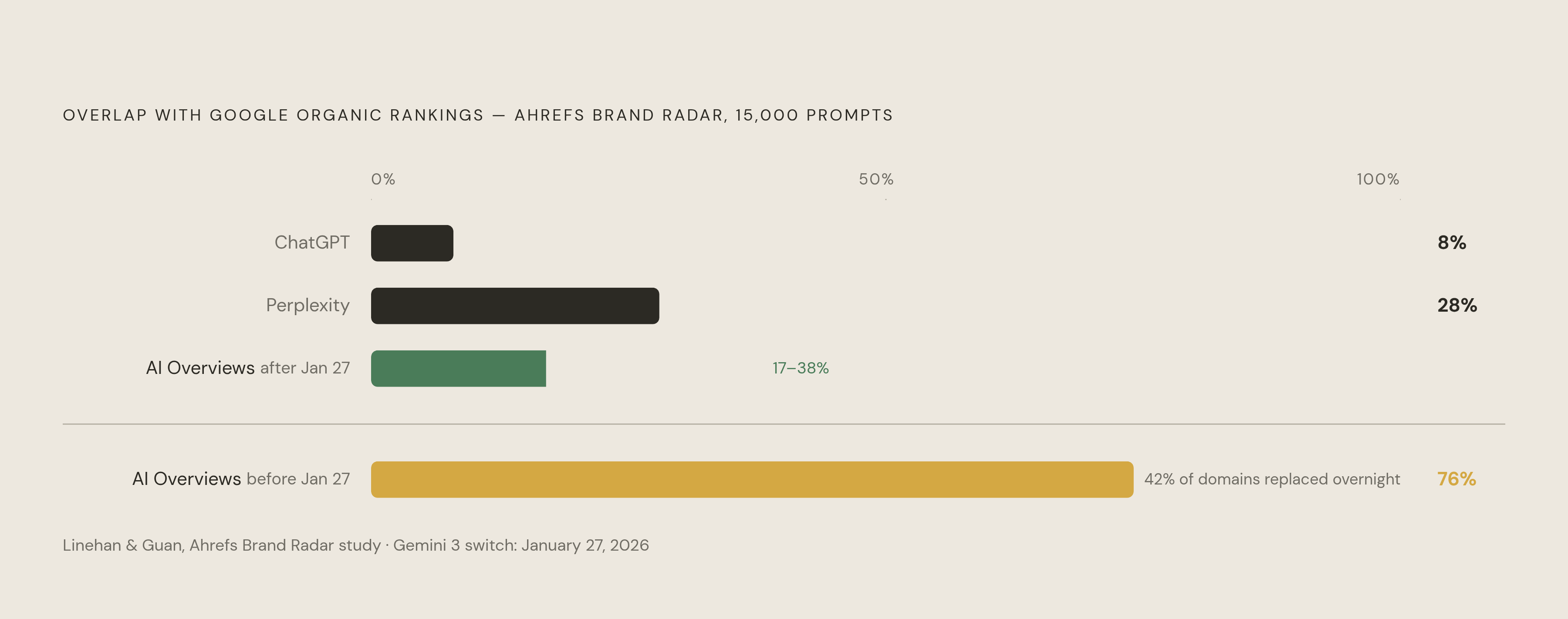
AI surfaces don't behave like one system wearing different logos. A study by Louise Linehan and Xibeijia Guan, running 15,000 prompts through Ahrefs Brand Radar, found the overall overlap between AI citations and Google's top 10 organic results sat at just 12%. ChatGPT showed only 8% overlap with combined Google and Bing results. Perplexity tracked closest to traditional rankings, at 28% overlap with Google and 14% with Bing. Google AI Overviews stood apart from all of them, with 76% of cited URLs matching organic rankings, at least before a major model change.
That change arrived on January 27, 2026, when Google switched AI Overviews to Gemini 3. Roughly 42% of previously cited domains got replaced outright, and the overlap between top-10 organic rankings and AI Overview citations fell from 76% down to somewhere between 17% and 38%, depending on which dataset you check (figures from Ahrefs and BrightEdge via ALM Corp). A brand tracking only its AI Overviews presence going into that switch had zero warning that nearly half its citations were about to vanish.
This is the practical argument for measuring per surface, continuously, rather than running a quarterly audit against a single platform. Model updates arrive without much notice, and citation patterns can shift underneath a brand overnight. Ongoing monitoring, especially around known update cycles, isn't a nice-to-have layered on top of GEO strategy; it's the strategy. Academic frameworks on GEO raise concentration, disclosure, and measurement-accuracy risks as the practice scales, a set of governance questions agencies advising clients on this work would do well to keep in view.
Managing AI visibility measurement across a portfolio of brands
Adoption has outrun infrastructure. Salesforce's State of Marketing report found 87% of marketers now use generative AI in at least one workflow, up from 51% in 2024, but the measurement tooling to match that adoption curve hasn't caught up at the same pace.
Running this across a portfolio of client brands means solving two problems at once. Each brand needs its own query set, its own competitor benchmark, and per-surface Share of Model tracking specific to its category. Agency leadership, meanwhile, needs a rolled-up view across the whole portfolio to spot patterns, decide where to put effort next, and show collective results to the business. Handling those separately, with a different subscription for SEO, another for content, another for analytics, and another for publishing, adds a meaningful range of extra software costs a month alone. A system that covers GEO monitoring and content operations together cuts that overhead down.
Reporting itself becomes a retention tool in this environment. A client who sees Share of Model movement, citation rate trends, and platform-level shifts laid out clearly has visibility into AI performance they'd otherwise have no way to see at all, and that visibility gives account teams something concrete to point to when the renewal conversation comes around. This is where Thrad fits: a single workspace built for agencies running GEO across an entire client roster, with cumulative analytics across every brand and granular controls at the individual client level. Bespoke weekly reports and per-client data exports give account teams the evidence they need to hold onto accounts on the strength of actual AI visibility results, not vague assurances.
An enablement piece is easy to skip: an agency can't credibly sell or report on a service its own account teams don't understand. An agency can't credibly sell or report on a service its own account teams don't understand at the level of detail their clients will eventually ask about. Fluency in Share of Model, citation rate, and AI-surface presence isn't a technical nicety reserved for the analytics team; it's the baseline for client trust.
What measurement looks like in practice over the first six months of a GEO program
GEO doesn't move overnight, but it doesn't move at the glacial pace of traditional SEO either. Plan on 3 to 6 months of consistent work before Share of Model shows meaningful change, though visibility shifts can appear faster than classic ranking improvements once content gets restructured or authority signals start building.
Month one is about establishing the baseline: run the defined query set across target surfaces, record the starting Share of Model, and document exactly which competitors are getting cited and on which platforms. Months two and three are where the content changes go in, and the team watches for citation rate movement in response, along with any platform-level shifts that emerge early. By months four through six, the reporting shifts toward share of voice trends, sentiment direction, and AI-attributed referral traffic, with the whole picture translated into the ROI formula executives actually need for budget conversations.
None of this replaces SEO. It sits alongside it, measuring a layer of discovery that rankings and organic traffic were never built to see.