Sustainable Supply Chain Management Practices
Most companies can't measure if sustainability spending actually works.

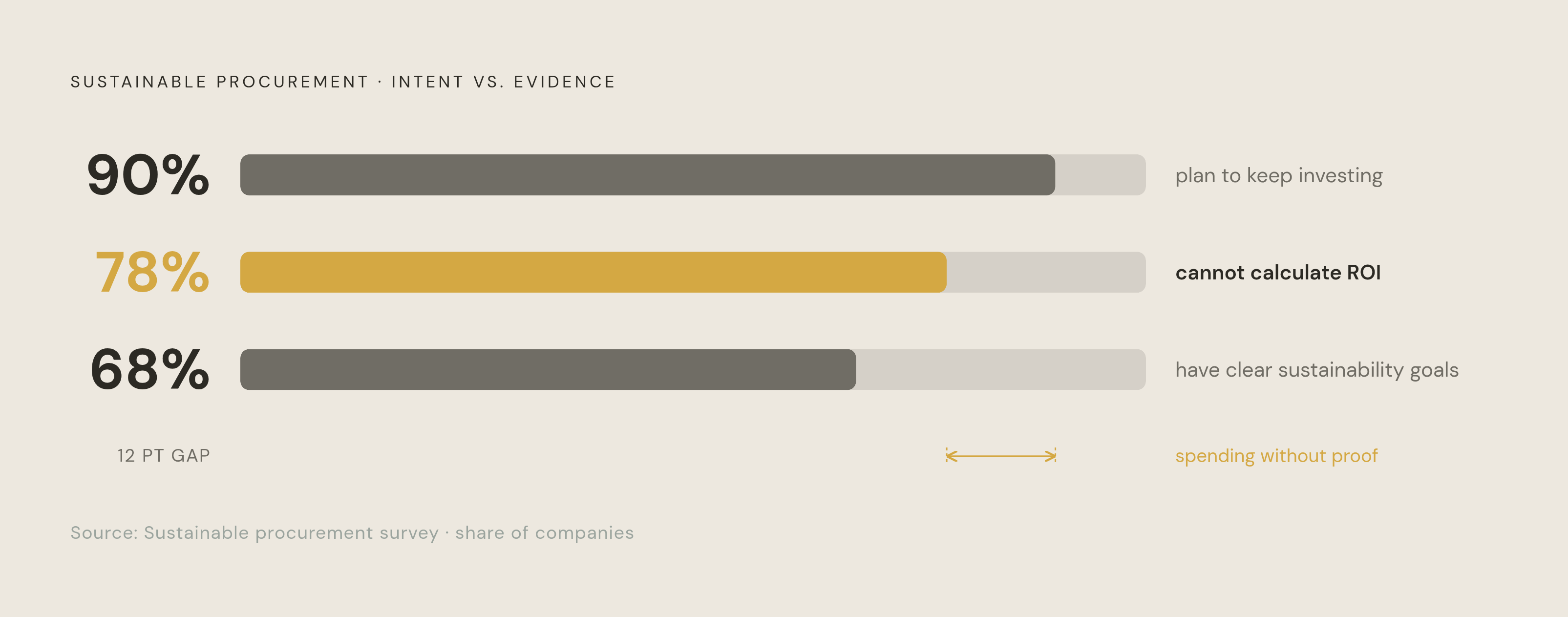
The core finding here is simple: companies are spending faster than they can prove it's working. A 2025 Capgemini survey of 1,000 supply chain executives found 68% now have clear sustainability objectives for their supply chains, up from 35% in 2022. That's nearly double in three years.
The pull isn't only internal, either. Consumer preference is tilting toward environmentally responsible brands, and on the investor side, a 2025 BNP Paribas ESG survey found 87% of institutional investors say their ESG objectives haven't moved.
Here's the catch worth sitting with: 78% of companies still can't calculate the return on investment for their sustainable procurement work. Yet 90% plan to keep investing regardless. Money is going into programs nobody can yet prove are paying off, and the spending isn't slowing down to find out first.
Is that reckless, or just what early adoption always looks like? Probably both, honestly. Adoption is outrunning measurement, and that gap is exactly why the next section carries more weight than any strategy deck sitting in a drawer somewhere.
Measuring what you own: Scope 1, 2, and 3 accounting as the foundation
Scope 1 is what a company burns directly, Scope 2 is the electricity it buys, and Scope 3 is everything else: supplier emissions, transportation, product use, disposal at the end of a product's life. That third bucket usually swamps the other two combined, which is most of why the CDP's 5.5x multiplier exists at all.
Here's what should make Scope 3 feel solvable: research published in Nature in 2025 found that 56% to 70% of Scope 3 emissions, under current science-based coverage guidance, sit within the first two tiers of supply. Most of the exposure sits close to the buyer rather than five layers down in some subcontractor nobody's ever heard of, which makes it addressable. The Science Based Targets initiative requires that companies whose Scope 3 emissions exceed 40% of total footprint set targets covering at least 67% of that number, and given where the concentration actually sits, that's a real bar.
None of it is simple to execute, though. Suppliers report data with wildly different quality, and shared logistics networks make attribution genuinely messy: if three companies use the same freight carrier, who owns the emissions from that one truck? Companies also have to pick between spend-based estimation, which multiplies dollars spent by an emissions factor, and activity-based estimation, which tracks the real thing (tons shipped, kilowatt-hours burned). The first is fast and rough, while the second is slow and accurate. Companies that skip straight to setting targets without doing this work are usually the same ones stuck in that 78% bucket, unable to show ROI, because there was never a baseline to measure against in the first place.
Once the baseline exists, the obvious next move is finding out who's actually generating the footprint. For most companies, that means suppliers.
Setting supplier standards and getting them to stick
Sending suppliers an annual sustainability questionnaire and calling it a standard pushes the paperwork downstream: suppliers fill out forms to keep the buyer happy, nothing structural changes, and everyone reconvenes next year for the same exercise.
Sourcing decisions that work start factoring supplier sustainability performance in from the beginning, rather than adding an audit after the contract's signed. Data and tools get shared so suppliers can set their own science-based targets instead of guessing at what the buyer wants to hear. Moody's, working through CDP Supply Chain, requires 60% of its suppliers by spend to have science-based targets set by the end of 2025, backed by active webinars and disclosure support alongside the deadline. Mastercard has set a 20% absolute Scope 3 reduction target and leans on supplier target adoption as the main lever to get there.
One barrier gets underdiscussed: clean energy access. Suppliers in emerging markets often can't get affordable financing for renewable installations, and many lack the in-house expertise to navigate power purchase agreements or renewable energy certificates on their own. If a buyer wants clean electricity somewhere in its supply chain, sometimes that buyer has to help solve the financing and knowledge problem directly, alongside demanding the outcome.
The scale of this shift shows up in the numbers already: nearly 11,000 companies are committed to or validated under SBTi, covering over 40% of global market capitalization. Suppliers everywhere are running into customer requirements tied to that framework whether or not they set out looking for it. Standards that actually stick share a few features: contractual minimums instead of vague aspirations, joint capacity-building instead of one-way demands, preferred-supplier status tied to real performance, and escalation timelines for suppliers who fall short. The common thread is a relationship that keeps going, built on more than a form that gets filed once a year.
The regulatory environment companies are now operating inside
Multiple major EU regulations are reshaping how supply chains have to report and behave, including the Corporate Sustainability Reporting Directive, the Corporate Sustainability Due Diligence Directive, and the Carbon Border Adjustment Mechanism, among others — overlapping, on different clocks, with different companies caught in different nets.
The CSDDD alone covers roughly 6,000 EU companies and 900 non-EU companies, with fines for non-compliance reaching 5% of annual worldwide turnover, the kind of number that gets a general counsel's attention within a single meeting. In April 2025, the "Stop-the-Clock" amendment raised the threshold to companies with at least 3,000 employees and €900 million in net worldwide turnover, cutting the number of in-scope companies by roughly 70% from the original text.
So can mid-sized suppliers relax now? Not really, and this is the part most people misread. A company sitting outside the direct scope is often still a Tier 1 supplier to a customer who's very much inside it, and those requirements roll downhill regardless of what the supplier itself is legally on the hook for. Recent EU legislative amendments have narrowed scope and pushed back timelines, which reads like retreat if you squint, though recalibration describes it more precisely.
Beyond the EU, other jurisdictions including the UK and the US are advancing their own carbon and disclosure requirements on separate timelines. The financial stakes aren't abstract: supply chain incidents cost companies an average of $184 million, while proactive due diligence programs cut risk incidents by up to 40%. Compliance sets a floor, telling a company what to report, while changing the supply chain that actually generates those numbers takes something more.
Redesigning for circularity: moving from linear supply chains to closed loops
Here's a number that should stop people mid-sentence: the global circularity rate, meaning the share of materials cycled back into the economy instead of extracted fresh and eventually dumped, remains strikingly low and has been declining in recent years. Boardroom talk about circularity is rising everywhere, and the actual global number is moving backward. That gap between talk and action is the whole story of this section, worth sitting with for a second rather than rushing past.
What does circularity look like when it's real? Products get designed for disassembly and reuse from the start, rather than retrofitted for recyclability after the fact, supplier contracts require take-back of materials at end-of-life, and reverse logistics gets built alongside forward logistics instead of tacked on years later. Packaging redesign carries real financial upside too: research on circular packaging suggests reuse programs can deliver meaningful cost reductions once the system reaches scale.
The business case shows up in survey data as well. A 2025 Bain and World Economic Forum survey of 420 manufacturing executives found 72% expect circular models to increase revenue by 2027. There's a standards infrastructure catching up to the demand too: the Global Circularity Protocol is a science-based standard for corporate circular action, tying metrics to strategy, targets, and ESG reporting in one place. The EU's Circular Economy Action Plan sets ambitious recycling targets, which creates binding pressure on any company selling into EU markets, circular ambitions or not.
The real argument for moving now: upstream design changes take years to move through a product line, so companies starting today are building structural advantage while the ones waiting for certainty are setting themselves up for retrofit costs and stranded assets down the road.
Logistics and transportation: the operational levers for emissions reduction
Freight sits among the most concentrated supply chains around, and logistics decisions compound daily in a way supplier negotiations or product redesigns simply don't. Every truck route, every partial container, every idling fleet vehicle adds to the total in real time, not on some quarterly reporting cycle.
The levers here are well understood, even if they're underused in practice. Modal shift moves freight from air and road onto rail and sea wherever lead times allow, and the emissions gap between air and ocean freight per ton-mile isn't subtle. Route optimization and load consolidation cut down on empty miles and half-full trucks driving anyway. Fleet electrification is gaining real traction: a 2025 survey of 525 senior executives found 40% name electrification as a key sustainability priority. Nearshoring shortens supply lines, which cuts transport emissions and improves resilience at the same time, one of the rare cases where the sustainability goal and the risk-management goal actually point the same direction. Warehouses matter too, since on-site renewables, LED lighting, and better cold-chain management all chip away at the operational footprint bit by bit.
There's a visibility problem sitting underneath all of it, though. Optimizing routes and loads requires real-time data on where things are, how full the trucks actually are, and what emissions factor applies to each leg of the trip. Companies running fragmented transportation management systems and ERP setups that don't talk to each other can't optimize what they can't see. This is a data architecture problem first, one that happens to block everything else riding on top of it.
Natural resource management belongs in this conversation too: 29% of supply chain executives name natural resource management a key priority, and these considerations increasingly shape where logistics facilities get sited and how they operate day to day. Reverse logistics ties this section straight back to circularity: when product recovery gets built into the network from the start instead of bolted on later, it shares infrastructure with forward delivery and lowers cost per unit rather than adding a new line item to the budget.
Building the sequenced implementation roadmap (and what to prioritize first)
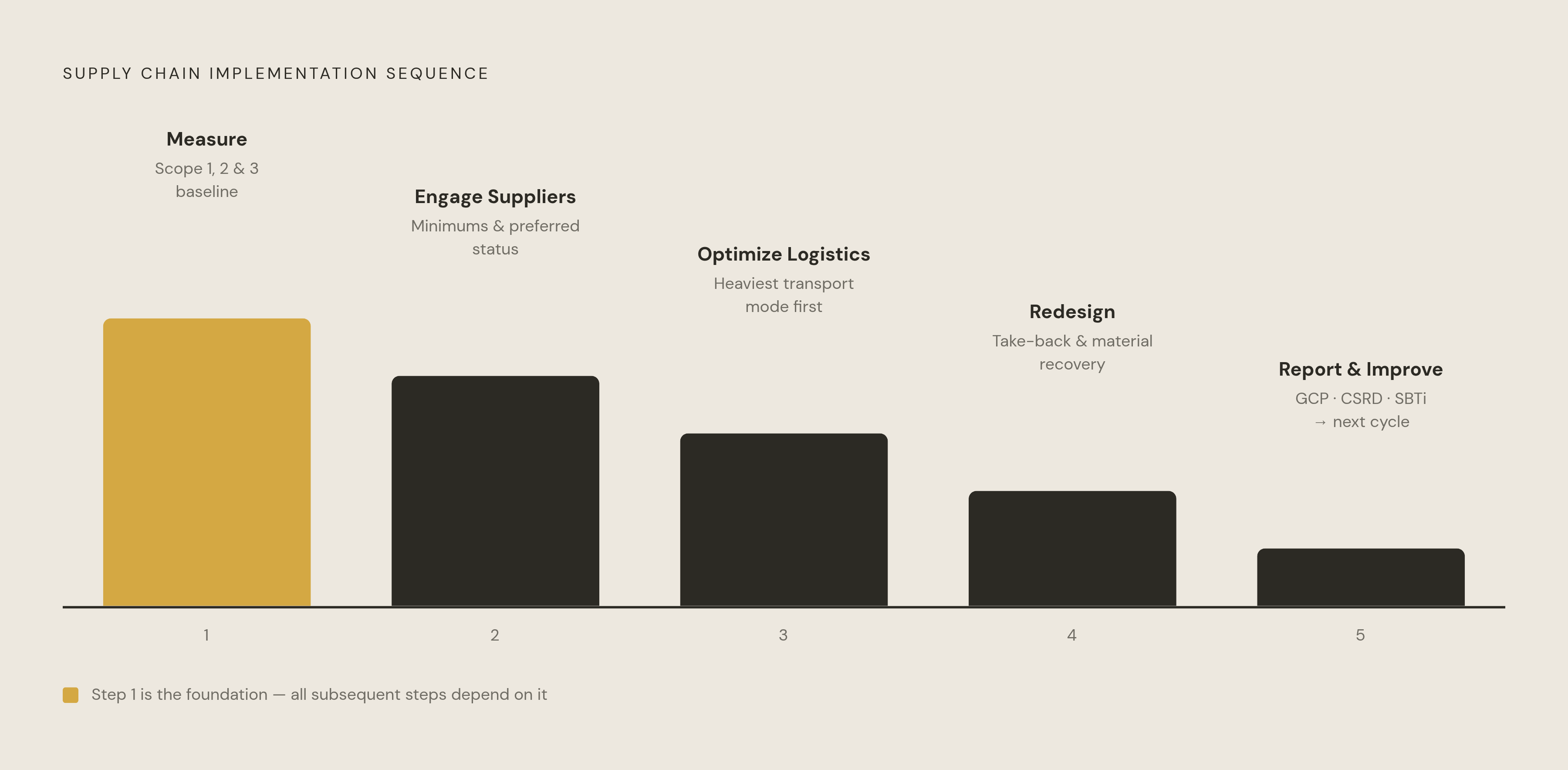
Order matters more than most companies want to admit, and this is where the whole piece lands. Launch circular product design, supplier science-based targets, and fleet electrification all in the same fiscal year, without a measurement foundation underneath any of it, and the whole thing tends to seize up. These practices depend on each other in sequence; skipping the base layer just means rebuilding it later, under worse conditions and with less patience from leadership.
A workable sequence looks something like this. Start by measuring: build the Scope 1, 2, and 3 baseline, and find out which supplier tiers and which logistics modes carry the heaviest exposure. From there, engage suppliers, setting minimum standards, offering real capacity-building support, and tying preferred-supplier status to measurable progress, starting with the highest-spend, highest-emission categories rather than spreading effort across the entire vendor list at once. Once that's moving, optimize logistics using the baseline data to target whichever transport mode carries the largest footprint. Then redesign for circularity: build take-back programs, packaging redesign, and material recovery into new product lines and supplier contracts, accepting these changes have long lead times and won't show results next quarter, or maybe even next year. Last, report and improve, using frameworks like the Global Circularity Protocol, CSRD, and SBTi to structure disclosure, then feeding that disclosure back into the next round of targets instead of treating the report itself as the finish line.
Sustainability and operational efficiency overlap more than they conflict, which cuts against the "sacrifice performance for the planet" framing that shows up in so many boardroom debates. Route optimization, inventory reduction, and waste elimination all improve emissions and the bottom line at the same time. They often share the same budget line under two different names.
The ROI gap from the second section doesn't close on its own, and no separate reporting exercise bolted onto existing operations will close it either. The same data infrastructure that drives the reductions also proves their value, with measurement and proof of value running as one system rather than two projects in parallel. Worth noting that 71% of executives now say the business value of sustainability outweighs the cost, which suggests the argument over whether any of this is worth doing is mostly settled. What's left is the less glamorous work: building it into procurement criteria, product design briefs, logistics contracts, and supplier scorecards as ordinary operating procedure, the way the supply chain runs day to day, with its own budget folded into existing line items rather than a slide deck nobody reads twice.