Authenticity Verification Methods in Luxury Recommerce

The secondhand luxury market has grown into a business worth tens of billions of dollars, and at that scale, trust can no longer rest on the judgment of any single inspector or any single transaction. It has to be built into infrastructure. Counterfeit sophistication has kept pace with that growth, and a meaningful share of professional authenticators cannot initially distinguish high-end "superfake" handbags from genuine items. Even people trained to close that detection gap cannot always do it.
U.S. Customs and Border Protection's FY 2024 seizure data shows luxury handbags and wallets as the single largest category by MSRP value among counterfeit goods intercepted at the border. The category under the heaviest counterfeiting pressure is also the category generating the most resale volume. The risk and the reward sit in exactly the same product line. For buyers, a failed authentication means financial loss on an item that may have cost thousands of dollars. For brands, it means reputational damage that extends well beyond the single transaction. For platforms, the consequence runs deeper still: a marketplace that cannot credibly authenticate what it sells gets structurally excluded from the premium segment of the market, regardless of how much inventory it moves.
Demand-side pressure matches the supply-side risk. Boston Consulting Group data shows that most resale buyers name guaranteed authenticity as their top purchase factor, so it ranks ahead of price, condition, or brand selection. Buyers are telling the market directly what they need before they will commit real money to a secondhand luxury purchase. Everything covered in the sections that follow, physical inspection, AI visual analysis, blockchain provenance, and the brand strategies now emerging around all three, exists because that demand has to be met with something more defensible than a seller's word.
What physical inspection can and cannot do
Human expert inspection is the oldest method in the authentication stack, and it remains the most defensible approach for rare, atypical, or ultra-high-value items. It does not scale, and it is not infallible; it became the foundation the rest of the system was built on top of.
Rigorous physical inspection involves trained authenticators examining the construction details counterfeiters most often get wrong: stitching, hardware, logo geometry, font precision, lining materials, date codes, and serial numbers. Expert tip frameworks used by resellers stress that no single detail can decide the outcome. Authentication requires reading several signals together, because a counterfeiter who nails the hardware might still miss the stitch spacing or the font weight on an interior tag. At The RealReal, every authentication team member needs at least 40 hours of intensive initial training, including job shadowing and daily quizzes, and then keeps training in sessions designed to stay ahead of counterfeiting techniques that keep evolving. Vestiaire Collective applies automatic physical inspection to every purchase over €1,000, with the work processed at authentication centers in Tourcoing, Crawley, Hong Kong, Brooklyn, and Seoul.
Material testing extends what the human eye can do into territory it cannot reach on its own. The RealReal uses X-Ray Fluorescence machines to analyze the metallic composition of jewelry and watch hardware, identifying the exact alloys used in cases, settings, and clasps. That test can catch plated fakes that look identical to the genuine article under ordinary inspection. GIA's materials workflow uses gemological and spectroscopic techniques to separate natural, laboratory-grown, treated, and simulant stones, and its iD100 device distinguishes natural diamonds from lab-grown stones and simulants in under two seconds. Spectroscopic testing operates as a working layer in the authentication stack. Platforms like myGemma lean entirely on GIA-trained gemologists and handbag experts who evaluate every piece by hand, treating human judgment as a deliberate point of differentiation in a market that is otherwise automating.
The limits are structural. Training investment creates a hard ceiling on throughput: 40 hours minimum at The RealReal, 750 hours at Vestiaire Collective, neither of which can be compressed without sacrificing rigor. Human expert systems perform best on rare or atypical items where AI training data runs thin, but on high-volume, common items, the consistency advantage shifts toward automated systems that do not tire, get distracted, or vary from one inspector to the next. Superfakes are built to defeat visual inspection, even the trained kind. Material testing turns authentication into something objective and instrument-based rather than purely perceptual, and that is the same logic that drives the AI layer covered next.
AI-powered visual analysis and its operational scale
AI-powered visual authentication is now the largest single segment of the authentication market by service type, and at the platforms that use it, the technology has moved well past the pilot stage into daily operational volume. It exists to handle a scale problem physical inspection cannot solve: when a platform needs to authenticate millions of items rather than thousands, human review alone cannot keep up.
The strongest systems use deep-learning models trained on proprietary brand datasets to detect counterfeit deviations in fabric structure, hardware engraving, logo placement, quilting pattern, stitch spacing, and font geometry. These are the same regions a human expert inspects, examined at machine speed and with machine consistency. Entrupy's current luxury workflow authenticates more than 20 top luxury brands at 99.86% accuracy, comparing microscopic captures against millions of records, and for its 2025 apparel expansion it draws on more than 90 million reference images. AI-based systems typically deliver an analysis within 30 seconds to 3 minutes per item, and they can scale to unlimited concurrent users. A 2024 Springer paper on counterfeit detection reported 98.8% accuracy overall, and its key-area-guided model held 92.1% accuracy even after you cut the sample size by 80%. Pattern-matching performs best when a system concentrates on the specific visual regions where brand identity actually resides.
Capture methods are shifting toward ordinary smartphones. Starting May 18, 2026, Entrupy moved from device-based microscopic authentication to a completely device-free system that authenticates bags and luxury goods directly from an iPhone or Android, removing the hardware barrier that previously kept smaller consignment shops and individual resellers out of the process. Research by Garcia-Cotte and colleagues reported 99.71% accuracy after 3.06% rejections, using images captured under natural, weakly controlled conditions such as retail stores, customs checkpoints, warehouses, and outdoor settings. Credible accuracy no longer depends on laboratory-grade equipment.
Platform-level deployment shows what this looks like in daily practice. The RealReal's proprietary AI system, Athena, processed 35% of all items by the end of 2025 and is on pace to handle close to half of all items by the end of 2026. The RealReal has also built TRR Vision and TRR Shield in its own TRR Authentication Labs, where specialists in authentication, automation, AI, and machine learning work together against counterfeiting. Vestiaire Collective's listings are digitally verified and curated by an internal team supported by AI, reserving physical verification for higher-value items, a tiered model that uses automation to triage before human attention gets applied where it matters most. Alitheon's FeaturePrint creates a unique, persistent identifier from an object's natural random surface features, using nothing more than a standard camera or mobile phone, which makes item-level fingerprinting possible even on objects with no removable tags, a particular advantage for watches and metal accessories.
None of this replaces human inspection. A key technical challenge is to hold accuracy steady across different product lines, seasons, and manufacturing variations, because the same handbag model can carry legitimate minor differences across production years, and a model trained on earlier examples may flag those as suspect. Where training data runs thin, on rare or atypical items, the system's judgment degrades and the decision reverts to the human expert's domain. That handoff is the hinge the rest of this piece turns on.
Blockchain-backed digital product passports and the provenance record they create
Physical inspection and AI visual analysis both answer the same underlying question: what does this item look like, and does that match what the genuine article should look like? Neither one can answer a different question that matters just as much: where has this item been? Blockchain-backed digital product passports exist to answer that second question, and they record an item's life cycle in a form that survives multiple resale events.
A digital product passport contains immutable data about an item's origin, ownership history, repairs, and resale events, built on blockchain technology that lets brands and tech companies create secure digital identities for physical products. The record is cryptographically signed, so nothing already on the chain can be quietly rewritten. A repair, a resale, or a customs crossing can be added to the record, but the entries that came before stay fixed. Physical linkage usually runs through an NFC chip embedded in the product, connected to the digital record through a smartphone scan. That chip is the bridge between the object in someone's hands and the digital identity attached to it.
Deployment has already moved past the experimental phase. The Aura Blockchain Consortium had issued over 40 million digital product passports by 2024, with Bvlgari and Tod's among the brands actively using the system, building shared infrastructure together. Tod's introduced a Digital Product Passport for its Di Bag through the Aura Blockchain Consortium, equipping each bag with an NFC tag that lets a consumer pull up its digital passport by smartphone. Breitling has taken a different route, adopting the Arianee open protocol to secure and distribute digital passports for its watches at scale.
Regulation is pushing adoption further. Digital product passport frameworks taking shape in Europe are pushing fashion marketplaces and retailers toward cryptographically secure authentication mechanisms, with compliance timelines accelerating from 2027 onward. What began as a voluntary differentiator for brands willing to invest early is becoming a regulatory requirement, and the infrastructure being built now will become compulsory later. That timeline sets up a harder question: even with provenance recorded on-chain, does the system as a whole actually close the authentication gap, or does it just relocate it?
Where each method falls short
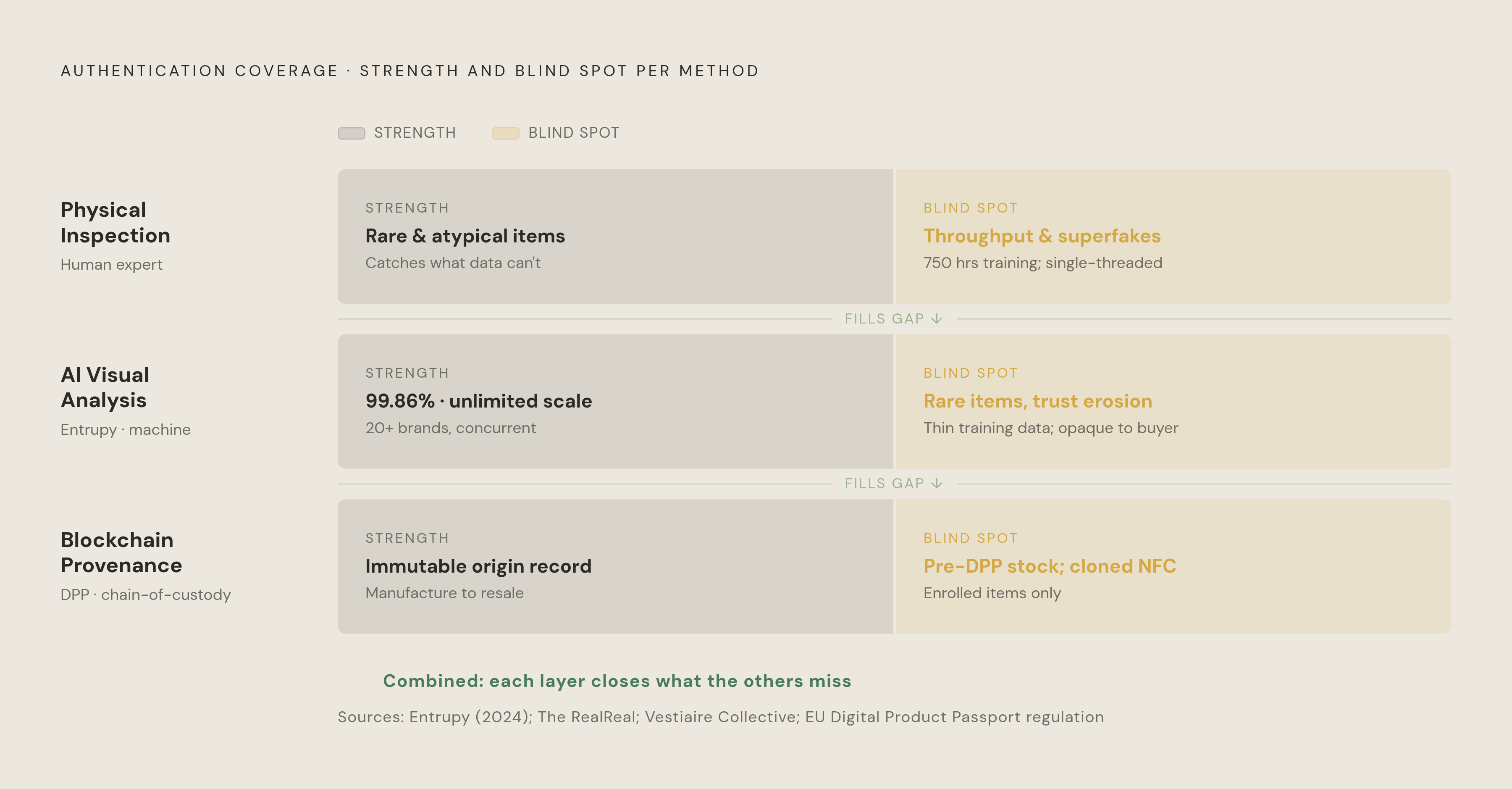
Physical inspection, AI visual analysis, and blockchain provenance each catch certain fakes and miss others, so no single method catches them all. Each method's weaknesses are offset, at least partially, by the strengths of the other two, and credible platforms are building all three into a single operating layer.
Physical inspection faces a closing gap between expert performance and counterfeit quality, because superfakes are engineered specifically to beat visual review by trained professionals. Its training investment sets a hard ceiling on throughput, and human judgment, while fairly consistent within a given expert, varies across different inspectors examining the same item. AI visual analysis struggles to hold accuracy across product lines, seasons, and manufacturing variations, and it depends on large, high-quality training datasets that simply do not exist for rare or atypical pieces. Peer-reviewed research published by Ma, Jin, and Dai in the Journal of the Academy of Marketing Science (Vol. 54) found, across eight separate studies, that consumers show a consistent preference for goods authenticated by human experts over those authenticated by AI, an effect the researchers attribute to perceived "perspective similarity" and one that holds for both buyers and sellers. That finding means the trust signal authentication is supposed to send can weaken precisely because of the automation that makes the process scalable, a tension platforms have to manage.
Blockchain provenance carries its own exposure. Advanced counterfeits using cloned NFC chips can link to fake websites instead of an official encrypted registry, so the system's physical anchor can be spoofed if a buyer never checks that the chip actually points to a legitimate record. DPPs only work for items enrolled at the point of original manufacture, and the enormous installed base of luxury goods made before DPP adoption has no on-chain record at all, which leaves the method unavailable for most items currently circulating on resale platforms. A blockchain record is also only as honest as its first entry: if provenance data gets falsified at enrollment, the chain will preserve that falsehood immutably and without complaint.
Instead of ranking these three methods against each other, platforms should combine them. Platforms running all three can offset each one's failure mode: AI handles volume and flags anomalies, human experts resolve the ambiguous or rare cases AI cannot confidently judge, and DPPs supply chain-of-custody evidence that neither visual method can produce on its own. The RealReal's model, blending its proprietary Athena AI system with human experts who remain in the loop for edge cases, is a working example of that layered approach. The consumer preference for human review documented by Ma, Jin, and Dai points toward a specific response: platforms that explain their layered process, rather than simply announcing "AI-authenticated," can preserve the trust signal that automation alone tends to erode. A certificate of authenticity issued by a platform running a single method is weaker evidence than one issued by a platform that has run the item through several independent checks.
Brands taking back control of authentication by entering the resale market directly
When luxury brands launch certified pre-owned programs, they do more than open a new revenue channel. They are reclaiming authentication authority that third-party resale platforms had accumulated by default, simply by being the ones doing the verifying.
Rolex's Certified Pre-Owned program turned this dynamic in a new direction. Rather than resisting resale as a threat to new sales, the brand built authentication, warranty, and distribution into a program run through authorized dealers, retaining control over pricing integrity, product authenticity, and brand perception all at once. A brand that stays out of recommerce risks losing narrative control over its own secondary market: when third-party platforms do all the authenticating, the brand becomes a spectator in a market built around its own products.
The strategic logic is specific to provenance. A brand's own certified pre-owned program is the only authentication channel that can make claims starting from the point of original manufacture, a starting point no third-party platform can replicate after the fact. Brands that deploy digital product passports compound that advantage over time. As items enrolled at manufacture age into the resale market years later, their on-chain records become verifiable in ways that items authenticated only through visual inspection never can. That advantage does not require brands to shut platforms out. Rolex works through its authorized dealer network rather than building a standalone resale operation from scratch, and brands deploying DPPs through the Aura Blockchain Consortium or the Arianee protocol are building shared infrastructure rather than isolated, brand-only systems. The partnership model, brands and platforms working together on authentication rather than competing over who controls it, is where this is heading, and it has direct consequences for what an individual buyer or seller should actually do.
Evaluating an authentication claim
Given how much authentication methods vary in rigor and coverage, the right question is which method was used, who performed it, and what the resulting certificate actually guarantees.
If you are evaluating a high-value purchase, find out whether the platform used a single method or a layered process. If a platform combines AI triage, human expert review for ambiguous items, and material testing for jewelry and watches, you get meaningfully stronger assurance than one relying on a single tool. Vestiaire Collective's 750-hour specialist training program and The RealReal's minimum 40-hour initial training with ongoing updates are concrete, publicly stated benchmarks, and a platform that will not disclose its training standards deserves appropriate skepticism. If a DPP or NFC-linked provenance record exists, check that the chip links to an official brand registry rather than a third-party site, because cloned chips pointing to fake records are a documented attack vector. Finally, check the platform's policy for an item that later proves inauthentic. Guarantee and refund terms function as a direct proxy for how much confidence the platform has in its own process.
Sellers have their own set of considerations. Authentication channel affects realized price directly: items authenticated through brand-certified programs like Rolex's CPO, or through platforms with strong authentication reputations, command premiums that reflect the trust infrastructure behind the sale, not just the item's physical condition. Adding a DPP at resale, where the item was originally enrolled at manufacture, removes friction from every future resale event, as provenance compounds across each successive sale. If you have high-value jewelry or watches, pursuing material testing, XRF or spectroscopic analysis, through a platform or an independent gemologist before listing gives you documentation that speeds the eventual sale and defends the asking price.
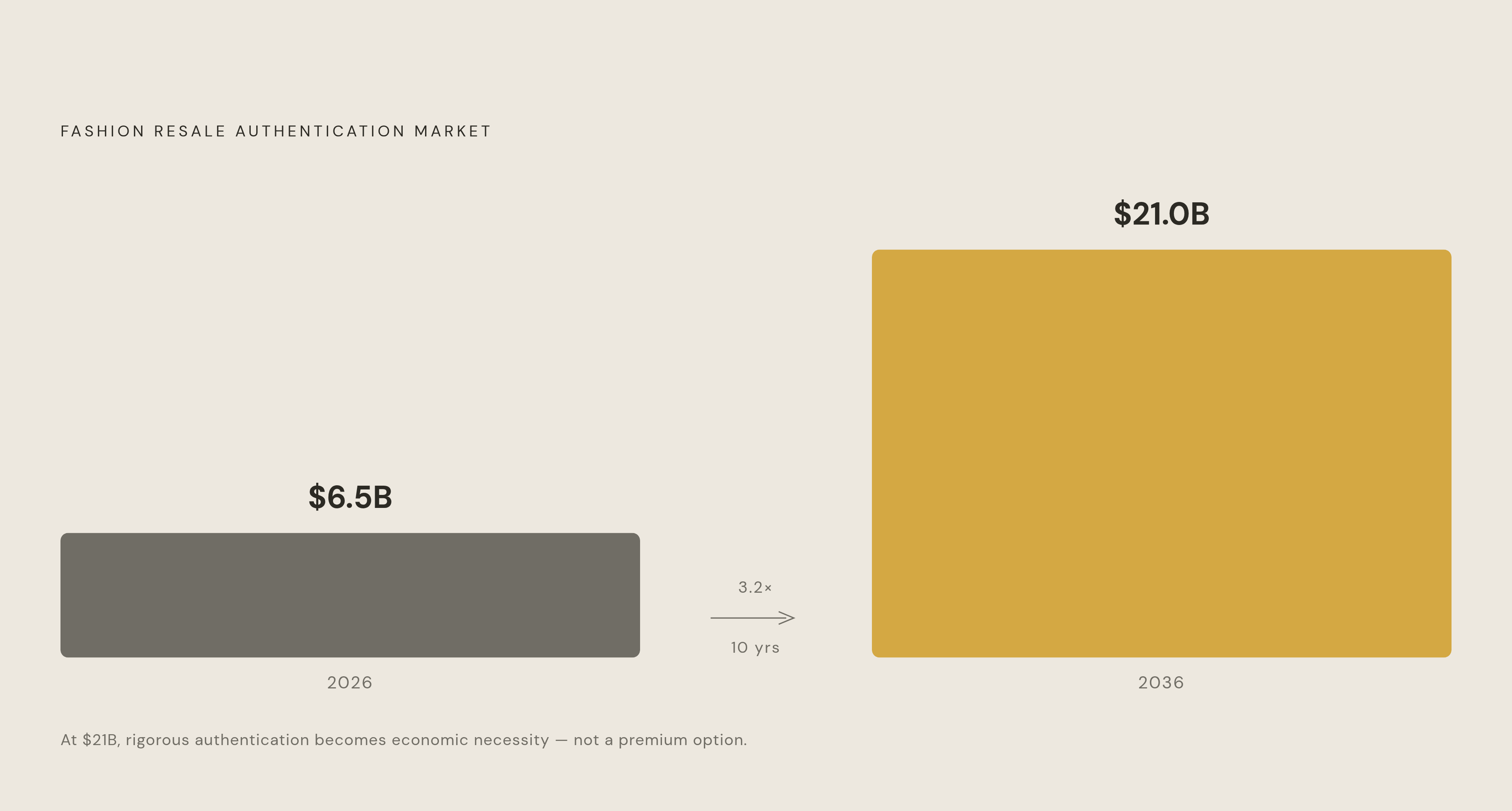
The authentication market itself is growing fast enough to change what "normal" looks like for buyers in the next decade. The fashion resale authentication market is projected to grow from USD 6.5 billion in 2026 to USD 21.0 billion by 2036. That growth brings more specialized providers, more competing methods, and more variation in quality for buyers and sellers to sort through. Items carrying richer documentation, layered authentication, verified provenance, material testing records, will progressively command better prices as that market matures. That gives both sides of a transaction a reason to treat rigorous authentication as something to demand now, not as overhead to tolerate later.