Ecodesign Requirements Under EU Regulation
New EU rules require companies to design sustainable products and disclose their environmental data.

The ESPR, published in the EU Official Journal on 28 June 2024 and in force from 18 July 2024, replaces the Ecodesign Directive, which targeted only energy-related products. The new regulation covers virtually every physical good placed on the EU market or put into service, including components and intermediate products that never reach a consumer directly. That single change in scope, from a narrow category of energy-consuming appliances to nearly all manufactured goods, is what separates the ESPR from a routine update of existing rules.
The Directive it replaces existed to correct a specific market failure: national governments were imposing their own, inconsistent energy efficiency measures, which raised compliance costs and fractured the internal market for manufacturers trying to sell across borders. The ESPR was built to close that gap permanently by setting sustainability requirements once, at EU level, binding on every product and every seller, including importers bringing goods in from outside the bloc. Where the old Directive asked a single question, how much energy does this product consume, the ESPR asks about durability, reusability, repairability, recyclability, upgradability, recycled content, substances of concern, carbon footprint, and the information made available across a product's entire lifecycle.
That expansion did not happen by accident or regulatory ambition for its own sake. Product design determines up to 80% of a product's environmental impact across its lifecycle. Rules governing waste disposal and recycling after the fact cannot deliver the circularity the EU has targeted. If the impact is locked in at the design stage, the regulation has to reach the design stage, and that is precisely what the ESPR does by extending its authority upstream into materials, manufacturing choices, and product architecture rather than confining itself to end-of-life handling.
None of this arrives through the ESPR's own text alone. The regulation is a framework: it does not set concrete requirements for any specific product but grants the European Commission the power to adopt delegated acts, product by product or horizontally across multiple product groups at once. That structural choice means the regulation's practical weight will land in successive waves over the coming years rather than all at once on the date it entered into force. For manufacturers, brands, and importers trying to assess their own exposure, the first task is not to memorize a single rulebook but to understand the two instruments through which every one of those future delegated acts will operate.
The two-track structure: performance requirements and Digital Product Passports
Every delegated act adopted under the ESPR will impose one or both of two categories of requirement, and the distinction between them is the practical starting point for any compliance assessment.
The first track covers performance requirements: quantitative or qualitative standards a product must meet, drawn from a list of up to 20 potential parameters written into the regulation itself. Those parameters span durability, reliability, reusability, upgradability, repairability, the possibility of maintenance and refurbishment, the presence of substances of concern, energy and water and resource efficiency, recycled content, the possibility of remanufacturing, recyclability, the possibility of material recovery, environmental impacts including carbon footprint, and the expected generation of waste. Delegated acts select which of these parameters apply to a given product group, and the Commission retains discretion to decide that performance requirements are not appropriate for a particular group. The Commission must justify any decision not to impose performance requirements, so the default expectation for an in-scope product is that such requirements are coming.
Track two is the Digital Product Passport (DPP). The DPP functions as the main tool giving access to product-specific sustainability information, including evidence of compliance with whatever performance requirements apply, and information requirements will include, at minimum, the DPP itself alongside substances of concern data. Every DPP has to be linked to a persistent unique product identifier, accessible through a data carrier such as a QR code, an NFC chip, or an RFID tag, and that link has to remain functional for the entire lifecycle of the product it describes. The passport itself must be machine-readable and built to standardized data formats, storing technical and environmental performance data, circularity and sustainability information, and compliance documentation such as manuals and safety labels. Where feasible, the DPP will be linked to existing EU tools such as the European Product Registry for Energy Labelling (EPREL) or the SCIP database for substances of concern in articles. A product already governed by an equivalent digital system may be exempted from separate DPP obligations, but that exemption has to be written into a delegated act; it does not happen automatically simply because a company can point to a comparable system already in use. The EU Central DPP Registry went live on 19 July 2026 under Article 13, linked to the customs single window EU CSW-CERTEX, and an unregistered passport stops a shipment at the border.
Substances of concern run through both tracks simultaneously rather than sitting in either one alone. A substance of concern disclosure may need to cover the substance's name, its location within the product, its concentration, instructions for safe handling, and information on how to manage the product at end of life. On the performance side, delegated acts can restrict substances because certain substances interfere with reuse and recycling processes. The closed list covers SVHCs under REACH, substances classified under CLP, and persistent organic pollutants under the relevant EU regulation on persistent organic pollutants, and an open list of additional substances of concern may be added by delegated act.
The two tracks interact rather than operating as alternatives: a product might face a performance requirement mandating a minimum share of recycled content and, at the same time, an information requirement forcing disclosure of exactly which substances are present in that recycled material. The DPP is expected to apply to every priority product group unless a delegated act specifically carves out an exemption, so the question of how to build the data infrastructure behind a passport applies across product lines. It is an organization-wide question for any company whose goods will eventually fall under one of the Commission's delegated acts.
The first working plan's commitments and timeline
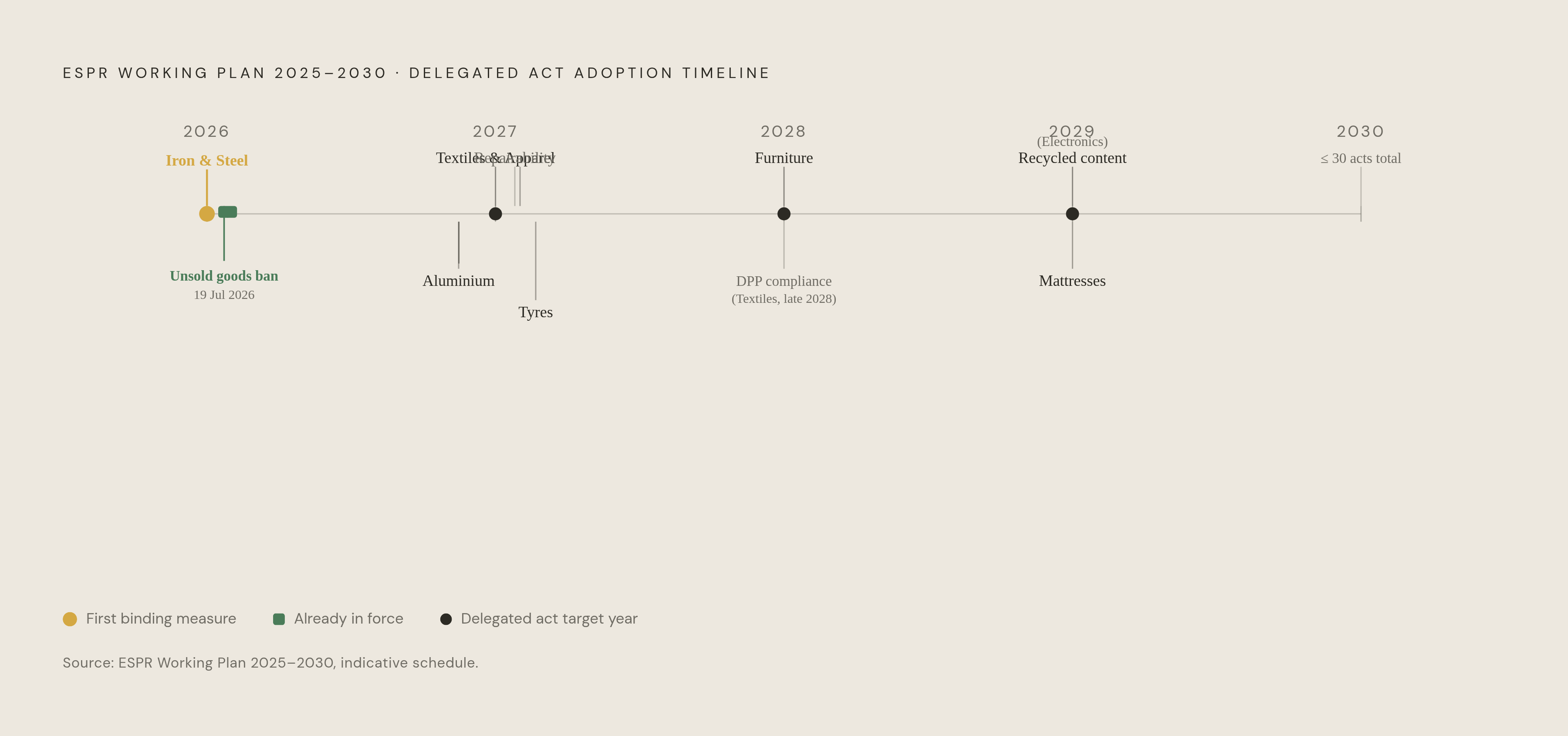
On 16 April 2025, the Commission published its first working plan under the ESPR, covering the period from 2025 to 2030 and naming the specific product groups slated for delegated acts along with indicative adoption timelines. The delegated act adoption date marks the Commission's target for adopting a delegated act.
Among intermediate products, iron and steel carry the earliest deadline, with delegated act adoption targeted for 2026, making it the first intermediate product group brought under ESPR measures. The requirements are expected to focus on emissions, energy and water efficiency, and strategic resilience, and they are designed to complement the EU Emissions Trading System, the Carbon Border Adjustment Mechanism, and the Clean Industrial Deal rather than duplicate them. Aluminium follows on a 2027 timeline, with requirements expected to push greater use of secondary materials and reduced greenhouse gas emissions, again aligned with the ETS and CBAM frameworks.
Four final product groups round out the working plan's priorities. Textiles and apparel carry a delegated act target of 2027 for general requirements, with a separate delegated act on DPPs for textiles expected in January 2026 and anticipated to be adopted in late 2027, with mandatory compliance expected approximately 18 months later, around late 2028 to early 2029. The measures are intended to extend product lifespans, improve material efficiency, and cut environmental impacts tied to water use, waste, climate change, and energy consumption. Tyres share the 2027 target, with requirements addressing recyclability, recycled content, and end-of-life waste management in a sector where existing rules have not solved those problems. Furniture follows in 2028, focused on resource use and the environmental impacts tied to material supply, waste generation, and effects on air, soil, and biodiversity. Mattresses close out the list at 2029, aimed at material efficiency, waste reduction, and product longevity.
Every delegated act under the ESPR imposes one or both of two types of requirement. Repairability, potentially including a formal scoring system, is targeted for 2027, with early indications that the scope could extend to consumer electronics and small household appliances. Recycled content and recyclability requirements for electrical and electronic equipment are targeted for 2029. Energy-related products already governed under the old Ecodesign Directive continue to receive updated requirements under the new framework as well.
Altogether, the working plan anticipates as many as 30 new delegated acts by 2030, with a mid-term review built in for 2028 to reassess priorities as implementation proceeds. Notably absent from this first wave are chemicals, footwear, detergents, paints, and lubricants, though the Commission has retained the authority to add product groups in future working plans, so absence from the first list is not a permanent exemption.
These timelines describe when the Commission intends to finalize the rules, not when the obligations bite. One ESPR obligation has already skipped the delegated act process entirely and become binding law on its own.
The unsold goods destruction ban: the first ESPR obligation already in force
The prohibition on destroying unsold apparel, clothing accessories, and footwear is the first ESPR obligation to take direct legal effect without waiting for a product-specific delegated act. Since 19 July 2026, Article 25 of the regulation has barred large companies from destroying unsold goods in these categories; medium-sized enterprises have until 19 July 2030 to comply, while micro and small enterprises are exempt from the ban entirely. The rule exists because unsold-goods destruction represents a direct, avoidable source of waste and emissions that the Commission chose to address immediately rather than leave for a later delegated act cycle.
Two further acts, both adopted on 9 February 2026, filled in the operational detail the ban needed to function. A Delegated Act set out the specific and justified circumstances under which destruction remains permitted, covering situations such as safety concerns or products that have been damaged beyond usability. An Implementing Act introduced a standardized reporting format requiring businesses to disclose the volumes of unsold consumer goods they discard, with that reporting obligation taking effect from February 2027.
The framework has not gone unchallenged. Stakeholders have criticized the documentation obligations and retention periods attached to the derogation process, along with what they view as an overly narrow set of exemptions. A more structural concern involves the boundary the ban draws around company size: advocacy groups have warned that the exemption for micro and small enterprises could create an incentive for large companies to route unsold stock through smaller, exempt entities to avoid the destruction ban altogether. The regulation anticipates this risk directly and gives the Commission authority to extend the destruction ban to micro and small firms if evidence of such circumvention emerges.
The destruction ban demonstrates a pattern that recurs throughout the ESPR: certain obligations arrive earlier and with less warning than the delegated act timetable would suggest, ahead of the broader product-specific rules still working their way through the Commission's process. That earlier arrival raises a harder question about who actually carries the burden of compliance once the rules do land, and how far that burden extends beyond companies that sell directly into the EU.
The DPP obligation's reach into global supply chains
The ESPR places its legal obligation on the economic operator that puts a product on the EU market, typically the importer or the brand. The information a DPP requires, however, usually originates two to three tiers upstream in the supply chain, at the level of raw material suppliers, component manufacturers, and subcontracted producers who have no direct legal relationship with EU regulators at all. That distance between legal obligation and underlying data gets closed through private contract rather than through any regulatory exemption or carve-out.
The mechanism works as a chain reaction. The regulation holds the primary manufacturer or brand responsible for aggregating data across the entire value chain, so that brand in turn writes structured digital compliance data requirements into its supplier contracts, regardless of whether those suppliers are themselves within the ESPR's direct legal scope. A supplier based outside the EU, selling components to an EU brand rather than finished goods to an EU consumer, faces no obligation under the ESPR itself, but faces a commercial obligation from its customer that amounts to the same thing in practice.
The consequence for smaller suppliers is severe and specific. A small or medium-sized enterprise that cannot integrate with its customer's upstream DPP data systems risks being cut out of EU-bound supply chains entirely because it cannot supply the data its customer needs to comply with its own obligations. There are no automatic exemptions for SMEs from DPP requirements, and both the ESPR and relevant regulations leave room for future support measures, but no such measures are in force.
The effects extend beyond the EU's own trading relationships and into international trade law. When the WTO Committee on Technical Barriers to Trade met in July 2026, its agenda included formal concerns raised by members about digital product passports, covering the scope of requirements, the time available to comply, and the recognition of equivalent regulations. An instrument conceived as a tool for the circular economy had become a subject of formal international trade dispute before its main provisions had even taken effect. Formally WTO-compatible rules can function as de facto market-access conditions for foreign exporters who lack the data infrastructure that EU competitors have built.
The practical reality follows directly from this structure. The DPP is a data infrastructure project that a company must build well before shipping products, not a labelling requirement it can bolt onto existing packaging at the last minute. It is a data infrastructure project, and that infrastructure has to extend into supplier networks that, in many cases, have no direct regulatory relationship with the EU whatsoever.
Waiting for final delegated acts as a compliance risk
The most common misreading of the ESPR's phased rollout treats the indicative adoption date for a delegated act as the effective compliance deadline. The data collection and systems integration work a DPP requires cannot be compressed into the narrow window between a delegated act's adoption and the date it actually applies.
Most product-specific requirements will not become enforceable until 2028 or later, but the infrastructure needed to comply, tracing supplier data, building machine-readable records, registering products centrally, takes far longer to construct than that remaining window allows. A company that waits for a delegated act to be finalized before starting that work will find itself scrambling against a deadline it can no longer meet comfortably.
Textiles make the compression concrete. The DPP delegated act for textiles is expected in late 2027, with the compliance deadline following roughly 18 months later, around late 2028 or 2029. That leaves roughly a year and a half to build the underlying data systems, bring suppliers onto those systems, and register products in the EU Central DPP Registry, a registry that itself only became operational on 19 July 2026. Given that the registry already links directly to the EU's customs single window, a textile brand that has not built its supplier data pipeline well before the 2027 delegated act lands will be building it under the pressure of a border that can stop an unregistered shipment on arrival.
Sources
- ESPR: New EU Requirements for Sustainable Products
- With Ecodesign for Sustainable Products Regulation, EU Will Impose Ecodesign Requirements on Virtually All Products Sold in EU
- European Commission Releases List of Priority Products for Ecodesign Requirements
- Ecodesign Regulation (ESPR): A Complete 2026 Guide
- What Does the Digital Product Passport (ESPR) Require?
- Ban on destruction of unsold clothes and shoes enters into application - Environment
- Deep Dive: EU Finalises New Requirements for Unsold Consumer Products Under ESPR - Lexology
- EU Ecodesign Regulation: consultations on information disclosure for discarded goods and exemptions to the ban on destroying unsold clothes, Julia Voskoboinikova