Recommerce as a Customer Retention Strategy
Trade-in programs turn the moment customers leave into their next reason to return.
A customer who finishes using a product and has nowhere to take it is a customer a brand is about to lose. Recommerce exists to close that gap: it gives brands a structured way to intercept the end of ownership and turn it into the start of a new purchase cycle, rather than ceding that moment to a competitor or a resale marketplace the brand doesn't control.
Customer loss at the end of the ownership cycle
Standard ecommerce runs in a straight line. A brand sells a product, a customer owns it, ownership eventually ends, and the customer moves on to whatever comes next. In that model, the brand has no assigned role once the product has served its purpose, and so it has no real claim on what the customer buys after. The relationship was built for a single transaction, and it expires the moment that transaction's product is no longer wanted or needed.
What fills that vacuum matters. Without a structured way for the brand to intercept the end-of-ownership moment, the customer's next move defaults to a third-party resale marketplace, a competitor's product, or an exit from the category. None of those outcomes return value to the brand that made the original sale. The brand did the work of acquiring the customer, earning the first purchase, and building whatever trust got the product into the customer's hands in the first place, only to hand off the most valuable part of the relationship, the next purchase, to somebody else.
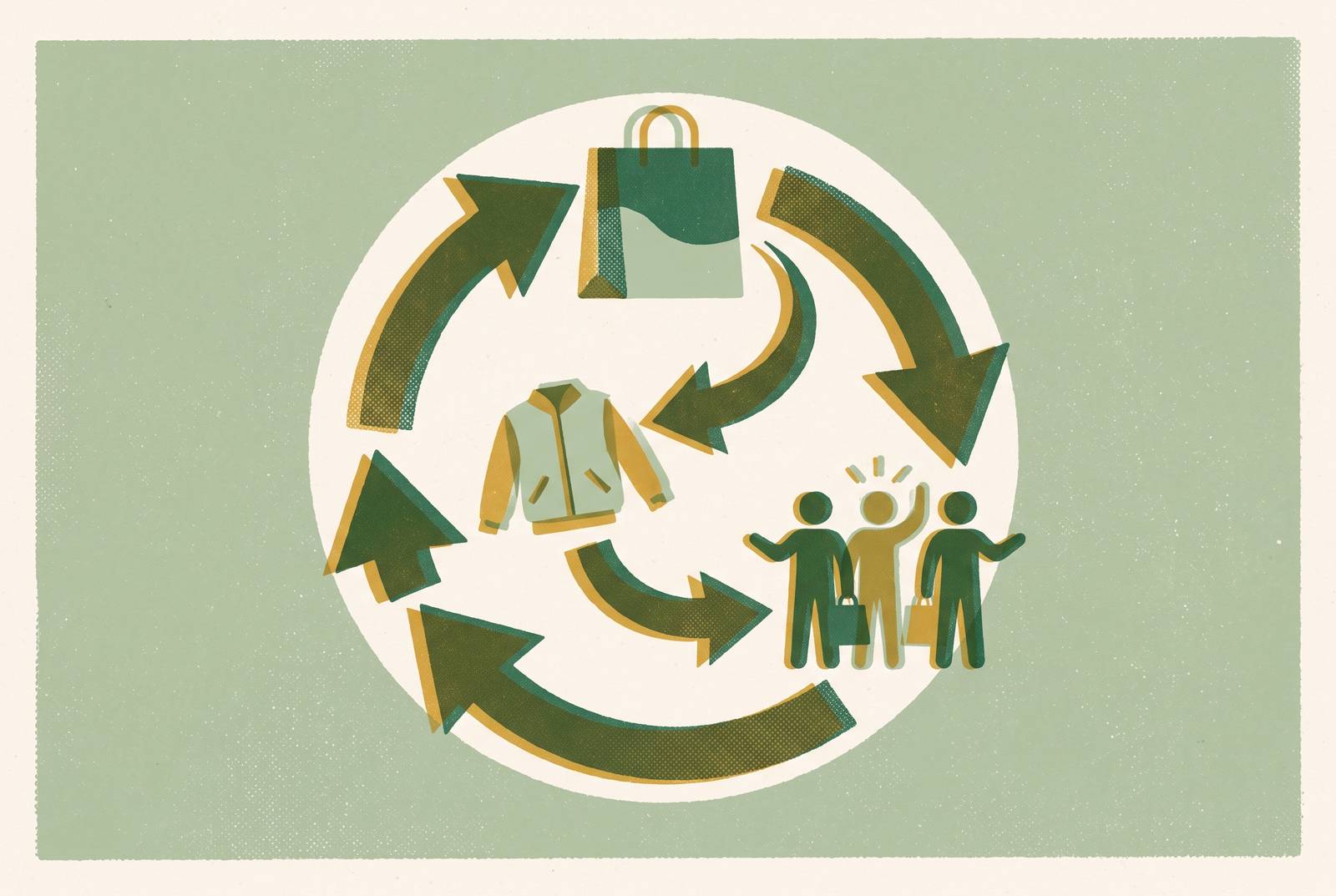
Recommerce changes the shape of that relationship from a line to a circle. The customer returns the used product to the brand, the brand refurbishes and resells it, and the customer, in exchange for that return, re-enters the brand's own purchase cycle instead of leaving it. The end of ownership becomes not the end of the relationship but the trigger for the next one. That reframing is the whole argument for recommerce as a retention strategy: the moment a brand is most likely to lose a customer is also the moment it is best positioned to win the next sale, provided it has built the infrastructure to catch that moment rather than let it pass.
How the trade-in loop redirects customers to the brand
The trade-in loop keeps customers because it makes returning to the brand the easiest available option at the exact point when they would otherwise look elsewhere. That distinction matters. A loyalty perk asks a customer to choose the brand out of goodwill or habit. A structural loop removes the need for that choice by making the brand the only place the customer's trade-in value can go.
The mechanics are simple, and the simplicity is the point. A customer returns a used product. The brand issues store credit in exchange. That credit is redeemable only with the brand. The customer then re-purchases within the brand's own ecosystem, closing the circle. Each stage depends on the one before it, and the credit at the center of the sequence is the architecture of the transaction itself.
That architecture produces a different psychological relationship to the incentive than a discount code or a points balance does. A discount code is free to the customer and costs nothing to let expire. Trade-in credit carries the weight of a real asset, the used product the customer physically handed over, and letting that credit go unused means walking away from value already surrendered. That raises the odds a customer redeems it, and redeeming it means buying from the brand again.
Sourcing inventory through trade-ins also serves the brand's own economics well beyond the retention effect. Trade-in sourcing carries the lowest acquisition cost of the major recommerce sourcing methods, generates the highest retention impact, and produces the most predictable inventory pipeline, since the brand controls the timing and volume of what comes back to it rather than depending on wholesale liquidation or third-party supply. Brands that source resale inventory primarily from their own returns and trade-ins capture more of the value in that inventory than brands that buy it from outside channels. The loop, in other words, pays the brand twice: once in the customer it keeps, and once in the margin it protects on the inventory that customer hands back.
Recommerce as part of a broader retention strategy
Recommerce does its best work when it operates alongside the loyalty and post-purchase systems a brand already runs. Retention strategy generally combines incentive with friction reduction: points programs create switching costs, tier systems create aspiration, and post-purchase communication keeps a customer engaged in the stretch between one purchase and the next. None of those tools, on their own, address what happens when a product reaches the end of its useful life. Recommerce fills that specific gap.
The trade-in credit mechanism functions as a switching cost in its own right. A customer holding outstanding credit, with a product approaching end-of-life and eligible for trade-in, has a concrete financial reason to return to the brand before shopping anywhere else. That reason sits on top of whatever loyalty tier or points balance the customer already has, reinforcing rather than duplicating it.
Selective retention marketing, which concentrates outreach on the highest-value customers rather than treating every customer identically, applies directly to recommerce. Trade-in outreach works better when it targets customers with strong purchase history and products nearing the end of their expected lifecycle, rather than blanketing the full customer file with the same message regardless of relevance.
Recommerce also generates something a points program cannot produce on its own: behavioral data. What products customers return, at what point in the product's lifecycle, and in what condition, all feed into customer profiles in ways that sharpen segmentation for every other retention campaign the brand runs. A fashion or lifestyle retailer that integrates resale data with its loyalty program and its broader customer database builds a sharper picture of who its customers are and what they'll need next. That integration is expected to deepen in coming years as more retailers treat recommerce as a permanent part of product lifecycle strategy rather than a side project.
The cannibalization objection
The most common reason brands delay building a recommerce program is fear that it will eat into new-product sales. The logic seems reasonable on its face: if a customer can buy a used version of a product at a lower price, why would they pay full price for new? Brands that hold off on that basis are often protecting against a risk the available evidence doesn't support, while losing the retention benefit in the meantime.
The concern deserves a fair hearing before it gets dismissed. A customer choosing a cheaper used item over a new one at full margin is a real possibility in theory, and any brand launching a resale channel has to take that possibility seriously before scaling it. But the customer personas involved in resale and new-product purchases tend not to overlap as directly as the objection assumes. The recommerce buyer skews more eco-minded and more cost-conscious than the typical new-product buyer. The two channels are often serving different customers with different motivations rather than competing for the same sale.
Research backs this up more directly. Harvard Business School research by Agarwal, Ofek, and KC found that branded recommerce programs can increase purchase intention for new products sold by the brand through its own buyback programs. Brands observing their own resale data have found something closer to the opposite of cannibalization: shoppers who first encounter a brand through a used item often go on to buy new from that same brand later. Recommerce, in that pattern, functions as a lower-cost entry point into the new-product funnel rather than a drain on it.
The real risk sits elsewhere. A poorly run recommerce program, one with inconsistent grading, slow processing, or unclear credit terms, damages trust in the primary brand, not just in the resale arm. A customer who trades in a product and gets an unclear credit amount, or waits weeks for a refurbished item to ship, doesn't file that frustration under "resale." They file it under the brand's name. That execution risk is legitimate, and the answer is to build the resale experience to the same quality standard as the primary retail experience, an operational problem rather than a strategic one.
The operational infrastructure a trade-in program requires to function as a retention tool
A trade-in program that fails at intake, grading, or credit issuance destroys the retention value it was built to create. Every stage of the loop has to hold up to the same standard as the brand's primary retail operation, because a weak link at any point undercuts the trust the whole mechanism depends on.
Returns intake is the stage most often overlooked, and the one where the loop breaks most frequently. Many brands still treat standard returns and resale intake as separate workflows run by different teams on different systems. The handoff between those two workflows loses data, slows processing, and produces inconsistent grading on units that should have been evaluated identically. Fixing that handoff is less glamorous than designing the credit program itself, but the rest of the system depends on it.
Grading and inspection come next, and they carry real consequences for pricing and trust. Without a standardized grading approach applied at intake, resale pricing turns into guesswork, and customer trust in the program erodes within weeks of launch. Most recommerce operations run on a three-tier grading system, and each returned unit typically passes through functional testing, cleaning, repairs where needed, authentication checks, and certification tagging before it's priced or routed anywhere. Capturing photos, video, and written notes at the point of intake isn't optional paperwork. Without that documentation, every pricing and routing decision made downstream is built on guesswork rather than record.
The reason a product comes back matters as much as its condition. Cosmetic damage, a functional defect, a simple change of customer preference, and a sizing issue each point toward a different resale path or disposal route, and treating them identically at intake produces mismatched outcomes later.
Pricing has to account for depreciation and condition variability rather than applying a flat markdown across a category. Fast-depreciating categories like electronics need dynamic pricing tied to current demand and inventory levels, and every program needs a defined margin floor, a point below which a unit gets scrapped rather than listed at a loss.
Credit issuance is where the retention mechanic either earns its keep or fails. The credit needs to be easy to understand, clearly redeemable, and issued promptly, because friction at this stage creates a negative association with the brand at the precise moment the brand is trying to pull the customer back in. Certifications and warranties attached to resold items raise buyer confidence and reduce the stigma that still clings to pre-owned goods in some categories, which makes the resale channel more attractive on its own terms and reinforces the loop from the demand side.
Brands have a real choice in how they build this infrastructure. Some run it in-house. Others work with a platform partner, as Eileen Fisher does with Trove for its Renew program, and as Patagonia did with Trove (formerly known as Yerdle). Others run a hybrid of the two. The trade-off running through all three options is the same: more in-house control buys more margin but demands more operational complexity, and more reliance on a partner trades some of that margin for speed and simpler execution.
Building the recommerce loop into a repeatable program
A single trade-in converts one exit into one re-purchase. A program built around repeat participation converts that single exchange into a cycle that raises customer lifetime value with each pass through it. An actual retention program pulls the customer back into the loop after their second purchase, not just their first.
A few design choices determine whether that repetition happens. Outreach timed to a product's expected lifecycle, rather than to an arbitrary calendar schedule, catches the customer at the moment they're likely to be done with the product, intercepting them before they start looking elsewhere. Tiered credit value, which rewards customers who trade in more frequently or who return items in better condition, builds a sense of aspiration inside the recommerce program itself, similar to what a loyalty tier does for a points system. Giving customers visibility into their credit balance through their account, a digital wallet, or their loyalty profile keeps the brand present in a way that mirrors what wallet-based loyalty cards already do: visibility that shows up daily rather than only at checkout. Education at the point of first purchase, explaining how the trade-in program works before the customer ever needs it, closes the loop before it even opens, since a customer who understands the program early is far more likely to use it when the moment actually arrives.
A major furniture retailer's buyback and resell program, launched a few years ago, shows how this works at scale in a durable-goods category. The program lets customers sell back used and assembled furniture in exchange for store credit, and it relies on standardized condition requirements to keep quality consistent across a catalog far larger and more varied than a typical apparel line. A retailer moving high volumes of durable goods needs that kind of standardization to institutionalize the loop rather than run it as a one-off promotion.
Recommerce, built this way, lets a retailer extend the customer relationship well past the first sale, improve retention measurably, and meet a growing customer expectation for longer product lifecycles. The program architecture, not any single trade-in transaction, is what makes that extension structural rather than occasional. Each pass through the loop also generates data: what products come back, when in their lifecycle they come back, and in what condition. That data feeds directly into the retention segmentation model, surfacing which customers trade in frequently, which are starting to lapse, and which products have the shortest effective ownership cycles. Every loop a brand runs makes the next one sharper, the compounding advantage recommerce holds over a static loyalty program that never learns anything new about the customer.