B2B Green Marketing Strategy Differences
B2B buyers now score sustainability like a line item on a vendor questionnaire, not a brand story.

B2B green marketing strategy differs from B2C not by degree but by kind. A consumer buying a bag of coffee responds to a story, a color palette, a cause tied to the label; a procurement team evaluating a supplier runs that supplier through a scored questionnaire, files the answers, and defends the decision later to a CFO and, sometimes, an auditor. That difference in who's on the other end of the sale changes almost everything about how sustainability gets marketed, and understanding it is the starting point for any B2B green strategy that actually closes deals.
Most green marketing advice is recycled B2C thinking ("tell an authentic story, pick a cause, add a leaf to the logo"), an approach that fails when a buying committee scores suppliers against a questionnaire before a salesperson picks up the phone. B2B purchasing runs on logic and process; B2C runs on emotion. Complex industrial or technical products don't sell through lifestyle advertising at all, they sell through webinars, whitepapers, case studies, and technical documentation that a buyer can actually take into a decision meeting.
None of this makes sustainability a soft brand attribute in B2B the way it sometimes is in consumer marketing. It's a scored line item on a supplier questionnaire, sitting right next to price and quality in the weighting formula. Treating this as a matter of degree, as though B2B just needs "more proof" than B2C, misses the point entirely. One is a narrative discipline, and the other is an evidentiary one. B2B campaigns emphasize rational, data-driven messaging with a strong focus on ROI, while B2C efforts lean into emotional appeal and lifestyle narratives; that's the finding from scalewithfuture.com. ESG marketing and green marketing diverge in B2B, where an EcoVadis medal frequently determines who clears the supplier gate before the product's own green features are even evaluated.
The size of the B2B sustainability opportunity and the reasons behind its acceleration
Scale first, then the behavior underneath it. The global green marketing market is on track to hit $1.2 trillion by 2030, and the executive mood backs that trajectory: 70% of global CEOs call sustainability critical to business success, and 64% of businesses have already folded sustainability goals into their marketing strategy Marketing LTB Bain & Company. Momentum is building on the spending side too, with 63% of companies planning to increase sustainability-related marketing in 2025 and 74% reporting positive ROI from the campaigns they've already run Marketing LTB.
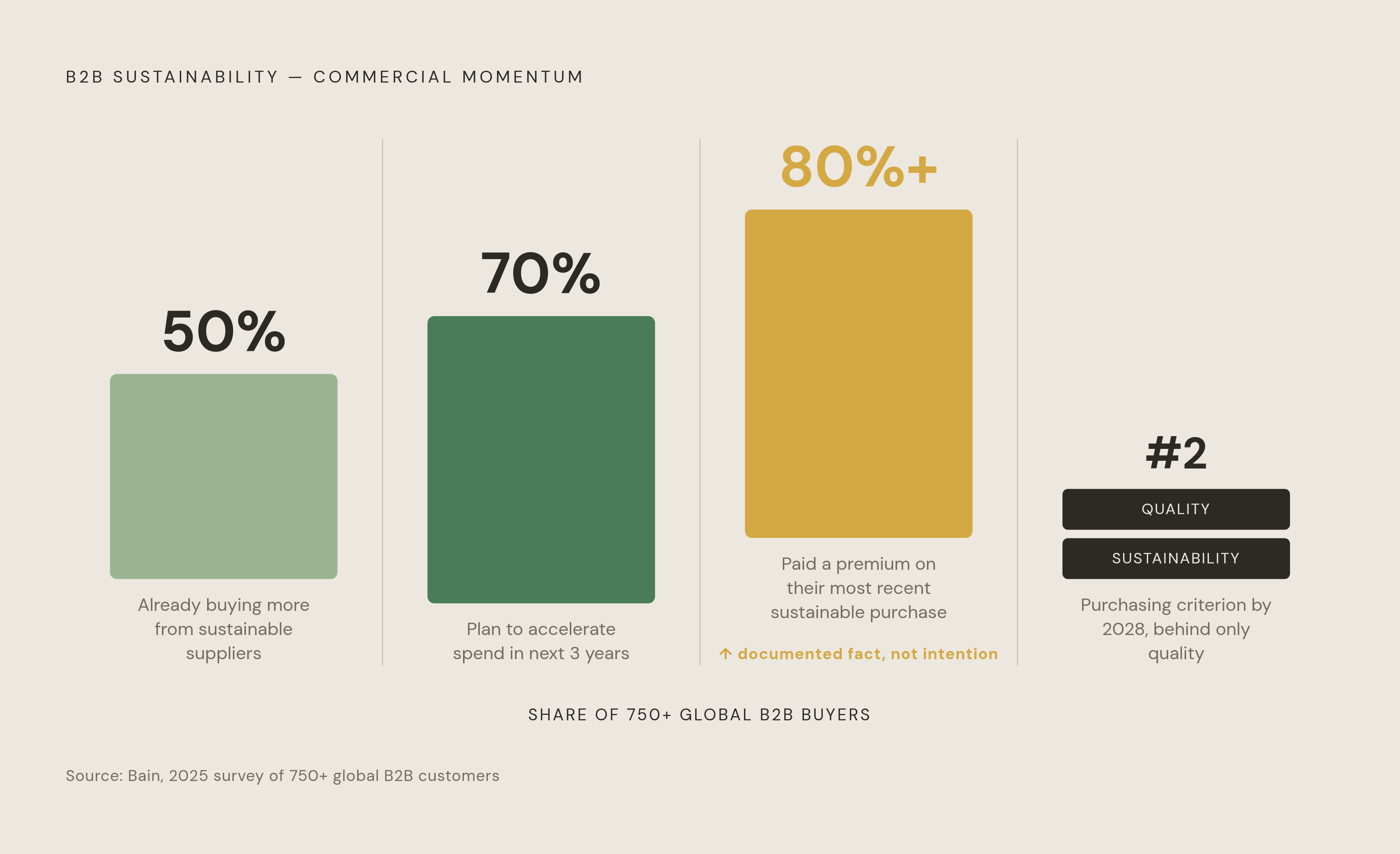
The market-size numbers matter for context, but the behavioral data is what actually proves the case. Bain surveyed more than 750 global B2B customers across automotive, packaging, chemicals, machinery, metals, and construction in 2025, and found that half of them already buy more from their more sustainable suppliers, with nearly 70% planning to accelerate that buying pattern over the next three years Marketing LTB Bain & Company. Bain also projects that by 2028, sustainability will rank as the second-most important purchasing criterion for B2B buyers, trailing only quality Bain & Company. Among the companies growing fastest year over year, 90% expect sustainability to help their business over the next three years, and that holds even in regions where governments have pulled back on climate policy Bain & Company.
More than 80% of B2B buyers in that same Bain survey paid a premium on their most recent purchase of a sustainable product, a number that should reframe how suppliers think about pricing Bain & Company rhoimpact.com. That's not a hypothetical willingness to pay; it's a documented one. And the pattern isn't confined to B2B: consumer goods marketed as sustainable grow at roughly a 28% price premium and expand at nearly twice the rate of conventional goods, a signal that the same commercial logic is working its way through B2B supply chains too Bain & Company. Writer note: use the Bain figures as the evidentiary spine here, since the macro market figure provides scale but the buyer-behavior data is what earns the argument.
The Scope 3 imperative: why a supplier's emissions data has become a procurement input
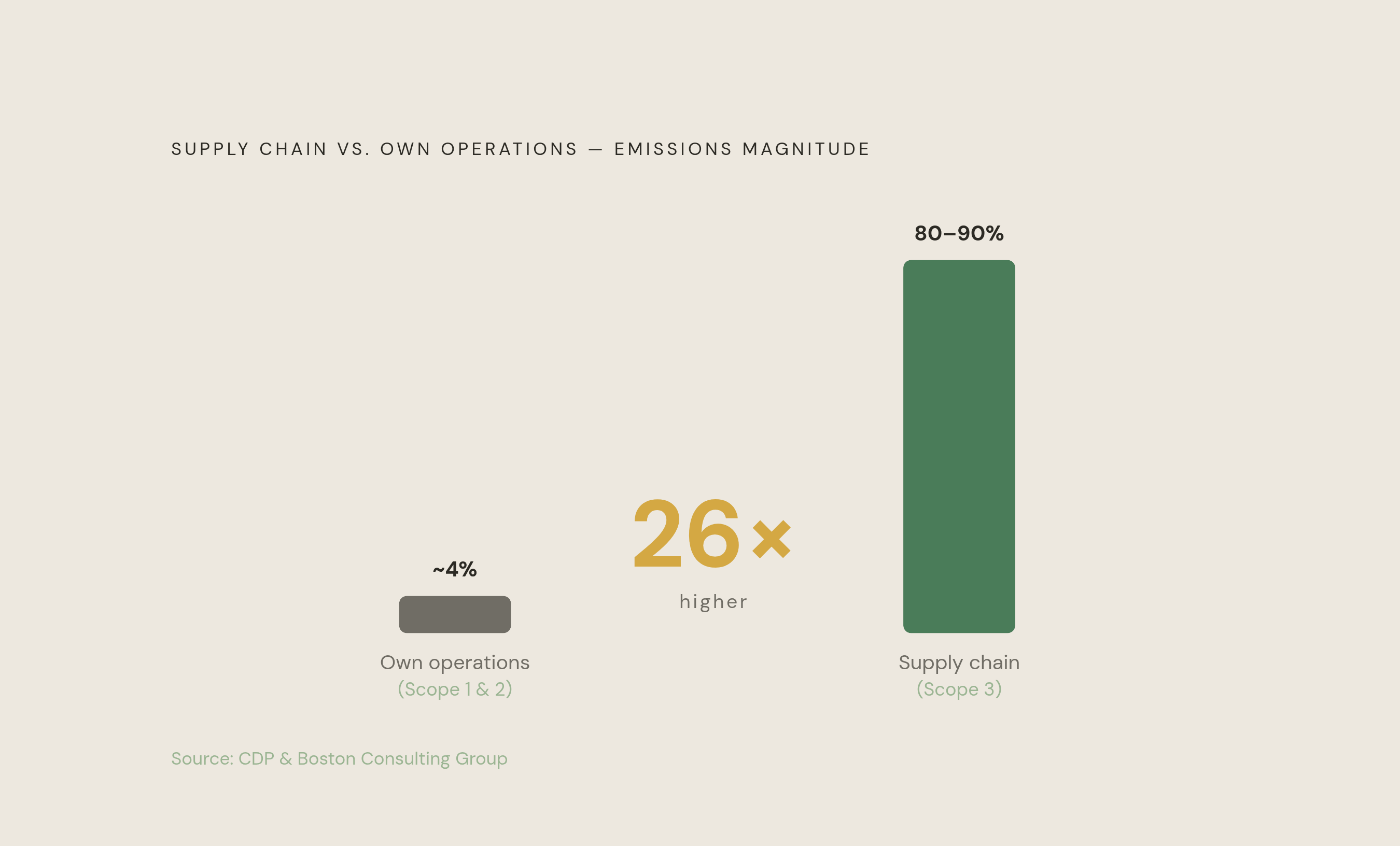
Scope 3 emissions, the indirect ones generated upstream and downstream of a company's own operations, make up somewhere between 80% and 90% of a typical company's total emissions footprint Bain & Company rhoimpact.com. That means the supply chain isn't adjacent to a company's climate math, it is the climate math. CDP and Boston Consulting Group have found that corporate supply chain emissions run, on average, 26 times higher than a company's own operational emissions.
Around 40% of companies are now required to report and reduce their Scope 3 emissions ivristech.com. Those companies need their suppliers' carbon numbers just to close their own books ivristech.com. Procurement has stopped being a cost-control function bolted onto sustainability, and has become the operating capability that carries it: procurement teams are now expected to support Scope 3 measurement, supplier due diligence, and value chain disclosure under frameworks like CSRD, CSDDD, and IFRS S2 CDP and Boston Consulting Group. ESG now ranks as the number-two priority for B2B procurement executives heading into 2025, according to the Economist and SAP's Procurement Study.
The practical consequence lands hardest on suppliers without documentation. Within three to five years, OEM suppliers who can't produce credible Product Carbon Footprint data will find themselves at a real disadvantage with any buyer carrying a net-zero commitment. Major CPG buyers, including Nestlé, Coca-Cola, and PepsiCo, have already put phased timelines in place: Tier-1 suppliers covering roughly 70 to 80% of spend were expected to disclose Scope 1 and 2 emissions in the 2024 to 2025 window, with product-level carbon footprint data required for major categories by 2026 to 2028 Bain & Company Bain & Company rhoimpact.com CDP and Boston Consulting Group. In effect, a B2B buyer in 2026 is buying that supplier's entire upstream network along with its product, which makes supply chain impact mapping a marketing asset in its own right CDP and Boston Consulting Group. A supplier who can't produce this data is becoming ineligible for consideration. It's becoming ineligible for consideration.
B2B buyer behavior when sustainability evidence is absent or vague
Absence of proof doesn't read as neutral to a buyer, it reads as a red flag. 27% of B2B buyers say they'll switch suppliers if they can't find sustainability information on a vendor's website, and that holds even when the product itself met their sustainability requirements: more than a quarter of buyers will simply walk rather than pick up the phone and ask supplychain247.com. Over a third of B2B buyers say ethics and sustainability could be outright dealbreakers in their decision-making.
Vague language is about to become more than a weak pitch, it's about to become a legal exposure. Starting September 27, 2026, the EU's Empowering Consumers Directive bans generic "eco-friendly" wording and offset-only "carbon neutral" claims outright CDP and Boston Consulting Group.
The deeper problem sits inside the supplier's own sales organization. Bain found that 59% of suppliers believe their salesforce can't explain why their sustainable products actually outperform conventional ones Marketing LTB Bain & Company. That's a communication failure sitting on top of real performance, and it costs deals directly: vendors have won competitive bids specifically because they could hand over detailed quarterly sustainability reports, even when a competitor had the better price, simply because that competitor couldn't produce the documentation the buyer needed marketboats.com. Buyers doing early-stage research won't wait around for a sales call to get access to certifications and carbon data, they expect to find it themselves CDP and Boston Consulting Group.
Framing sustainability value for a B2B buying committee through ROI and total cost of ownership
North American buyers, in particular, want a business case sitting right alongside the environmental one: cost savings, risk reduction, or competitive advantage. The strongest B2B green case studies follow a specific shape, something closer to "How We Helped ABC Manufacturing Reduce Packaging Waste by 43% While Cutting Shipping Costs 12% in Eight Months," where the environmental win is visible and the financial win is stated with equal weight marketboats.com.
Peer-reviewed research published in Industrial Marketing Management backs this up directly: communicating the quantified value of a green offering in monetary terms reduces buyer uncertainty, because it applies a lifecycle-based view that signals concrete benefit from the point of purchase through end of use. German flooring manufacturer UZIN put this into practice with its Eco2 Choice eco-label, launched in 2023, which tied an improved CO2 emission balance directly to cost and regulatory benefits for its construction industry customers. That framing let UZIN grow in less cyclical segments, flooring maintenance and energy renovation among them, during a broader sector downturn. The label didn't just describe a greener product, it gave buyers a financial reason to choose it even when budgets were tight.
McKinsey data, cited by co2ai.com, documents direct price premiums of 2 to 10% for consumer products tied to sustainability credentials, and suppliers who earn preferred status, reduced price pressure, innovation partnerships, and priority access to new product launches typically get there by making that financial case legible, not by making the loudest environmental claim. Total cost of ownership is the frame that tends to work best here, because it captures what a sustainable product saves across its life: lower energy draw, less waste, fewer compliance penalties, longer replacement cycles. Bain's finding that over 80% of B2B buyers paid a premium on their most recent sustainable purchase already proves the willingness to pay exists Bain & Company rhoimpact.com. The actual job left for marketing is to quantify the value clearly enough that the premium reads as savings rather than a surcharge Bain & Company rhoimpact.com. Writer note: this section should move from framing advice to the specific structure of a financial proof point, with the UZIN case serving as the worked example to anchor it.
The certification and third-party proof ecosystem B2B procurement uses
Certifications aren't a differentiator on their own anymore, 58% of businesses already use sustainability certifications somewhere in their branding Marketing LTB. The differentiation now lives in which certifications a supplier holds and how it puts them to work in front of a buyer.
ISO 14001 remains the baseline environmental management standard for industrial supplier qualification, held by more than 360,000 organizations worldwide, and plenty of multinationals require it outright as part of their sustainability procurement policy EcoVadis. But holding it is no longer enough by itself. Buyers are moving past ISO 14001 as a simple pass or fail gate and starting to ask harder questions: are the environmental targets quantified and time-bound, does the environmental management system actually address Scope 3, and is environmental management built into product design rather than bolted on afterward CDP and Boston Consulting Group.
Companies that provide documented emissions data score materially higher in the Environment theme of EcoVadis's scoring than those who can only describe policy. Chemical company Ecovyst earned an EcoVadis Gold rating for 2025, placing it in the top 5%, the 95th percentile, of all companies EcoVadis rated over the preceding 12 months, a useful marker of what a fully documented submission can achieve.
CDP Supply Chain functions as another key data-collection layer, used by buyers including Nestlé, Coca-Cola, and PepsiCo to gather carbon data from their own suppliers. Participating in it signals that a supplier is ready to report quantitatively. ISO 50001, the energy management standard, is gaining ground too, especially for energy-intensive manufacturing where energy cost and carbon output sit close together. And for product-level claims specifically, Environmental Product Declarations and full Life Cycle Assessments are increasingly required as the artifact that answers a request for product-level carbon footprint data. Each of these credentials answers a specific question a buyer is going to ask somewhere in the process, the useful exercise for a supplier is mapping which credential closes which question, not collecting all of them as a badge collection.
The claim-to-proof method: a repeatable five-step sequence for turning green performance into procurement-ready evidence, using a method for validating environmental claims
It starts with the Claim itself, stripped of generic words like "sustainable" or "eco-friendly," since from 27 September 2026 the EU's Empowering Consumers Directive bans such generic wording and offset-only "carbon neutral" claims CDP and Boston Consulting Group.
Next is Certify: backing that number with third-party validation, whether that's ISO 14001, an EcoVadis score, CDP, B Corp status, or a formal Environmental Product Declaration. Legal compliance isn't a final check anymore, it's a precondition the claim has to survive before it goes anywhere near a buyer. The last step is Communicate: putting the proof where buyers actually make decisions, meaning RFP responses, supplier scorecards, case studies, and sales battle cards.
Where that proof lives matters as much as whether it exists. Building a central, self-service repository where buyers can pull certifications and carbon accounting reports without talking to a salesperson closes the exact gap that sends 27% of buyers looking elsewhere supplychain247.com. Salesforce enablement belongs inside this method too, not off to the side of it: since 59% of suppliers admit their own sales teams can't explain why their sustainable products outperform conventional ones, the fix is a battle card for each product that connects a spec sheet to the buyer's ESG goal, includes a short ROI calculator, and has answers ready for the supplier questionnaire before it's ever asked Marketing LTB Bain & Company. Green Hat's B2B research found that buying groups now engage vendors earlier in the process but narrow down to a short list fast, and the vendor sitting in first place at the end of that selection phase wins almost every time CDP and Boston Consulting Group. Proof infrastructure built before the sales conversation even starts decides whether a supplier makes that shortlist. Ivristech.com lays out the five-step sequence as follows. Calculate: attach a number with a named method (LCA, GHG Protocol, or a total cost of ownership model), so the figure is traceable and repeatable. Comply: pressure-test all wording against the EU Empowering Consumers Directive, in force from 27 September 2026, and FTC Green Guides; CDP and Boston Consulting Group note that legal compliance is now a precondition, not an afterthought. Writer note: the five steps are a framework, so connect them as a sequence where each step makes the next one credible, with the battle card and self-service repository serving as delivery mechanisms.
What separates suppliers who win on sustainability from those who have the performance but lose the deal
The gap between winning and losing here isn't a tactics problem, it's an organizational one. The performance gap between winning and losing suppliers is documented in the data, not just theoretical. It just never gets translated into language a buyer's procurement team can use.
Volume doesn't fix that gap, substance does. Green Hat's 2026 predictions found that a single well-documented case study, backed by verified figures, consistently beats a whole library of narrative blog posts in B2B buying contexts CDP and Boston Consulting Group. That tracks with everything else in this piece: buyers aren't looking to be moved, they're looking to be convinced with something they can put in a file.
Timing has also compressed hard. Suppliers who wait until a tender lands to start assembling their evidence are already behind. The ones who win aren't necessarily the ones with the better sustainability numbers, they're the ones who had those numbers certified, quantified, and sitting in a buyer's hands before the RFP ever went out. The gap is organizational: Bain, as cited in ivristech.com, found that 59% of suppliers believe their salesforce cannot explain why sustainable products outperform conventional ones, and Marketing LTB and Bain & Company found that performance exists but is not translated. Green Hat's own B2B buyer research shows buying cycles are shortening to around 11 months, and the window to establish proof before a shortlist forms is narrowing, leaving brands that have not built their evidence layer before a tender is issued at a disadvantage. SOURCE PAGES, what the pages behind the outline's links say.