Greenwashing Risks and How to Avoid Them
Regulators worldwide now demand proof behind green claims, not just persuasive marketing language.

Greenwashing is a proof failure, not a messaging problem. A company makes a claim it cannot back up with evidence, and the gap between the two is exactly where regulators, courts, and now consumers go looking. The fix requires something other than better copywriting. It's building a discipline of substantiation into sustainability communications before anything goes out the door, not after a fine arrives, and the brands still treating this as a wordsmithing exercise are the ones that will get caught first.
How the regulatory environment turned substantiation from best practice into legal obligation
Greenwashing used to cost a company some bad press and an awkward apology. Now it costs money set by statute, and the trend line runs the same direction in every major market.
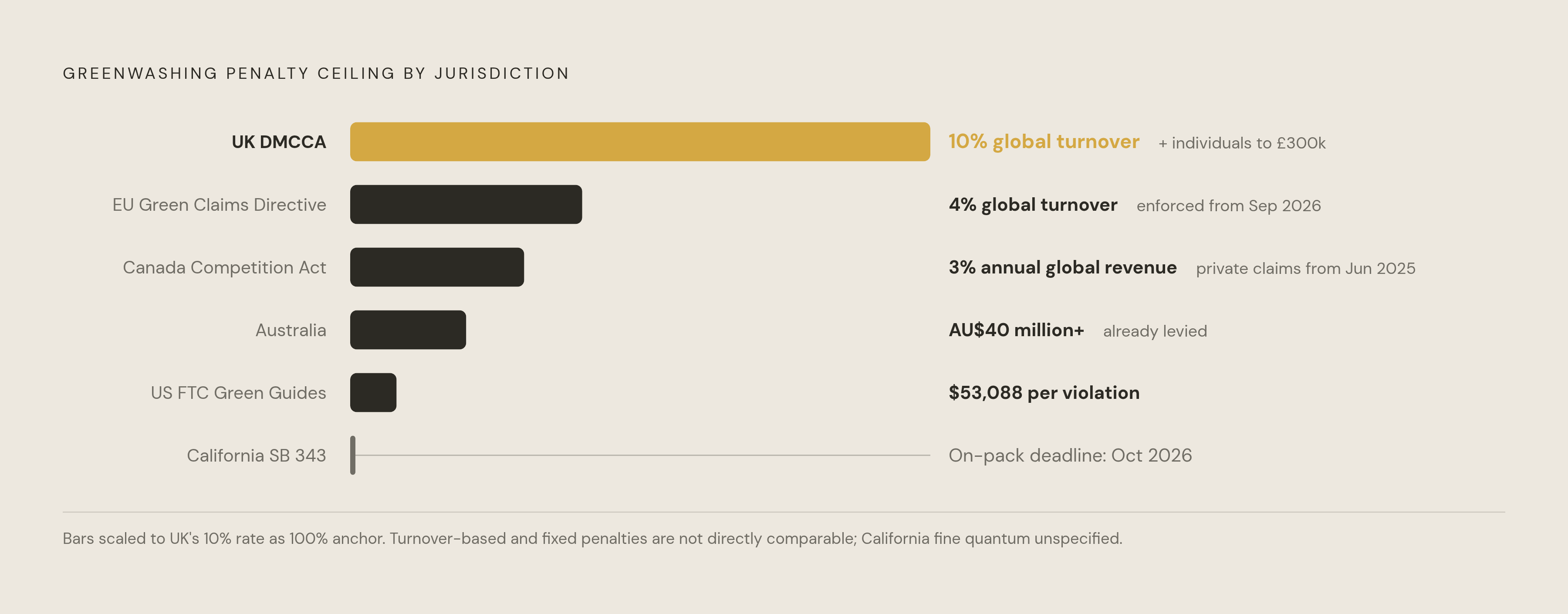
In the EU, the Green Claims Directive requires credible evidence and a defensible methodology behind broad claims like "carbon neutral" or "made from recycled materials." Non-compliance can run up to 4% of global turnover, and Member States are required to enforce starting September 27, 2026. The CSRD adds independent verification on top of that for entity-level reporting, and the Ecodesign Regulation layers on lifecycle-based substantiation rules for products themselves. Three separate tracks, all converging on the same question: can you prove it?
The UK moved just as decisively. The Digital Markets, Competition and Consumer Act 2024 gives the Competition and Markets Authority power to fine companies up to the greater of £300,000 or 10% of global turnover for greenwashing, with individuals personally liable up to £300,000. The FCA's anti-greenwashing rule has applied to all regulated firms' sustainability communications since May 31, 2024.
In the US, the FTC's Green Guides remain the operative standard, with civil penalties up to $53,088 per violation. An update expected in late 2024 is stuck in limbo, and that ambiguity should read as risk, not relief. The Keurig Dr Pepper case, an SEC action in 2024 over inaccurate recyclability claims, shows greenwashing exposure has crossed over into securities law. It's no longer confined to consumer protection.
Canada's Competition Act amendments, in force since June 2024, require substantiation for any public claim about the environmental benefit of a product or business activity, with penalties up to 3% of annual gross global revenue. Since June 20, 2025, private citizens can bring greenwashing claims directly. Australia logged more than AU$40 million in penalties from court cases brought by the country's finance regulator and competition commission. California's SB 343 released its final findings on April 4, 2025, opening an 18-month window before on-pack claims must meet the new standard on October 4, 2026.
A brand selling in five markets faces five overlapping frameworks, each with its own threshold and regulator. Strip away the local variation, though, and the legal test collapses into one question asked the same way everywhere: can you prove it? That's what makes substantiation a universal discipline rather than a patchwork of compliance checkboxes, and treating it as the latter is the mistake that gets expensive.
What the numbers on consumer trust actually reveal about the cost of getting this wrong
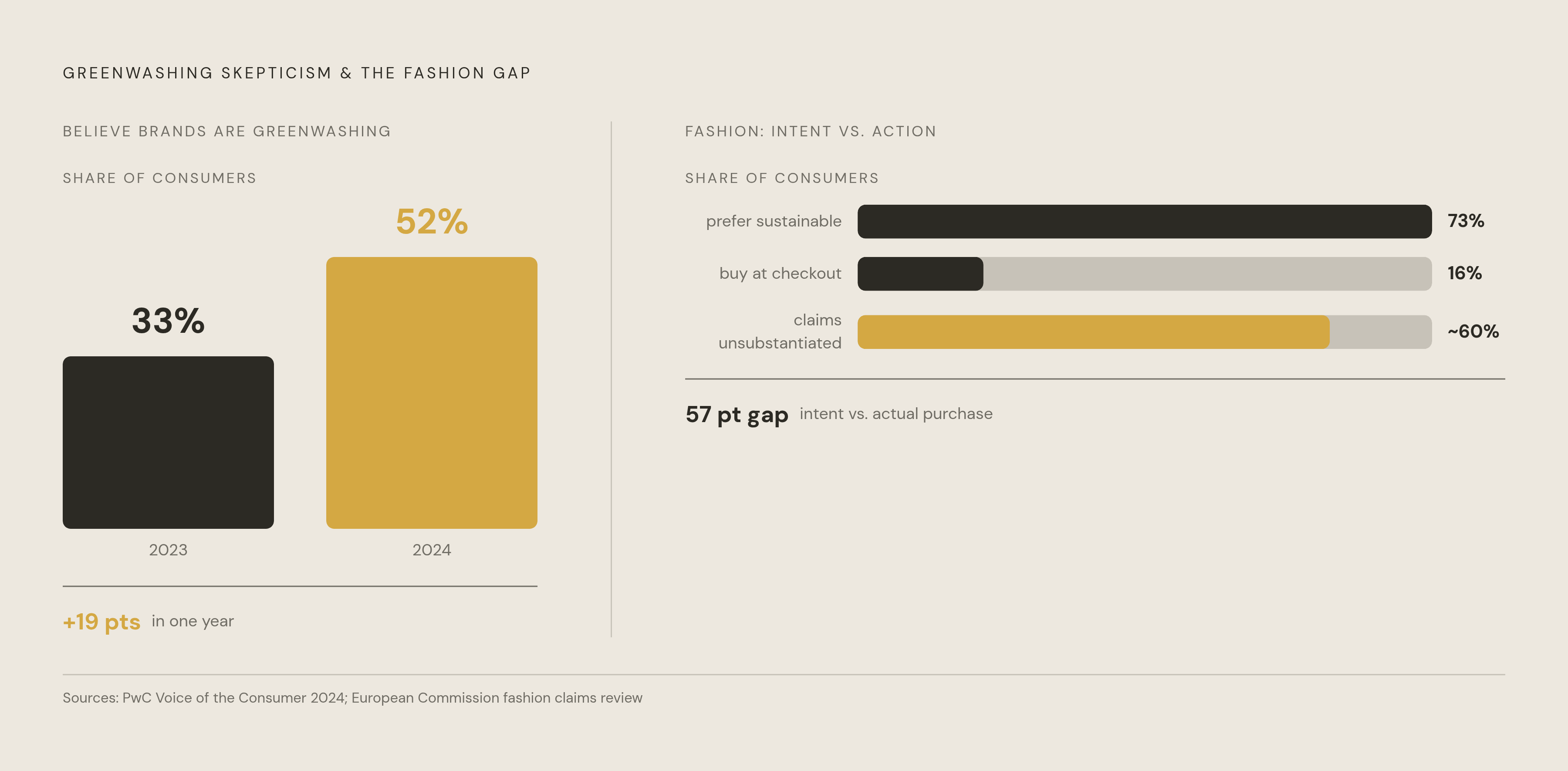
Skepticism about green claims is the baseline assumption now, not a fringe sentiment. Capgemini research reported via Sustainability Magazine found that 52% of consumers believed organizations were greenwashing their sustainability initiatives in 2024, up from 33% the year before. That's a 19-point swing in twelve months, which is not a gradual drift, it's a collapse in the benefit of the doubt.
That shift changes the starting position for every sustainability claim a brand makes. Consumers don't take a claim at face value anymore and wait to be disappointed later. They assume it's inflated until proven otherwise, so the burden of proof sits with the brand from the first sentence, not the last.
The consequences follow directly. 54% of UK consumers say they're prepared to boycott brands over misleading green claims. Fashion is where the gap shows up most starkly: 73% of consumers say they prefer sustainable brands, yet only 16% of those who say so actually follow through at checkout, and roughly 60% of sustainability claims in fashion are unsubstantiated or misleading to begin with. Put those numbers side by side and the skepticism stops looking irrational. It looks earned. Consumers have learned, purchase by purchase, that the claim and the product frequently don't match, so they've stopped extending credit on the claim alone.
None of this splits into a legal workstream and a marketing workstream. The evidence that satisfies a regulator is the same evidence that earns a customer's trust, and agencies still running these as separate approval tracks are duplicating work that should produce one file, not two.
The recurring patterns in greenwashing that substantiation discipline directly prevents
Look across enforcement actions and the same handful of failure modes show up again and again.
Vague umbrella terms top the list: "eco-friendly," "green," "sustainable," "natural," deployed without a defined scope or methodology behind them. This is the single most common failure and the explicit target of both EU and FTC guidance, and it's also the easiest to fix, which is what makes it inexcusable.
Selective disclosure runs close behind. A brand highlights one genuinely sustainable feature while the rest of the product line, or the business model as a whole, carries much larger unaddressed impacts. Shein's evoluSHEIN line, marketed as a more sustainable sub-brand inside a fast-fashion business built on volume, is close to a textbook case. So is the ruling against Apple over carbon neutrality claims for certain Apple Watch models.
Recyclability and circularity claims get overstated in a similar way, implying closed-loop systems that don't exist or promising a level of recyclability the average consumer's local waste system can't actually deliver. Banana Boat's "reef friendly" labeling, accurate for some ingredients in the formula but not others, shows how a partial truth gets sold as a whole one.
Targets get treated as achievements. A company sets a net-zero goal for 2040 and lets its marketing imply the work is already done. Shein's own pledge, a 25% emissions cut by 2030, was called out by the Italian court as generic and flatly inconsistent with the company's rising emissions in 2023 and 2024. A newer variant of this involves setting ambitious targets and then quietly walking them back when they prove inconvenient.
Then there's a genuinely new failure mode: AI-generated sustainability copy. Natural language generation tools produce dense, data-rich, highly persuasive sustainability narratives that sound completely credible and aren't backed by anything at all. The sophistication of the language has outrun the evidence behind it, and that gap is only going to widen.
Every one of these patterns shares the same structural defect: the claim got written before the proof existed. Substantiation discipline just means reversing that order, which sounds simple and apparently isn't, given how often it fails.
Some companies have responded by saying nothing at all, a retreat known as greenhushing. That's not a solution, it's an abdication. It hands the field to competitors willing to make the case, and it does nothing to fix the underlying discipline problem. It just delays the reckoning.
Building a substantiation discipline before claims go out
Substantiation isn't a legal sign-off tacked onto the end of a creative process. It has to shape what gets claimed in the first place, which means the review happens at the drafting stage, not the approval stage, and any process that puts legal review after the creative is already final has the sequence backwards.
A workable claim-level check runs through a short set of questions. Is the claim specific, naming exactly what's being claimed, for which product or process, over what timeframe? What evidence backs it, internal data, a third-party audit, a lifecycle assessment, a certification, and is that evidence proportionate to the size of the claim? "Carbon neutral" demands a lot more than an offset receipt. "Made with recycled materials" demands a disclosed percentage and material type, not a gesture in the general direction of sustainability. Does the claim match what the company actually does operationally, especially where a future target gets dressed up as a present-tense achievement? And will it hold up in every jurisdiction it appears in, not just the one it was drafted for?
Independent verification matters here as a structural backstop, not a nice-to-have. The CSRD requires independent verification for EU entity-level reporting. Regardless, brands that build third-party verification into their process by default, rather than waiting on mandates to catch up, close off the most common avenue regulators use to build a case. Brands that build third-party verification into their process anyway, regardless of what's legally mandated, close off the most common avenue regulators use to build a case.
Qualification is a strength woven into a claim. It's usually what makes the claim defensible. "This product line," "in this market," "as of this date," these are the scoping phrases that turn a sweeping, unprovable statement into a narrow, provable one.
Documentation is where the real failure happens, more often than the claim itself. The evidence behind a claim has to be kept and easy to retrieve, because regulators across several jurisdictions can and do demand it after the fact. Companies that try to assemble that paper trail retroactively, once a claim is already public and under scrutiny, are almost always the ones that get caught short. The finding that roughly 60% of sustainability claims in fashion are unsubstantiated or misleading is the clearest evidence that this discipline still isn't standard practice, which also means the brands that adopt it now get a real edge over the ones still winging it.
Why AI-generated answers create a new substantiation risk brands have not yet priced in
Consumers no longer discover a brand's sustainability story mainly through the brand's own website. EMARKETER forecasts that 31.3% of the US population will use generative AI search in 2026, and AI assistant traffic rose sharply in 2025. These tools have become a primary channel for how people encounter what a brand claims to be doing on sustainability, and that channel behaves nothing like a press release sitting on a corporate site.
Roughly 85% of what AI systems cite comes from third-party platforms, not from brand-owned sites. An AI-generated summary of a company's sustainability record gets pieced together from press coverage, NGO reports, and regulatory filings, largely outside the brand's control and often without its knowledge that the summary exists at all.
The accuracy problem compounds this. A Columbia Journalism Review Tow Center study found that leading AI search tools answered more than 60% of test queries incorrectly, in some cases fabricating citation links. An AI system can take an outdated or exaggerated third-party claim about a brand's environmental record and present it as settled fact, with no signal to the brand that any of this is happening in the background.
Inconsistency across a brand's own channels becomes its own liability here. If the website states one version of a claim, the press release states another, and a social post states a third, a language model drawing on all three can produce a garbled or inaccurate composite of the brand's actual story. Citation sources aren't stable either: between 40% and 60% of the sources AI platforms cite change month to month, so a narrative represented accurately last month may not be this month.
Bad actors can exploit this without any technical sophistication at all. Publishing a page with an exaggerated or false environmental claim, optimized with ordinary generative engine optimization techniques, can be enough to get that claim folded into AI-generated answers about a brand it has nothing to do with.
Consistent, specific, well-worded sustainability claims across every channel aren't a trust exercise for human readers anymore. They're the raw material AI systems draw from to construct a brand's story, whether that brand participates in the process or not. Vague or contradictory claims don't just risk a regulator's attention. They get synthesized into AI narratives that are wrong in ways the brand never signed off on and may not discover for months.
Monitoring what AI systems say about your sustainability claims as an ongoing practice
Brands need to know what AI-generated answers actually say about their sustainability claims, not just what their own website and press office say. That's a distinct monitoring surface, sitting alongside traditional media monitoring rather than replacing it.
The useful metric here is share of model: how often a brand shows up in AI-generated answers to sustainability questions, and what those answers say when it does. Think of it as share of voice for the AI era. If a competitor's narrative dominates the answer to a given sustainability question and a brand barely registers, that's a measurable gap, and a fixable one.
Because 85% of AI citations trace back to third-party sources, the monitoring task has to include tracking which third-party sources are actually feeding those answers. Earned media, NGO assessments, and regulatory filings all become inputs a communications team has to manage, not background noise it can afford to ignore.
Correcting a wrong or outdated AI narrative runs through those same sources. Updating the brand's own website doesn't fix it on its own, since the AI system may still be pulling from an old press report or a stale third-party assessment. The accurate version has to reach the third-party ecosystem too, not just the owned channel.
Generative engine optimization, applied here, is less about traffic and more about narrative alignment. Structured, consistent, evidence-backed sustainability content across owned and earned channels gives AI systems accurate material to draw from in the first place. Applied to sustainability claims specifically, GEO is substantiation discipline extended to the AI layer, nothing more exotic than that.
Platforms such as Thrad give agencies and brand teams the infrastructure to track brand mentions across AI surfaces, spot when a sustainability narrative has drifted or been misrepresented, and surface the evidence needed to correct it. That turns AI visibility into something actively managed, instead of something that happens to a brand while nobody's watching.
Frequency matters more than most teams expect. With citation sources shifting substantially month to month, a single audit tells a brand what was true that day and nothing else. Catching drift before it reaches consumers at scale means checking continuously, not occasionally, and quarterly reviews are already too slow for how fast these sources turn over.
What a substantiation-first communications process looks like for agencies managing multiple brands
Agencies carry this risk multiplied across a client roster. A substantiation failure in one client's sustainability content is a reputational hit for the agency that wrote it, and a legal exposure for the client whose name sits on top of it.
Consistency at scale is its own problem. The same category of claim, recyclability, carbon neutrality, supply chain ethics, shows up in different forms across different client accounts. Without a standardized review process, whether a claim clears the proof bar ends up depending on which account team happens to be handling it that week. That's the absence of a system. It's a coin flip, and it's exactly the kind of inconsistency that gets picked apart in an enforcement action.
Per-brand substantiation files fix part of that. Each client's sustainability claims should carry a corresponding evidence record: source data, verification status, and any scope qualifications attached, kept current as the claims themselves get refreshed or expanded.
AI visibility monitoring belongs in this workflow too, as a service line, not an afterthought. An agency tracking what AI systems say about each client's sustainability claims can catch misrepresentation early, push a correction through the right channels, and show that value directly in client reporting.
None of this works without training account teams to actually understand the substantiation requirements and how AI systems source their answers, well enough to advise a client rather than just produce content on request. Agencies that get their teams fluent in greenwashing regulation and AI narrative dynamics stop being production vendors. They become the advisor a client calls before a claim goes public, not after a regulator calls first, and that distinction is where the retainer either grows or gets cut.
Thrad's agency model, portfolio-wide AI visibility monitoring, per-client analytics, and bespoke weekly reporting, gives account teams exactly this kind of infrastructure, offering visibility into what AI systems say about each client's sustainability narrative, an early read on drift, and evidence to back a recommendation in the next client meeting.
As greenwashing enforcement tightens across jurisdictions and AI-driven discovery keeps expanding its share of how people find and evaluate brands, the agencies treating substantiation and AI narrative monitoring as a managed service, not an afterthought, are the ones that keep their clients out of the next fine, and out of the next AI-generated headline nobody at the agency signed off on.