Building Competitive Advantage Through Sustainability
Executives now treat sustainability as a core business strategy that competitors can't quickly copy.

Sustainability has stopped being a side project for the compliance team and become a lever executives pull to win on cost, capital, and talent. A decade ago, "sustainability" meant one department, one set of recycling and emissions targets, and a report nobody outside investor relations read closely. Today, CFOs and COOs treat ESG the way they treat pricing strategy or supply chain design: as something that shows up on the balance sheet, not just in the annual filing's appendix.
The definition has widened along with the stakes. Environmental stewardship, social responsibility, and governance now sit inside risk management, product design, financing decisions, and hiring, not next to them. And the cost of ignoring that shift is no longer hypothetical: climate exposure, reputational blowback, missed innovation, and regulatory penalties are increasingly concrete business risks, not vague warnings. What follows traces how sustainability moves from an isolated initiative that competitors can copy in a quarter, to a capability baked so deep into operations that copying it would mean rebuilding the company.
The strategic logic that makes ESG hard to copy
The resource-based view of the firm, a foundational idea in strategy research, holds that lasting advantage comes from resources and capabilities that are valuable, rare, hard to imitate, and hard to substitute. Most corporate assets fail at least one of those tests. A handful of ESG capabilities pass all four: proprietary green manufacturing processes, circular-economy operations woven into supplier contracts, and governance routines built around an inclusive culture that took years to form. None of these can be bought off a shelf or copied from a rival's sustainability report.
Stakeholder theory adds the second half of the argument. Firms that genuinely serve customers, employees, suppliers, and the communities they operate in build something competitors can't fast-follow: loyalty, supply chain stability, and a kind of local license to operate that survives bad news cycles. A November 2025 paper by Sui Yan in the International Journal of Business and Management makes the case directly: ESG shapes firm outcomes through brand reputation, innovation capacity, risk management, and access to capital, all at once, which is why the paper treats it as a strategic imperative rather than an optional add-on.
What separates a marketing campaign from a moat is the imitation problem. Any competitor can announce a recycling initiative or a diversity pledge by next quarter. What they cannot do quickly is reverse-engineer a decade of supplier relationships built on shared sustainability standards, or a governance culture where ESG decisions get made the same way pricing decisions do, without a committee meeting first.
What executives and investors actually believe about ESG's financial payoff
The conviction numbers are striking on their own. Thomson Reuters found that 71% of C-suite leaders consider ESG investment a competitive advantage for their company, and 82% expect ESG's importance to corporate performance to keep growing. KPMG's research puts a number on the horizon: 55% of CEOs expect substantial returns from sustainability investments by 2030. IBM's research ties belief to outcome: companies that integrate sustainability are 75% more likely to post stronger revenue growth and 52% more likely to beat competitors on profitability.
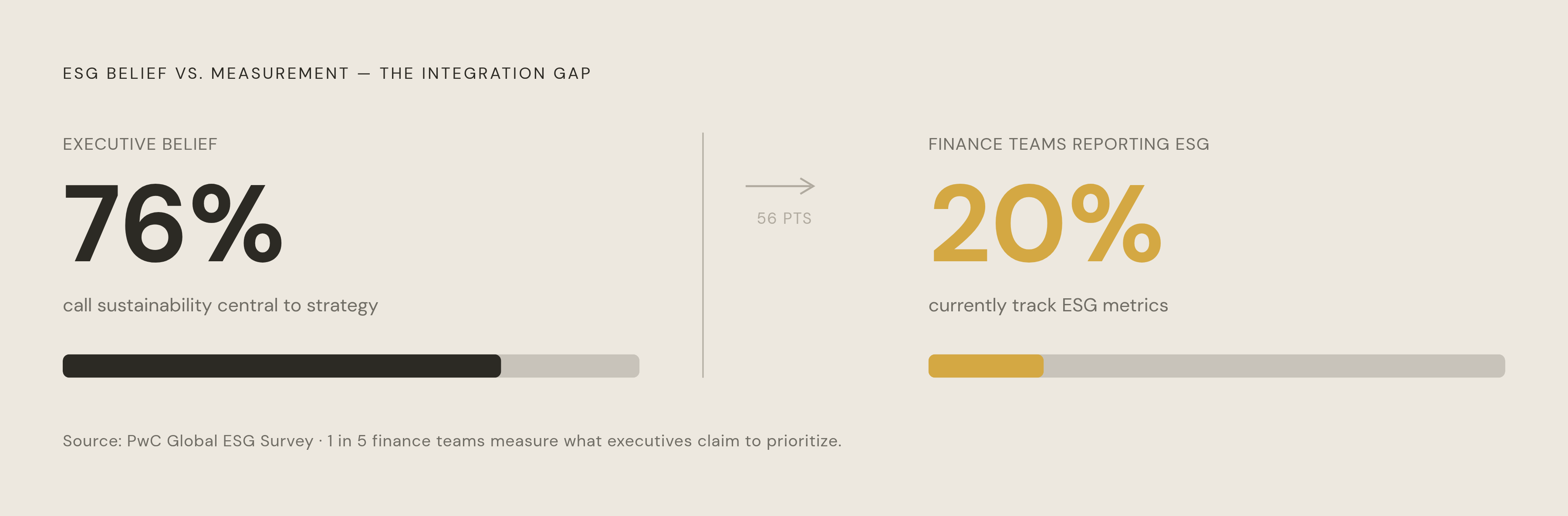
But the belief runs ahead of the practice. Data from keyesg.com shows 76% of executives call sustainability central to business strategy, yet only one in five finance teams currently reports on ESG metrics. That gap is the whole story in miniature: conviction without measurement produces scattered initiatives, not an embedded advantage. A company can believe sustainability drives value and still have no finance-grade way to prove it.
Investors are moving in the same direction, past box-checking and toward strategic read. Morningstar Sustainalytics' 2025 State of ESG Data Report found 22.8% of investors growing their sustainable investing strategies, 24.8% holding steady, and 25.7% still using sustainability data but changing how they talk about it publicly. Investors are done treating ESG as a disclosure obligation. That raises the cost, for any company still treating it as one.
How consumer and talent markets reward integrated sustainability
Sustainability now buys pricing power, not just goodwill. Sage found that 71% of consumers say they'll pay more for a sustainable brand, and the generational split sharpens that number: Harvard Business Review reported in 2023 that shoppers in a younger generational cohort are 27% more likely than older generations to buy from sustainable brands.
The labor market tells a matching story. Deloitte's 2023 research found 46% of Gen Z and 42% of Millennials had changed jobs, or planned to, over climate concerns, while 54% of Gen Z and 48% of Millennials said they were actively pushing their employers to adopt sustainability practices. Trust follows the same pattern: the 2025 Edelman Trust Barometer found 67% of consumers more likely to trust a company that shows real commitment to social issues, and Capgemini found 79% of consumers changing purchase habits based on social responsibility, inclusion, or environmental impact.
None of this belongs to a single campaign's win. It compounds. A company that prices higher because customers trust it, hires better because candidates seek it out, and retains staff because employees believe in the mission, is building three separate advantages that reinforce each other. Patagonia is a frequently cited example of this kind of hardwired brand identity, where environmental commitment runs through the business rather than sitting on top of it as a campaign, which is exactly why competitors who mimic its messaging alone are unlikely to replicate the loyalty behind it.
The four operational channels through which sustainability reshapes cost and risk
Four distinct mechanisms link sustainability work to the bottom line, and they rarely get named separately, which is part of why the connection feels abstract to skeptics.
Cost reduction comes first. Green manufacturing and circular-economy design cut waste, lower disposal costs, and simplify packaging, while energy-efficiency investment reduces input costs year over year. Circular models go further, opening service-based revenue lines (repair, resale, leasing) that offset material costs directly.
Supply chain resilience is the second channel. Supply chains face growing scrutiny for their environmental and social footprint, and sustainable sourcing reduces exposure to climate disruption and resource scarcity in ways that show up as fewer surprise cost spikes. EcoVadis' 2025 Business Sustainability Landscape Outlook found 65% of executives view supply chain sustainability as a competitive advantage, not a compliance cost.
Governance is the third channel, most often overlooked. Harvard Business Review found that 90% of companies with strong ESG practices experience less bribery, corruption, and fraud, which is operational integrity functioning as cost avoidance. Tying sustainability targets to executive pay turns stated values into enforced accountability. Unilever's experience is instructive here: embedding ESG into board oversight and risk management improved investor confidence and cut the company's exposure to volatile resource markets, according to cse-net.org.
Brand integrity is the fourth channel, and it works as a shield rather than a growth engine. A credible sustainability record doesn't just build goodwill, it limits the damage when something goes wrong. Companies without that credibility face amplified reputational fallout from the same incident that a trusted competitor would absorb and move past.
These four channels don't operate in isolation. Resilient supply chains reduce cost volatility, tighter governance reduces fraud losses, and brand integrity protects pricing power, so the advantage compounds across all four at once rather than adding up one at a time.
What the greenhushing trend reveals about strategic commitment versus public positioning
EcoVadis' 2025 Business Sustainability Landscape Outlook, based on a survey of 400 executives, found nearly 48% of companies keeping sustainability investment unchanged since early 2025. But 31% are investing more while promoting it less, and 8% are investing without any public communication about it at all.
The political backdrop matters here. Shifts in that national market. climate and sustainability policy through 2025 made public ESG claims a reputational liability with some audiences, which is exactly the condition that produces greenhushing. What's telling is that investment kept going anyway. Companies aren't backing off the work, they're backing off the announcement, which suggests the work itself pays for itself regardless of the political weather.
EcoVadis frames this pattern this way: sustainability is becoming, in the survey's words, a behind-the-scenes lever for long-term growth rather than a headline. That distinction is the whole argument of this piece in miniature. A company that only ever used sustainability as a marketing story stops when the story becomes risky to tell. A company that built sustainability into how it sources, manufactures, and manages risk keeps doing the work, quietly, because stopping would cost more than staying quiet. Data from venasolutions.com backs that up: 43% of businesses already report financial benefits from ESG, which means the companies still investing have evidence behind them, not just conviction.
The reporting and measurement gap that separates intent from advantage
Adoption of ESG reporting is nearly universal now: 90% of S&P 500 companies release some form of ESG report. But volume isn't the same thing as strategic integration, and the data behind those reports tells a messier story.
keyesg.com's figures lay out the problem in full. 47% of investors cite gaps in ESG data coverage as their single biggest challenge, 41% report quality issues with the data they do get, and 40% point to inconsistencies across different data providers. On the corporate side, 60% of finance leaders say ESG data is fragmented across systems that don't talk to each other.
Companies publishing ESG reports without fixing that infrastructure problem underneath are producing disclosure theater, language that reads well but connects to nothing. It circles back to the earlier gap: only one in five finance teams currently reports on ESG metrics, which means the function best equipped to link sustainability to financial results is largely sitting outside the process. Sui Yan's 2025 paper names the same persistent obstacles across industries: greenwashing risk, uncertainty about cost-benefit tradeoffs, and the absence of standardized reporting metrics that would let one company's numbers mean the same thing as a competitor's.
Measurement is what turns sustainability from a story into a case. Without it, a company can't connect its investment to revenue growth, cost reduction, or risk avoidance, which means it can't make the argument internally to its own board, let alone externally to investors. The companies solving the data infrastructure problem now, building systems where ESG numbers reconcile the way financial numbers do, are building a strategic intelligence advantage over peers still managing sustainability by instinct and press release.
What governance structures look like when sustainability is genuinely central
Governance is where intention either becomes structure or stays a slogan. Effective governance structures treat sustainability as a standing board agenda item, discussed the way revenue or risk gets discussed, not delegated to a committee that reports up once a year.
Roles need to be explicit. Roles across the C-suite need to be explicit, with financial, operational, and strategic dimensions of sustainability each clearly assigned rather than left for someone else to claim. Tying sustainability targets to executive compensation is what converts a public commitment into something the leadership team actually has to deliver on, the same way a revenue target works. KPIs need to be specific and time-bound, mapped to material risks like climate exposure, resource use, social equity, and supply chain integrity, not written as vague directional goals nobody can be held to.
Alignment with recognized frameworks gives all of this a common language, drawing on science-based targets for decarbonization, the TCFD structure for climate-related financial disclosure, and the UN Guiding Principles on Business and Human Rights for supply chain accountability. Independent, third-party assurance of ESG data matters just as much, since it's what builds investor trust and closes off the greenwashing exposure that comes from grading your own homework. Unilever's experience again offers the clearest illustration: embedding ESG into board oversight and formal risk management produced a measurable lift in investor confidence, according to cse-net.org. Companies with these structures in place are better positioned to act on sustainability decisions with consistency and accountability rather than working case by case.
How companies move from isolated initiatives to fully integrated sustainability strategy
There's a simple test for whether sustainability has actually been integrated: does it shape capital allocation, product design, hiring criteria, supplier selection, and executive incentives, or does it just show up in a report filed separately from all of those decisions? Companies that pass the test have stopped treating sustainability as a report and started treating it as an operating constraint, the same way cash flow or regulatory compliance already function.
The Institute of Sustainability Studies frames 2025's integrated strategy around a set of core pillars. Climate action and decarbonization means science-based targets, full Scope 1/2/3 emissions accounting, and climate scenario analysis built directly into financial planning, not run as a side exercise. Circular economy and resource efficiency covers product design for durability and reuse, closed-loop supply chains, and service-based business models that reduce material dependency. Social equity and inclusion means DEI embedded internally and through the value chain, aligned with the UN Guiding Principles. Sustainable supply chains require emissions mapping and supplier collaboration built for resilience and transparency, not just audit compliance. Sustainable finance means ESG criteria woven into capital allocation decisions, including green bonds and sustainability-linked loans.
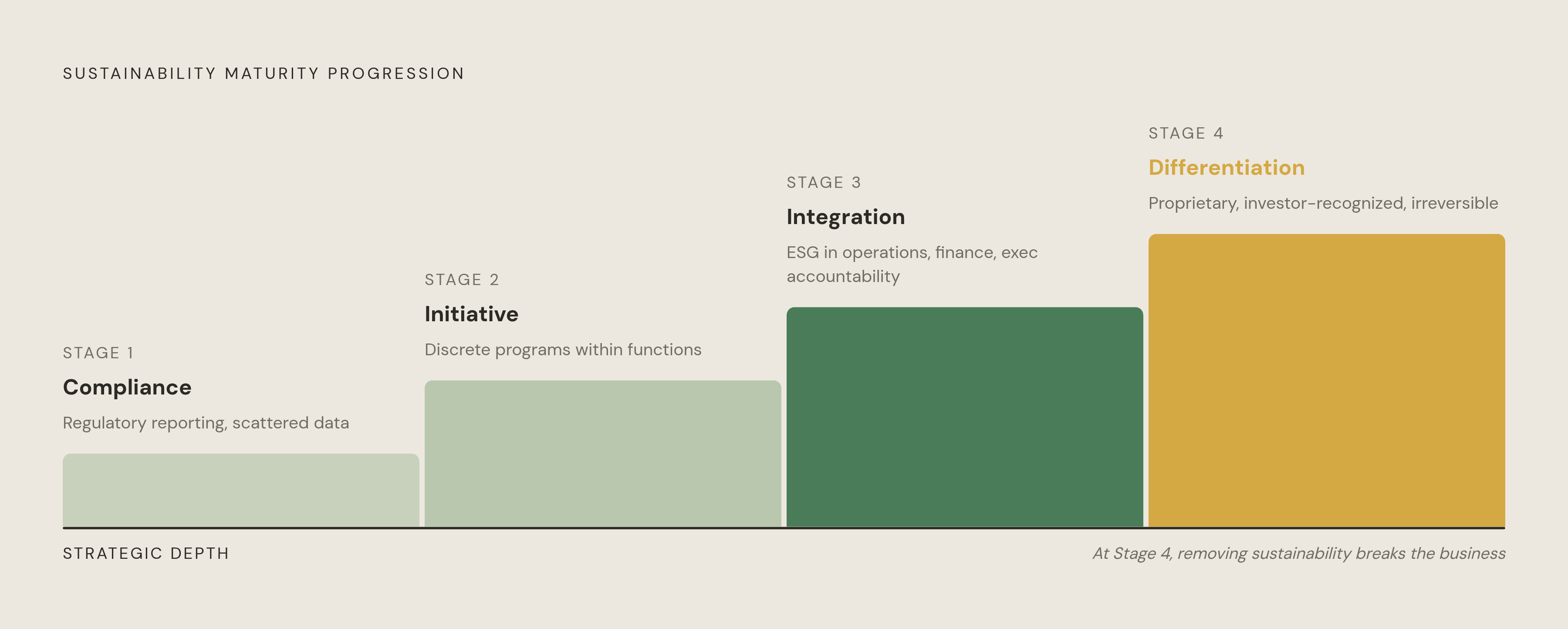
Companies tend to move through four stages on the way there. Stage one is compliance: reporting driven by regulation or investor pressure, with data scattered across departments. Stage two is initiative: discrete sustainability programs sitting inside individual functions, not yet talking to each other. Stage three is integration: ESG woven across operations, tied to financial planning, and backed by executive accountability. Stage four is differentiation, where sustainability capabilities become genuinely proprietary, hard to copy, and recognized by both investors and customers as a real point of distinction.
That fourth stage closes the loop back to the resource-based view that opened this piece. A company at stage four has built ESG capabilities that are rare, valuable, and embedded deep enough that a competitor can't reverse-engineer them in a fiscal year, which AchieveIt's analysis identifies as the actual definition of sustainable competitive advantage. The companies gaining lasting ground here aren't the ones with the boldest pledges or the most quotable sustainability report. They're the ones for whom pulling sustainability out would break something real in the business, not just complicate the brand story.
Sources
- (PDF) Sustainability and Competitive Advantage: The Impacts of ESG Practices on Business Performance
- What Is a Sustainable Competitive Advantage?
- What a strong corporate sustainability strategy looks like in 2025
- Why Sustainability Is a Long-Term Business Imperative in 2025
- venasolutions.com
- venasolutions.com
- cleantechnica.com