How to Choose the Right Green Marketing Strategy
Consumers doubt green claims, so match your strategy to the evidence you can prove.

More than half of consumers think brands overstate what they're doing for the environment. Research tracked by instituteofsustainabilitystudies.com put the figure at 57%, and that number should worry anyone building a green marketing strategy: the audience starts from doubt, not curiosity. Picking a strategy starts with one question, and it has nothing to do with tone or creative. Can the claim survive someone actually checking it? That question used to be mostly reputational. It isn't anymore.
The five types of green marketing, and what each one requires you to prove
Green marketing splits into five distinct types, and each one carries its own evidence burden, the amount and kind of proof needed before the claim is safe to make in public. Treating them as interchangeable, the first mistake most brands make, is the one that gets punished hardest.
Eco-branding folds sustainability into a brand's whole identity: sourcing, materials, public commitments, all of it. Because the claim covers the whole brand, the evidence has to cover the whole brand too, not one product line that happens to look good. This is the hardest type to earn and the easiest to get caught faking.
Sustainable product marketing points at specific benefits tied to a specific product: biodegradable packaging, recyclability, lower energy use in operation. It's the most auditable of the five, precisely because it's bounded. A brand is only proving one thing about one item, and life-cycle data either backs that up or it doesn't.
Green packaging claims reduced plastic or waste through biodegradable, compostable, or recyclable materials. Regulators watch packaging closely, so the evidence burden here means material certification plus proof of what actually happens to the packaging at end of life, not just what it's made from.
Green certification and labelling hands the substantiation job to a third party: Fair Trade, USDA Organic, Certified B Corporation, or newer entrants like Foundation Earth's eco-impact scoring, which grades products A+ down to G. The certification carries the weight of proof, but only if the brand uses it exactly as the certifying body allows: nothing stretched, nothing implied beyond scope. Digital eco-labels, QR codes that link straight to lifecycle data, are pushing this category toward even higher trust. Shoppers reward a label they recognize far more than a claim they have to take on faith.
Green advertising is eco-conscious messaging and imagery that reaches the widest audience while carrying the least attached evidence, which makes it the most exposed of the five. A slogan travels faster than a footnote, and that mismatch is exactly why this category draws the most regulatory attention.
All five have to survive one more test: the four Ps have to agree with each other. A brand can't claim green status through promotion while its product, its supply chain, or its pricing tells a different story. Sustainability that shows up only in the ad copy is a slogan, not a strategy. It's a liability waiting for someone to notice.
The regulatory backdrop makes all of this less optional, not more. The EU's Empowering Consumers for the Green Transition Directive bans generic green claims and offset-based "climate neutral" language starting September 2026, regardless of what happens with the separate Green Claims Directive, which the European Commission signaled its intent to withdraw in June 2025. Enforcement hasn't loosened just because that one proposal stalled: the EU's Consumer Protection Cooperation Network reached a "Common Understanding," welcomed by the Commission on June 30, 2026, that targets vague labels like "environmentally friendly" used without evidence behind them. Fines can run up to 10% of global turnover, with an earlier measure setting a 4% floor. Eco-branding and green advertising, the two loosest categories, sit squarely in the crosshairs after September 2026, and neither gets a grace period.
Matching strategy type to the evidence you actually have
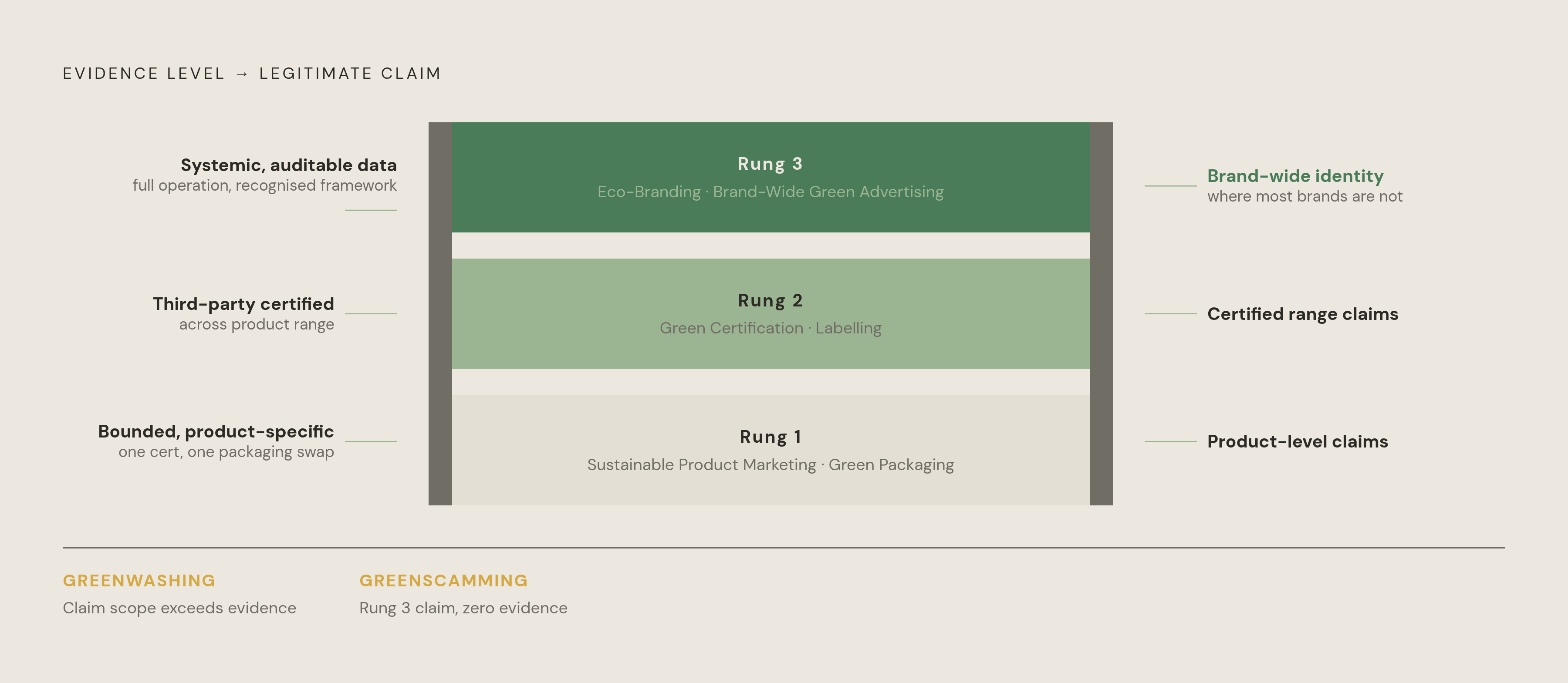
Pick the strategy with the narrowest claim scope your evidence can fully support. Expand later, once the evidence grows. Don't do it backward, and don't let ambition set the scope before the data can back it up.
Think of substantiation as a ladder with three rungs. Level 1 is product-specific, bounded data: one certified material, one verified packaging swap. That's enough for sustainable product marketing or green packaging claims, but nowhere near enough for eco-branding or a brand-wide green advertising push. Level 2 is third-party certification across a product range, which unlocks green certification and labelling, so long as the brand doesn't generalize the certified claim past what the certification actually covers. Level 3 is systemic, auditable data across the entire operation, ideally aligned with recognized sustainability reporting frameworks. Only Level 3 justifies a brand-wide identity claim. Skipping rungs is where the trouble starts, and skipping rungs is what most companies accused of greenwashing actually did.
Most of the failure modes people lump under "greenwashing" are really just this ladder climbed out of order. Greenwashing itself is the core mismatch: claim scope that exceeds the evidence behind it. Greenshifting deflects responsibility onto the consumer so the company never has to show its own numbers. Greenscamming makes commitments with no measurable milestones attached, which is a Level 3 claim made with zero evidence. Greencrowding is collective slow-walking, an entire industry moving at the same lazy pace so no single company stands out. That's more a transparency failure than an evidence failure, but it gets exposed the moment enforcement tightens anyway. Green hushing runs the other direction entirely: real progress that goes unreported, which just hands away competitive advantage for no good reason.
Brands still operating without rigorous, auditable sustainability data systems are building on sand, and tightening rules will find the cracks.
Before choosing any strategy, run one test: can the underlying data that makes this claim true be produced on request, right now? If the honest answer is no, the strategy is premature, full stop.
What brands doing this well actually look like
Ecover builds eco-branding on plant-based ingredients and biodegradable packaging across its range, and its "Refillution" campaign nudges customers toward in-store refills. Notice what that campaign does: it extends an existing claim, less single-use plastic, rather than inventing a new one. That's the discipline this whole framework is asking for.
Who Gives A Crap sells toilet paper made from recycled material and bamboo, skips plastic packaging, and donates a significant share of profits toward improving global sanitation. That 50% figure is specific and checkable, not a vague promise, and it's what lets the brand's mission-driven storytelling earn a claim at the brand level instead of just the product level.
Foundation Earth's grading scale, A+ for great down to G for not good, scores products on carbon emissions, water use, water pollution, and biodiversity loss, with transparency mechanisms linking to the underlying numbers. That's the digital eco-label model in practice: transparency turned into a measurable claim instead of a slogan sitting on a shelf.
The pattern across all three: the marketing claim never outruns what the operations behind it can support. None of them assert a brand identity their product reality can't back up.
Contrast that with a familiar failure: a fast fashion company launching a "sustainable collection" while mass production on non-renewable resources continues everywhere else in the business. That's Level 1 evidence, one collection, stretched to cover a Level 3 claim about the whole brand. It's the exact mismatch this framework exists to catch, the mismatch regulators find easiest to prove.
Why a green brand's claims need to perform inside AI answers, not just on its own site
Search behavior has shifted underneath all of this, and most green marketing strategies haven't caught up. Zero-click searches on Google climbed from 56% to 69% in a single year following the rollout of AI Overviews, according to Similarweb data from July 2025. People get answers without ever landing on a brand's website, so a green brand's substantiated claim now has to be findable and quotable by an AI system, not just readable by a human visitor. Separate research suggests the large majority of AI citations are sourced from earned media, which tells you where the real fight for visibility is happening: not on the brand's own domain.
The stakes compound here, too. If an AI system misstates a brand's environmental claim, correcting that record is nowhere near as simple as editing a webpage. Accuracy in what AI systems say about a brand now matters as much as accuracy in what the brand says about itself.
The gap between ranking well on Google and getting cited by AI is real, and it isn't closing on its own. A study built on 15,000 prompts using Ahrefs' Brand Radar tool found only 12% overlap between AI citations and Google's top 10 results overall, and ChatGPT specifically showed just 8% overlap with Google and Bing rankings. A brand's existing SEO position tells almost nothing about its AI visibility. These are two separate jobs now, and treating them as one is how a brand ends up invisible in the exact place its customers are asking questions.
Research from Princeton and the Allen Institute for AI, published at KDD 2024, found that content carrying verifiable statistics and named citations earns 30% to 40% higher AI visibility than content without them. That finding lines up almost exactly with what green marketing substantiation already demands: specific data, named certifications, auditable claims. A brand that's already done the evidence work to support a legitimate green claim is already producing the kind of content AI systems prefer to cite. The credibility project and the visibility project turn out to be the same project.
One tension is worth naming before someone else raises it as a gotcha: green brands adopting AI marketing tools will face questions about the energy cost of those tools. Researchers project AI workloads will drive more than half of data center power consumption by 2028. A brand leaning on AI to prove its sustainability credentials needs an answer ready for that tension, not a scramble.
How to make green claims visible and accurate across AI surfaces
Two disciplines have emerged to deal with this shift. GEO, Generative Engine Optimization, positions brand content so platforms like Google's AI Overviews, ChatGPT, and Perplexity choose to cite or recommend it. Unlike SEO, it optimizes for being treated as an authoritative source by a language model, not for ranking on a results page. AEO, Answer Engine Optimization, is broader: visibility across AI-powered answer engines built through a mix of SEO, PR, and affiliate work, tied together under AI visibility intelligence.
For a green brand, four things deserve budget, and they deserve it in this order. Entity and schema work, structured data that makes claims machine-readable, gets a substantial share of the investment. Citation equity, earning mentions across LinkedIn, Reddit, YouTube, third-party blogs, affiliate sites, and review platforms, wherever answer engines actually look, represents another major investment. Ongoing content production built around named statistics and certifications, the exact signals the Princeton research points to, forms a third core priority. Auditing, regularly checking what AI systems actually say about a brand's green claims, rounds out the approach and is the only way to catch a misrepresentation before it turns into a compliance problem.
Tools like Semrush's AI Visibility Dashboard now track brand mentions across ChatGPT, Perplexity, Google AI Overviews, and similar systems, providing visibility into how brands appear across AI-powered surfaces.
For agencies handling several green-focused clients, purpose-built AI visibility platforms can give account teams a unified workspace to monitor and prove client presence across AI surfaces at scale, making AI visibility performance something an agency can show a client, not just describe to them.
There's urgency here, and it's measurable: 92% of marketers say they plan to optimize for AI search, but only 40.6% are currently doing it. Green brands that move now, while that gap is still wide, stand to lock in a disproportionate share of AI-cited authority on sustainability topics before everyone else catches up.
Keeping green strategy coherent across a multi-brand or agency portfolio
Substantiation data doesn't transfer between brands. Each brand in a portfolio needs its own evidence base, its own claim scope, and its own regulatory compliance posture, because the compliance layer applies separately to each brand's claims, not to the portfolio as a whole.
Most agency workflows weren't built for this. Content strategy, voice guidelines, approval chains, discovery methods: all of it tends to get designed around a single brand. Five green brands under one roof means five separate evidence systems, not one shared system wearing five different logos.
Skip that separation and the consequences show up fast. A claim substantiated for one brand gets carelessly extended to a second brand that has no evidence to back it, which is the exact scope mismatch that defines greenwashing. Approval chains blur brand-specific compliance review together with general creative sign-off. Reporting can't isolate AI visibility performance brand by brand, so proving claim accuracy at the level regulators and clients actually care about becomes impossible.
MotionPoint's move offers a live example of the alternative. On May 14, 2025, MotionPoint introduced MarketFully as a parent organization bringing together translation, transcreation, and multilingual content creation under shared infrastructure. On December 2, 2025, MarketFully acquired Social Element, adding global social media operations and community management into that structure. The operational backbone gets consolidated, while each brand keeps its own distinct positioning on top of it. That's the model worth studying: shared infrastructure underneath, separation maintained on top.
A few disciplines hold up at scale. Pre-approved brief templates that bake in each brand's substantiation limits cut down on ad-hoc review requests and stop claim scope from drifting. Internal prompt libraries and brand context documents, organized client by client, turn green claim parameters into something the whole team can reference, not something locked in one account manager's head. Content routes automatically to the correct brand approver rather than a shared one, so compliance review stays brand-specific. Reporting templates need to scale from five clients to twenty-five without losing the per-brand detail that makes any of this defensible.
purpose-built AI visibility platforms can give account teams a unified workspace to monitor and prove client presence across AI surfaces at scale, making AI visibility performance something an agency can show a client, not just describe to them, is built around exactly this test. Flexible billing, either centralized or per client, paired with bespoke per-client reporting, lets an agency show AI visibility performance separately for every green brand in its portfolio. That's the standard a multi-brand operation has to hit: not just knowing the strategy for each brand, but proving, brand by brand, that the claim behind it still holds.