Industrial Symbiosis Networks and How They Work
Companies turn waste into raw materials by pairing firms whose outputs match each other's needs.
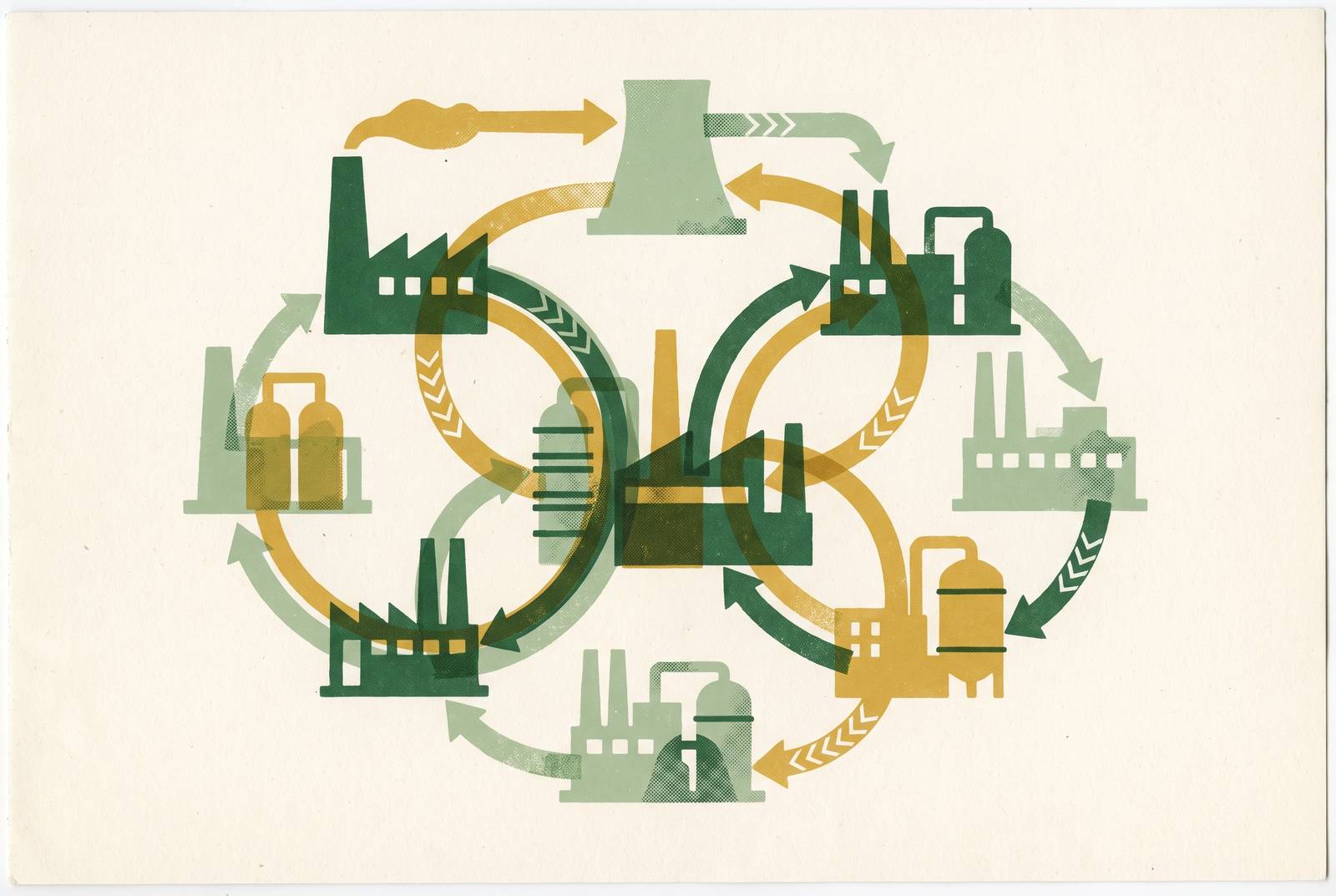
Industrial symbiosis networks take one company's waste stream and turn it into another company's raw material. That's the whole idea, and it runs directly against the take-make-dispose model most manufacturing still uses. Biology offers a useful comparison: symbiosis there splits into mutualistic (both organisms benefit) and parasitic (one wins, one loses), and IS only survives as the mutualistic kind, because a firm that comes out behind on the deal just walks away from it.
The move that makes this field work is treating "waste" as a category error. A residual coming off one production line is an input that hasn't found its match yet, and that's a small reframe with big consequences. The term gets stretched too far, though, so it's worth being blunt about where the line sits: curbside recycling falls outside IS, and so does a factory tightening its own internal efficiency. Both beat the linear model, but neither involves a second firm, and the exchange between two separate companies is the entire point. Geographic closeness helps but isn't required; some of the exchanges later in this piece run between firms that never share a fence line. The goal is simple to state and hard to pull off: get the most value out of every material, every watt, every gallon of water, every bit of know-how, across the line separating one company from another. The network, not the single factory, is the right unit to study here.
The linear model IS networks are designed to replace
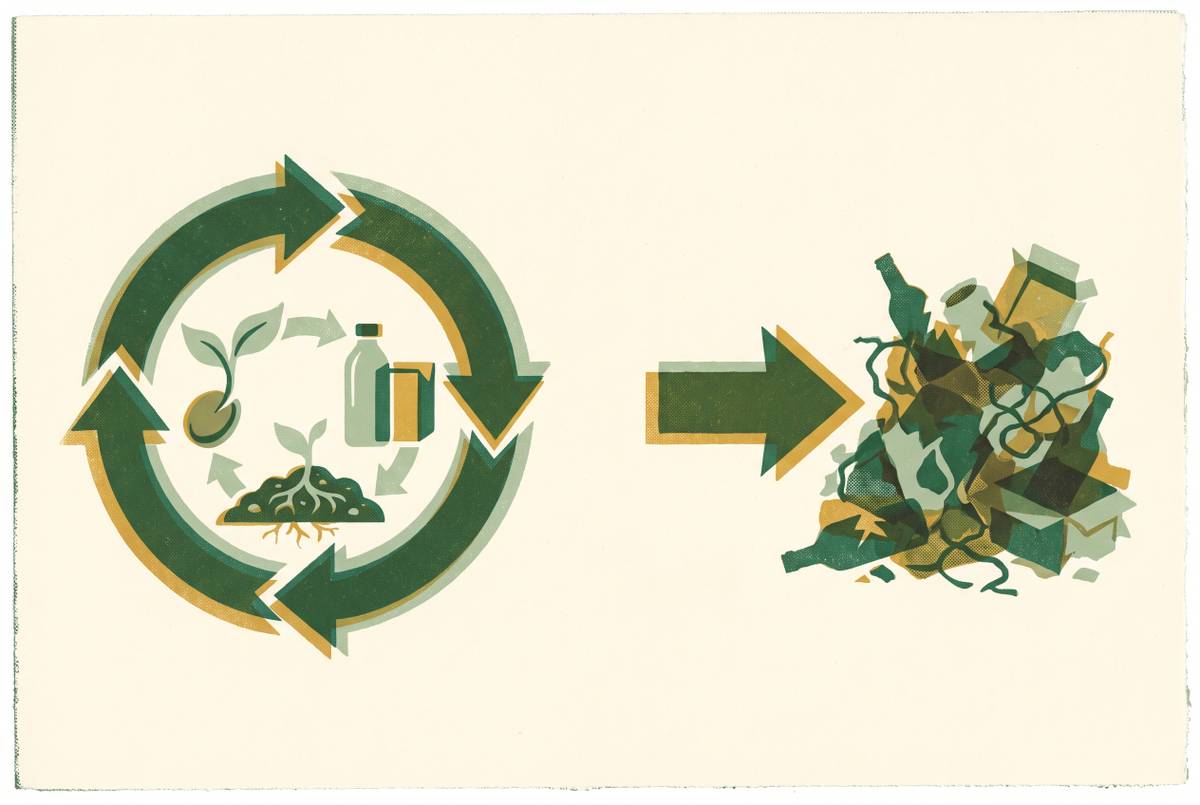
Take, make, dispose. Inputs come in one end, product goes out the other, and whatever's left gets pushed off as waste or emissions. That's the model most manufacturing was built on, and at the level of a single firm it works fine, or at least well enough that nobody's forced to change it. Disposal costs money, but that cost usually runs smaller than the value destroyed when a usable material gets landfilled or burned instead of reused.
That gap between disposal cost and destroyed value comes down to an information failure, and it's worth naming directly. A firm on its own has no way to discover that its scrap gypsum or waste heat or spent process water is exactly what some other facility down the road needs. Nothing about the system makes that discovery happen by accident, at scale, on a regular basis. Rising disposal costs and tighter regulation make the linear model more expensive every year, which builds the case for change, but cost pressure alone doesn't build the connective tissue between firms; it just makes building it more urgent. Worth sitting with: industrial symbiosis has moved from a corporate efficiency footnote into global climate policy discussions, reflecting growing recognition of its role in industrial decarbonization. What follows works through what's actually stopping wider adoption despite that logic and that cost pressure.
How the exchange mechanics work — matching inputs to outputs across firms
Strip IS down to its mechanics and it's a matching problem. Surplus resource leaves Facility A, becomes feedstock at Facility B, and three things drop at once: waste volume, raw material cost, emissions. The resources moving through these exchanges fall into a few recognizable buckets. Waste heat is one: a large manufacturer captures heat that would otherwise vent into the sky and pipes it to nearby greenhouses, apartment blocks, or fish farms. Wastewater is another; treated effluent gets reused as cooling water instead of pulling fresh water from a river or aquifer. Material by-products (fly ash, gypsum, organic residues, process gases) each have specific downstream buyers who need exactly that input and nothing else. Then there's the less tangible category: shared trucking routes, shared technical staff, know-how that moves between firms without a truck involved at all.
The hard part isn't the concept so much as the pairing. Firms have to find compatible input and output partners across industries that don't normally talk to each other, running on different scales and different production schedules. Nobody stumbles into this by chance; it takes systematic flow mapping, an actual audit of what crosses a facility's fence line in both directions, to surface matches that aren't obvious from outside. Proximity helps with anything physical (nobody wants to truck water three hundred miles) but isn't required for the non-physical stuff; two firms can share engineering expertise without ever sharing a loading dock.
There's a quality problem underneath all of this that's easy to underrate. A by-product isn't automatically fit to be someone else's raw material just because the chemistry looks compatible on paper. Specs have to hold, consistency has to survive batch after batch, and that validation work is where a lot of promising matches quietly die before they ever produce a contract.
How network configurations evolve from simple bilateral swaps to closed loops
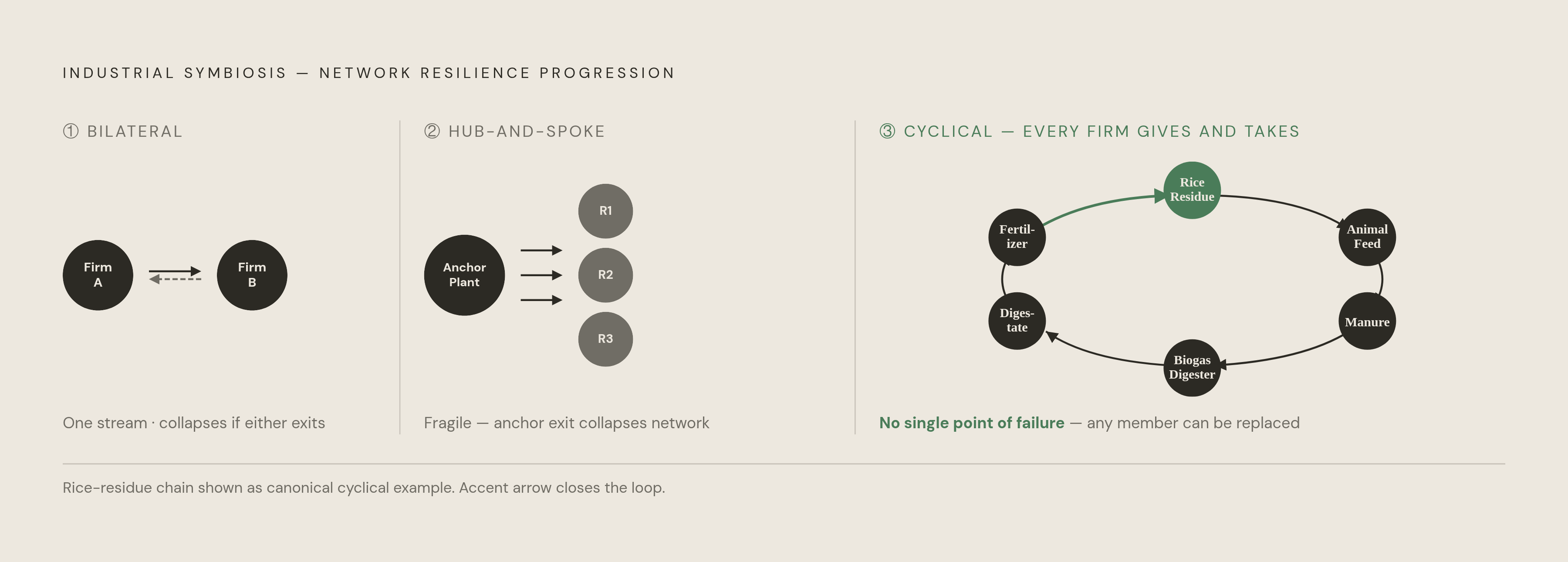
Networks don't start complicated. Most begin as a bilateral swap: two firms, one waste stream, a handshake deal trading one company's scrap for another's input. It's cheap to set up and easy to understand, but it's brittle. Pull one of the two firms out and the exchange collapses overnight.
The next stage is hub-and-spoke. One large anchor facility, a power plant or a refinery, throws off multiple by-product streams that feed several smaller receivers around it. More activity, more value captured, but the whole structure still depends on that one anchor staying put and staying productive.
The mature version is the cyclical network, where every actor both gives and takes. Agriculture offers a clean illustration: rice residue becomes animal feed, the animal produces manure, the manure feeds a biogas digester, the digestate becomes fertilizer, and the fertilizer goes back into growing more rice. Everybody plays both roles, supplier and customer at once. A network that's matured past the fragile early stage shows redundancy (more than one possible partner for any given stream), flexibility (inputs swapped for substitutes without breaking the chain), and a commercial logic sturdy enough to survive the departure of any one champion firm.
Early networks lean hard on individual relationships with specific firms, a weakness baked into the design from day one. Research into how these networks actually form backs this up: IS networks grow from what researchers call kernels, small opportunistic deals struck for commercial or regulatory reasons, and expand outward from there. Almost nobody builds one of these off a master plan. The bilateral swap is a starting point rather than a failure mode, and that's how every mature network in this piece got its start.
Kalundborg: what fifty years of organic symbiosis actually produced
Kalundborg, a single municipality in Denmark, is where this started, running since 1972, making it the oldest continuously operating industrial symbiosis network in the world. Seventeen public and private companies trade materials, energy, and water around an anchor built on Denmark's largest power plant, which passes gypsum, steam, and fly ash out to partners across entirely different sectors.
The roster tends to surprise people: Novo Nordisk, the world's largest insulin producer, sits in this network, alongside Novozymes, the world's largest enzyme producer, and Northern Europe's largest wastewater treatment plant. Global-scale industrial operations have been trading residuals here for more than fifty years, and reported figures put real numbers on the payoff: the network saves more than 3 million cubic metres of groundwater a year and recycles tens of thousands of tonnes of residual material annually that would otherwise go to landfill or incineration.
What makes Kalundborg worth studying is how it got built. Deals got struck one at a time because they made commercial sense in the moment, and the network grew outward from those kernels, echoing exactly the pattern Chertow described decades later. Research into Kalundborg adds the nuance worth sitting with: the economic motivation behind a given exchange is often tied to the buyer's or seller's broader operational performance, not the direct market value of the by-product itself. Put plainly, the exchange is frequently a side effect of a deeper business relationship, and that commercial logic is what keeps it running fifty years later, more than any environmental conviction. Kalundborg shows that organic formation can work over a long enough horizon. Whether facilitated formation can also work is a separate question, one with its own answer, and that's the subject of the next section.
What a national facilitation program can achieve that organic growth cannot — the UK's NISP
The UK's National Industrial Symbiosis Programme launched in 2005 as a deliberate answer to a slow process: rather than waiting decades for kernels to sprout on their own, a facilitator could go find the matches directly. NISP worked as an independent connector, linking businesses across sectors and sizes to find homes for materials nobody wanted, rather than waiting for two compatible firms to happen to meet at a trade conference.
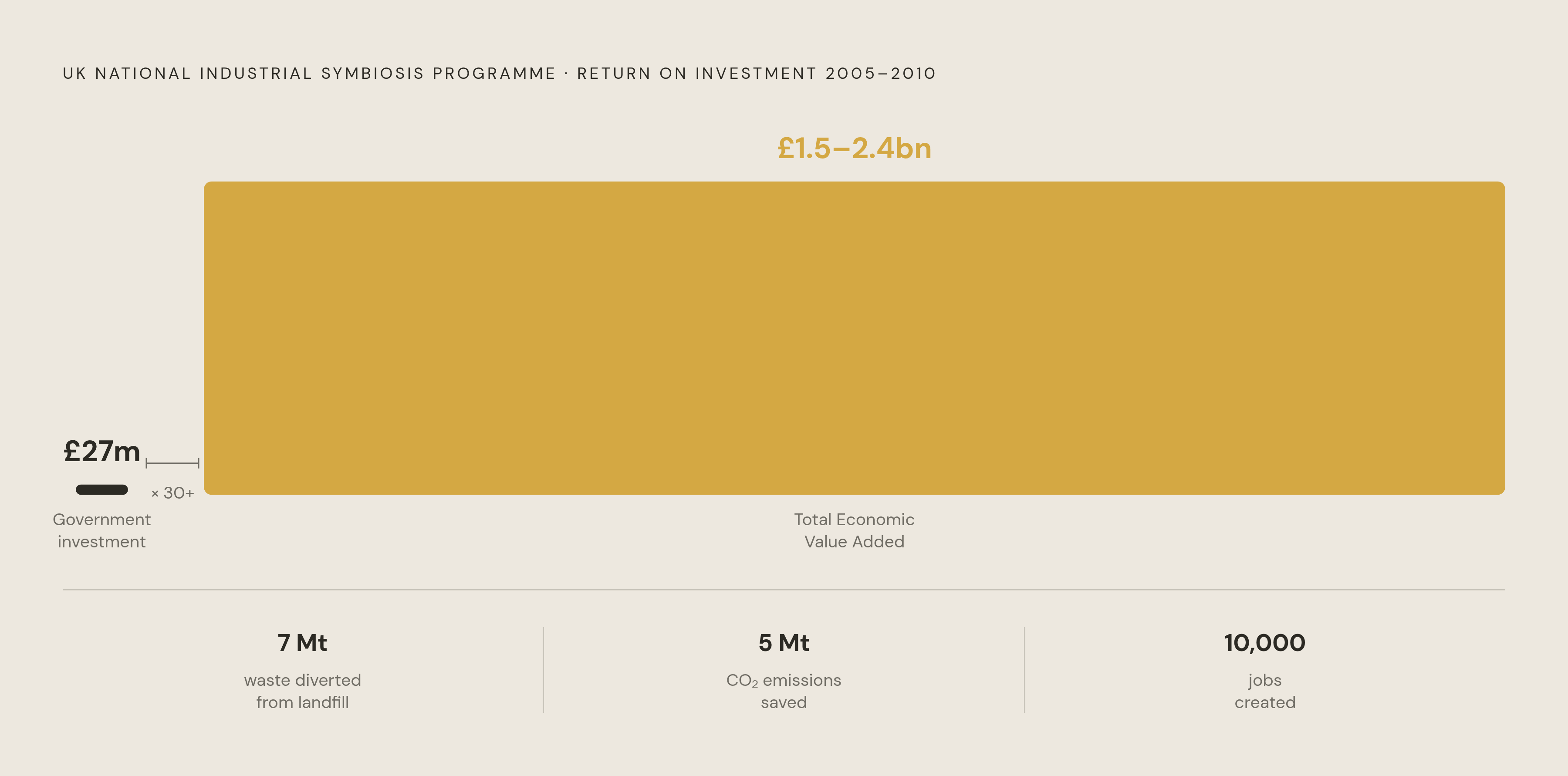
The mechanics were proactive: opportunity mapping, structured conversations between firms with no prior reason to know each other existed, and help navigating the legal tangle around waste classification. Over its first five years in England, 2005 through 2010, more than 7 million tonnes of waste got diverted from landfill, including 363,000 tonnes of hazardous material, and more than 5 million tonnes of CO₂ were saved. Water savings came in just over 9.5 million tonnes; virgin material savings landed around 9.7 million tonnes. Member businesses reported £176 million in additional sales and £156 million in cost cuts, and the program is credited with creating 10,000 jobs.
Here's the number that answers whether facilitation is worth paying for: a £27 million government investment produced somewhere between £1.5 billion and £2.4 billion in Total Economic Value Added, a benefit-cost ratio north of 30 to 1. No organic network in this piece, not even Kalundborg's fifty years of kernels, produced that kind of return on that small a public outlay in five years flat, and that comparison is the whole argument for facilitation right there. Organic formation clearly works, though it's slow, and slow has a cost nobody puts on a spreadsheet. Facilitation surfaces exchanges that need a third party doing the legwork to exist at all, on top of whatever speed it adds to deals that might have happened anyway. Given a return like that, the open question isn't whether facilitation works. It's why so few countries have copied the NISP model outright, because the arithmetic here isn't subtle.
How IS networks are taking shape in different industrial contexts today
Sotenäs, a seafood processing cluster in Sweden, is still in an early network stage and has already retained or created 20 jobs, spun off 5 new companies, and cut roughly 59 million kilograms of CO₂-equivalent emissions a year, an outsized return for a small town on a small footprint.
Move to the Netherlands and the scale changes entirely. According to Metabolic, recycling carbon monoxide out of steel industry waste gas could cut emissions by 57 million tonnes, roughly a 1.3% reduction in Europe's total carbon output from one material flow.
The copper-cement pairing is a quieter story but a sharper one. Iron silicate, a residual from copper smelting, substitutes for clinker in cement production and cuts the global warming potential of concrete by at least 36%. A landfill liability for the copper industry becomes a paid input for the cement industry, and it works anywhere both industries operate, no shared address required. That's the clearest case in the whole piece for treating proximity as a convenience rather than a requirement, since copper smelters and cement plants rarely sit anywhere near each other.
Portugal's HUB-CEIS project centers on a forest biomass hub that converts solid waste into renewable energy and green hydrogen, with an estimated 120 kilotonnes of CO₂ avoided per year and 60 direct jobs attached. Green hydrogen showing up here signals that IS is starting to plug into next-generation energy infrastructure alongside legacy heavy industry, stretching its reach well past cleanup work. Sweden's broader push reflects a whole country organizing its industrial and urban symbiosis efforts through regional collaboration across multiple hubs.
What holds constant across every one of these cases, seafood to steel to cement to biomass, is the matching logic underneath. The material changes every time. The need for somebody, a facilitator, an anchor firm, a government program, to actually make the introduction never does.
Why trust and institutional friction stop more networks than technical mismatches do
Reviews of the field have catalogued a wide range of distinct barriers to industrial symbiosis. That number points to a layered coordination problem, not one stubborn bolt. Some barriers are technical and real: by-product quality that varies batch to batch, transport costs that eat the margin, supply and demand cycles that don't line up on the calendar. Those get most of the attention in engineering circles, and they're the easiest to fix, which is exactly why they're not the reason most networks stall.
The barrier that actually kills more deals is relational, and it's the one worth getting right. Trust between two firms in different industries, carrying different risk exposure and different legal liability, doesn't build itself; it needs a track record, or a credible go-between willing to vouch for both sides. Layer on regulatory friction, where waste classification law often treats a perfectly usable by-product as legal waste anyway, and firms end up facing liability for the very material they're trying to sell productively. Add the more mundane institutional gaps, weak market incentives, missing data, no shared system for matching one firm's output to another's input, and the size of that 400-barrier list starts making sense.
The structural reason no single policy lever fixes this: IS operates at the meso level, between firms, but the obstacles come from three levels at once. Individual firm risk aversion sits at the micro level, regulatory and market failure sits at the macro level, and the coordination gap between two firms that have never spoken sits right in the meso middle. No single tool solves that. It takes a push across technical, organizational, economic, relational, and institutional fronts at the same time, or the fix just moves the bottleneck somewhere else. A facilitating organization matters here because it's often the only actor positioned to work across all three levels at once, and it's the actor most of these networks lack until someone decides to build one.
What makes a facilitating organization effective rather than ceremonial
Facilitators show up in different shapes: an eco-industrial park's management office, a cluster organization, a regional government authority, an independent program like NISP, or a project that starts with outside funding and eventually matures into a self-sustaining business-led association. The shape matters less than whether the organization does four things well, and most of the ones that fail are skipping the fourth.
Material and energy flow mapping, the systematic audit of what enters and exits each member facility, surfaces matches nobody would spot just by touring the plant floor. Structured dialogue between firms with no natural reason to be in the same room otherwise comes next. Then there's the legal maze: reclassifying a by-product, sorting out liability, clearing waste permit requirements written for a world where nothing gets reused. The piece most facilitators get wrong is sequencing, choosing which exchange to chase first. The smart order runs bilateral, high-value, low-complexity deals first, because those build trust and prove the commercial case before anyone attempts a three-way or four-way closed loop; a complicated cyclical network attempted first has no track record yet to make anyone trust it.
The Rotterdam harbour complex is worth naming specifically, because it's a network that came together through deliberate outside facilitation rather than organic growth from a kernel. That proves the model scales into existing, messy, already-built infrastructure, well beyond greenfield industrial parks built from scratch.
The most durable networks eventually make the jump from facilitated project to standing institution. Commercial logic takes over from dependence on the facilitator, the same way Kalundborg's deals now run on their own economic weight rather than anyone's environmental mission. That transition doesn't happen on its own, though; the facilitator has to stick around long enough for the commercial logic to actually take hold before stepping back. Digital platforms mapping input and output flows across a whole region are increasingly part of this toolkit, and they surface matches at a scale no single human facilitator could track by hand. They work alongside the trust infrastructure a facilitator builds, layered on top of it.
IS as the practical implementation layer of circular economy policy
Industrial symbiosis gets described in the literature as a meso-level implementation strategy for the circular economy, and that label does real work. Circular economy policy tends to live at the macro level: targets, regulations, tax incentives, national strategy documents. IS is the structure that takes those macro signals and turns them into an actual decision on an actual factory floor about where a by-product goes next.
That's what gives IS its reach, and also its complexity. It operates at the firm level (micro), the network or regional level (meso), and inside the regulatory and policy frameworks shaping what's legal and what's subsidized (macro), all at once. The IPCC's endorsement of industrial symbiosis as a strategy for sustainable growth and industrial resilience is a sign that this idea has moved out of the efficiency textbooks and into mainstream climate policy.
Put every case in this piece side by side: Kalundborg's fifty years, NISP's five-year sprint, Sotenäs's small early win, the Netherlands steel-chemicals deal running at continental scale. One pattern holds across all of them, and it's the one policymakers keep missing when they treat IS as a co-location amenity for industrial parks: symbiosis works across geography, industry, and scale, provided the matching, the trust, and the facilitation all show up together. Waiting for that to happen on its own, the way Kalundborg did, costs decades that NISP's numbers suggest nobody actually has to spend; a 30-to-1 return on a five-year program is not a subtle argument for building more facilitators instead of hoping more kernels sprout. Which leaves the real question for any organization or policymaker sitting on a waste stream or a spare boiler's worth of heat right now: does anything exist to find the match and make the deal formal, or does that value just end up in a landfill because nobody was looking?