The Green Marketing Mix in Practice
Most brands spend on the wrong marketing levers for green products.

A large share of consumers now factor sustainability into what they buy, a trend surveys have tracked as growing year over year. Yet only one in five believe the green claims brands make about those products, per Shopify's synthesis of recent survey data. That gap has a clear location: product, price, place, and promotion, the four levers marketers have used for decades, now doing double duty as environmental signals. Two of those four are doing almost all the work, and most brands are pouring money into the wrong two.
PwC's 2024 Voice of the Consumer survey found shoppers still willing to pay a 9.7% premium for sustainable goods, even with inflation squeezing budgets. Research has found that products marketed as sustainable have grown meaningfully faster than conventional ones over the past decade. The money is there, and so is the willingness. What's missing is a reliable way to convert one into the other, and that means treating the four Ps as a diagnostic tool instead of a checklist that gets equal attention across the board.
What the green marketing mix actually is and why the conventional 4P structure needs rethinking for sustainability
Green marketing mix takes the old product, price, place, promotion framework and builds environmental thinking into each decision, instead of bolting sustainability on as an afterthought. That's different from sustainable marketing, which zooms out to the whole business: how it makes money, how it treats workers, what it does to the planet along the way. Green marketing narrows the lens to the environmental attributes of what's actually sold.
The distinction matters because it's where a lot of brands quietly fail. A bamboo t-shirt made from a fast-renewing plant is green. Stitch it together in a coal-powered factory and ship it across oceans on diesel freighters, though, and the whole operation stops being sustainable, even as the product on the hanger keeps checking the green box. That gap between the label and the supply chain behind it is exactly where integration breaks down.
Researchers frame the mix as a set of structured market signals meant to shape how consumers evaluate a product and nudge them toward buying it (Mukonza and Swarts, 2020; Ahmed et al., 2023, cited in a 2026 Frontiers study). The literature is clear on one point that trips up a lot of marketing plans: green attributes don't walk straight into a purchase decision. They pass through perceived value first, and a product has to feel worth more, not just feel virtuous, before someone hands over money for it.
The clearest evidence of where this market is headed sits with LOHAS consumers, shorthand for Lifestyles of Health and Sustainability. LOHAS consumers are consistently identified as the heaviest buyers of green products, inside a market valued at roughly $472 billion in total addressable size. LOHAS made it into the Cambridge Dictionary at some point, which says something on its own: green positioning stopped being a niche differentiator a while back and turned into a baseline expectation for a large, well-funded slice of the market.
Each of the four Ps carries its own way of failing and its own way of working. The rest of this piece walks through them one at a time, and one argument threads through all of it: product and promotion emerge as the stronger drivers of perceived value, with price and place showing weaker effects in the research. Brands that lead with a discount or a distribution deal before the product is verified are spending in the wrong order.
How green product design works as the foundation, and what research says about which attributes actually move perceived value
Green product covers the entire lifecycle, not the line on the label. Sourcing, manufacturing, packaging, what happens to the thing when it's thrown out: all of it counts, and none of it is optional just because it doesn't fit on a hangtag.
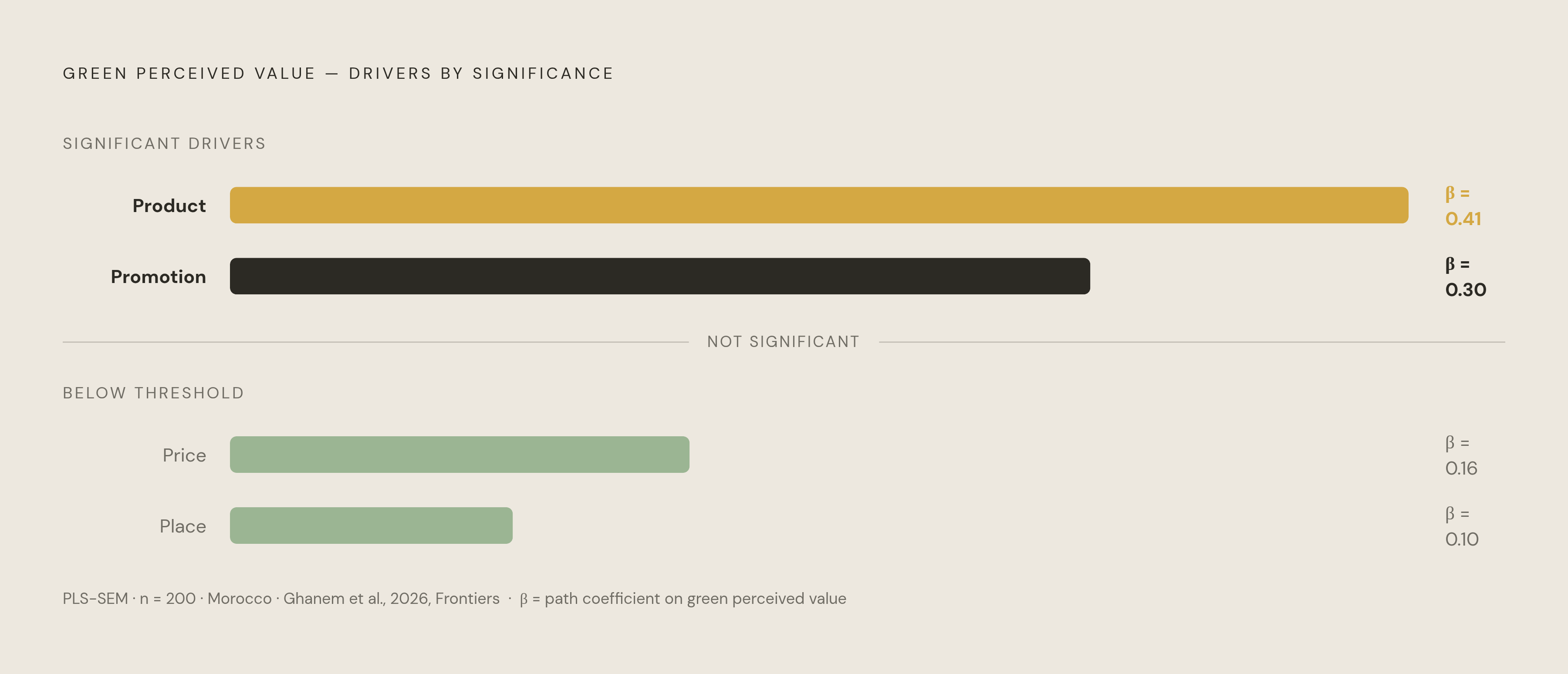
A 2026 Frontiers study out of Morocco (Ghanem et al.) tested all four Ps against perceived value using survey data from 200 respondents and PLS-SEM modeling. Product and promotion came back as significant drivers. Price and place did not clear the bar. That result should reorder how brands spend their attention: what a product is made of and how it's produced did more work than the price tag or the store shelf it sat on.
Product authenticity works as the first defense against greenwashing accusations, mainly because a product with real, checkable eco-attributes (third-party certification, lifecycle data, an ingredient list that doesn't hide anything) gives the marketing team something true to say. KraveBeauty, the skincare brand founded by Liah Yoo, built its business on the opposite of the usual playbook: fewer products, launched slower, with a marketing line that tells customers "you don't need this." Fewer SKUs, honest trade-offs, and a deliberate stance against overconsumption turned into a multimillion-dollar brand.
Unilever's move to acquire Wild, the refillable deodorant company, for a reported $300 million in April 2025, puts a number on how much the market now values product architecture built around cutting waste, rather than a green sticker slapped on a conventional stick of deodorant.
A 2024 MDPI Sustainability study out of China found that environmental knowledge moderated how consumers respond to green product cues, with researchers noting this as a meaningful factor in purchase decisions. Specificity isn't optional for sophisticated buyers. "Eco-friendly formula" reads as noise to them. A named percentage of recycled content, or a certified compostable packaging claim, reads as information, and that's the line brands keep crossing without noticing.
Why green pricing is harder than adding a premium and what evidence says about when price actually shapes purchase intention
The green premium exists, and PwC's 9.7% figure proves shoppers will pay it. But it's a bounded number, and inflation puts pressure on that ceiling every quarter. Treating the premium as a permanent, elastic budget line is a mistake brands keep making, and it's the wrong place to start pricing strategy.
Price sensitivity bites hardest in emerging markets. The Morocco study describes a consumption environment shaped by tight budgets, patchy availability, and information asymmetry, where green products sit next to conventional ones without any automatic edge on value. Consumers there are rejecting sustainability claims for reasons other than indifference. They're doing math, and the math doesn't always favor the greener option.
A December 2024 study published in Engineering, Technology & Applied Science Research looked at electric vehicle buyers in Palestine and found that green price support, meaning subsidies and incentives, positively shaped purchase intention. But the effect ran through what researchers called Green Perceived Value, with perceived value acting as a key mediating mechanism. Buyers weren't responding to a lower number. They were responding to a lower number that made the whole package feel worth more.
That's the distinction brands keep getting wrong: consumers don't pay extra for greenness as an abstract virtue, they pay for perceived value, which folds in function, emotion, social signaling, and economics all at once. Price support only works when it lowers the felt sacrifice, not just the sticker price. Subsidies, trade-in programs, refill discounts, extended warranties on durable eco-products, financing that spreads the upfront cost out over time: these tools work because they change how the trade-off feels, not because they change the number on the receipt.
The Morocco findings reinforce this: green price alone did not significantly predict perceived value there. Price signals without a strong product or promotion behind them just don't generate belief on their own. Brands that show their math, explaining why organic materials cost more or what exactly the premium pays for, earn more credibility than brands that simply charge more and expect trust to follow. Price works as a lever inside a value story, not standing alone, and any brand still leading with a premium instead of a reason for it is asking customers to trust first and understand later.
How green place (distribution, retail environment, and logistics) signals authenticity or undermines it
Green place means environmentally responsible distribution: sustainable logistics, retail environments that don't contradict the product, and availability that doesn't force consumers to hunt for the thing.
A low-waste product sold through packaging-heavy retail creates a visible contradiction, and shoppers notice it faster than most brands assume. Allbirds ran an Earth Day 2024 campaign built entirely around this idea: a one-day capsule called the "Greenwashed Collection," made up of pre-loved shoes in every shade of green, sold only through the brand's resale channel, ReRun. The statement wasn't in the shoes or the ad copy. It was in the choice of channel, resale instead of new retail, and that choice carried the entire argument.
Sustainable logistics shows up in smaller, less flashy ways too: consolidating last-mile delivery, offsetting shipping carbon, cutting packaging for e-commerce orders, running return and refill programs that close the loop at the point of sale. Retail environment matters as well. Placement next to certified organic products, in-store signage that lays out lifecycle information, a retailer's own sustainability record: all of it shapes how much a shopper trusts the claim before they've read a single word on the label.
Green products sold only through premium retail or urban stores create gaps that shrink the market and reinforce the idea that sustainability is a luxury good. Distribution needs to solve for reach, not for matching the brand's aesthetic. Brands that treat place as a curation exercise instead of a logistics problem end up serving a smaller, wealthier slice of the market than the product deserves, and that's a self-inflicted ceiling.
The Morocco study's finding that place didn't significantly move perceived value there says less about consumer indifference and more about scarcity: when green products are hard to find in a given market, the place lever doesn't have much room to operate. A channel that contradicts the product story will undercut trust no matter how good the product or the promotion is.
What makes green promotion work, and the specific communication practices that build rather than destroy credibility
Promotion was the other significant driver of perceived value in the Morocco study, alongside product. The Palestine EV research found the same pattern: green promotion lifted purchase intention, with awareness, trust, and emotional attachment to the brand each playing a role.
One detail from the Frontiers study stands out: health consciousness and environmental concern both moderated the relationship between perceived value and purchase intention, pointing to the role of personal relevance in the purchase decision. That's a practical cue for anyone writing the copy. Framing a green benefit in personal health terms lands harder with a general audience than framing it purely as an environmental good, and that cuts against the instinct to lead every green campaign with planet-first language.
Effective green promotion trades vague phrases like "environmentally friendly" for numbers: carbon footprint per unit, recycled content by weight, water saved per production run. It states what scope a claim covers, whether that's the whole product, one component, one region, or one link in the supply chain. And it backs claims with third-party verification. Allbirds attaches a carbon footprint label to every product, calculated with a lifecycle assessment tool verified against the ISO 14067:2018 standard. Verification is what turns a marketing line into an auditable fact, rather than a phrase a copywriter liked the sound of.
Electronic word-of-mouth adds another layer. Research on green consumer behavior has found that the green marketing mix drives green brand trust, which then shapes both buying behavior and how much customers talk about the brand online. Consumer voices carry a kind of credibility a brand's own channels can't fake.
Timing plays a role too. Interest in the term "eco-friendly" hit its highest point ever on Google Trends in June 2025, which says attention around sustainability spikes with events and seasons rather than sitting flat all year. Promotion timed to those moments lands differently than messaging running on autopilot.
None of it matters if the foundation underneath is thin. With only one in five consumers believing green claims to begin with, promotion without real substance behind it doesn't close the trust gap. It widens it. Promotion is the tip of the spear: it surfaces what product, price, and place have already built, and when those three are weak, promotion just exposes the gap instead of covering for it.
How greenwashing erodes the entire mix and what regulatory pressure now requires brands to do differently
Greenwashing goes beyond ordinary marketing exaggeration. It's deliberate deception that exploits the trust consumers extend toward eco-friendly claims, and that distinction carries legal weight now, not just ethical weight.
The damage doesn't stay contained to the offending brand. When trust erodes because of one company's greenwashing, cynicism spreads across the whole category, and every other brand in that space pays a higher cost to earn belief in its own, possibly honest, claims.
Regulators have started responding, though not always in one direction. The EU's Green Transition Directive, which took effect on March 27, 2024, amended the Unfair Commercial Practices Directive and the Consumer Rights Directive, and now requires substantiation behind sweeping environmental claims. Companies subject to the directive now have to substantiate sweeping environmental claims rather than rely on vague or unverified language.
Then there's the reversal. In June 2025, the European Commission said it planned to withdraw the proposed Green Claims Directive altogether, pointing to concerns that trilogue talks were expanding the rule to cover micro enterprises, something the Commission's original draft had specifically exempted. Regulatory direction on this front is not settled, and it isn't moving in one clean line. In the US, the FTC has updated its guidance to require verifiable evidence behind environmental claims, and Australia's ACCC has done the same, with penalties running from heavy fines to mandatory corrections to consumer lawsuits.
Compliance, treated seriously, functions as a marketing discipline and not just a legal obligation. Brands that build out verification and reporting systems ahead of the mandate end up with a structural edge over competitors scrambling to catch up once the rules bite. Swap sweeping phrases for numbers. State clearly what scope a claim covers. Define terms like "sustainable" and "net zero" instead of assuming shared meaning, and get third-party verification wherever possible: it isn't always legally required, but it functions as the real gold standard for credibility. Allbirds' "Greenwashed Collection" works precisely because it poked fun at vague eco-marketing while pointing back at its own verified carbon-label system as the receipt. The joke only lands because the product foundation was already real.
Why piecemeal green efforts fail and what integrated execution across all four Ps actually looks like
The Morocco study found only product and promotion significantly moved perceived value, but that doesn't mean price and place don't matter. It means those two levers lacked the supporting structure to activate in that market, and a brand that ignores them leaves holes the other two Ps can't patch over on their own.
Integration means each P backs up the others instead of contradicting them: a product with verified eco-attributes, priced with a value story the buyer can actually follow, sold through channels that match the environmental claim, and promoted with specific, third-party-checked language. Chipotle's 2015 commitment to going GMO-free and CVS's 2014 decision to pull cigarettes from its shelves, walking away from roughly $2 billion in annual revenue, both worked as credibility signals precisely because the product and distribution decisions came first. The marketing claim followed the operational change. It didn't substitute for it.
Unilever paying a reported $300 million for Wild says the same thing from the investment side: the market now prices integrated green positioning as a real asset, not a marketing flourish. Wild's refillable format and low-waste supply chain built the brand from the inside out, and the marketing simply told the truth about what already existed. Build the product, price it honestly, distribute it coherently, then talk about it in plain terms. Skip any one of those steps, and the other three end up carrying weight they were never built to hold.
Sources
- Frontiers | Green marketing mix and green purchase intention in an emerging market: the mediating role of perceived value and the moderating effects of health consciousness and environmental concern
- The Impact of Green Marketing Mix Practices on Customer's Purchase Intention of Electric Vehicles in Palestine: The Mediating Role of Green Perceived Value | Engineering, Technology & Applied Science Research
- Green Marketing in 2026: Definition & Strategies - Shopify
- Exploring the Impact of the Green Marketing Mix on Environmental Attitudes and Purchase Intentions: Moderating Role of Environmental Knowledge in China’s Emerging Markets
- Leveraging Customer Green Behavior Toward Green Marketing Mix and Electronic Word-of-Mouth
- dlapiper.com