Circular Business Models Explained
Circular models force companies to redesign how they make money, not just tweak their waste.
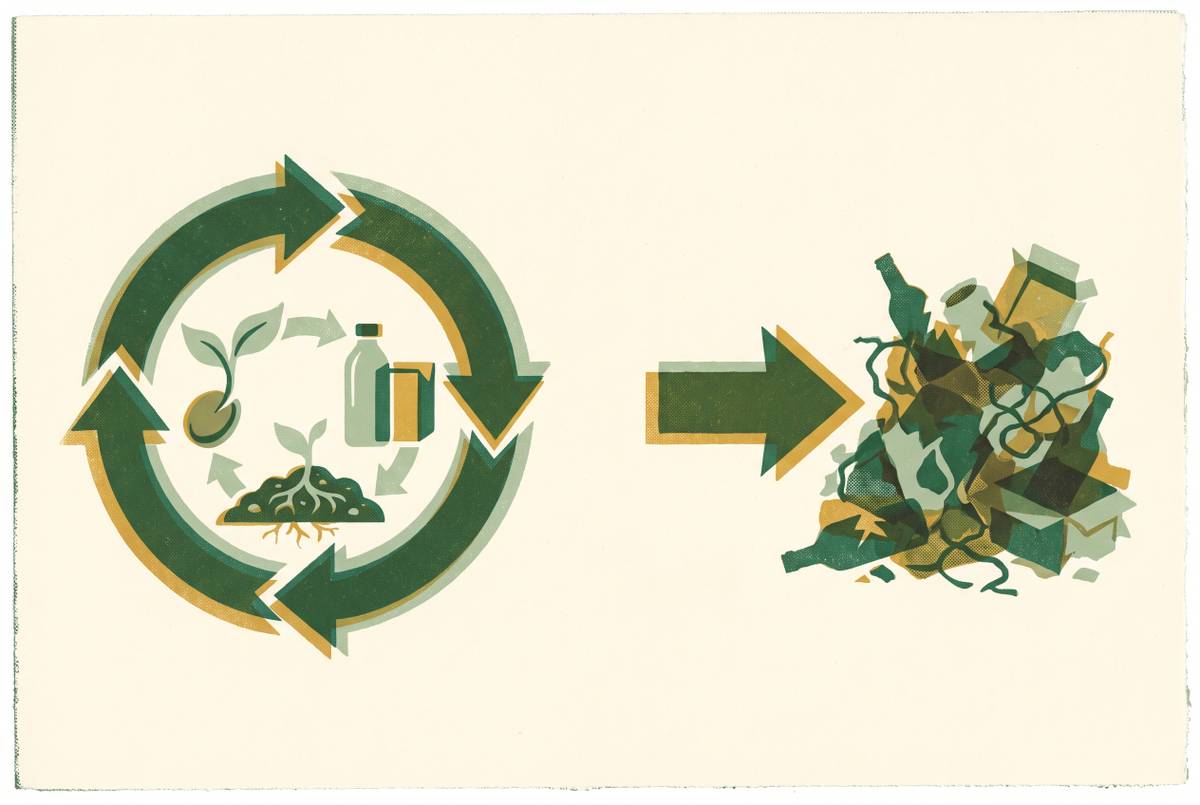
The take-make-dispose model has run its course, and the numbers explain why. Businesses pull resources out of the ground, turn them into products, sell them, and let customers throw them away. That logic depends on infinite raw material and infinite landfill, neither of which exists, and it's starting to cost real money instead of just raising eyebrows at sustainability conferences.
Consider e-waste alone. The International Telecommunication Union tracks it in the tens of millions of metric tons annually, a figure that keeps growing while the actual recovery rate lags far behind. Add in regulatory pressure like the EU's Ecodesign for Sustainable Products Regulation, in force since mid-2024, and the picture shifts from environmental concern to operational risk. ESPR doesn't stop at washing machines and light bulbs anymore; it reaches into textiles, furniture, chemicals, construction materials. Linear inefficiency used to be a footnote in the annual report. Now it's a competitive disadvantage, and companies that treat circularity as a marketing layer rather than a structural fix are going to find that out the hard way.
What a circular business model actually means
A circular business model changes how an organization creates, delivers, and captures value while cutting the ecological and social costs of doing so. Slapping a recyclable label on a product and calling it done falls well short of that bar. Product-level tweaks (lighter packaging, a recycled-content badge) sit at the surface, while a circular model rewrites the logic underneath, the actual mechanism by which the business makes money.
Three paths get a company there. A new venture can be built circular from day one, with no legacy factory floor or supply contract to unwind. An existing company can diversify, adding a circular offering onto its current lineup without touching the core business. Or it can attempt full transformation, restructuring the whole model, which research from Geissdoerfer and colleagues finds is usually driven less by growth ambition than by long-term resilience and regulatory pressure. That's the hardest of the three routes, and it shows: fewer companies attempt it, and fewer still finish it cleanly.
Much of the writing on this topic treats circularity as sustainability by default. The EU Circular Economy Platform's 2024 white paper makes the point directly, framing circularity as primarily a materials, design, and organizational challenge that has to be pointed deliberately at sustainability outcomes. A leasing model that gets customers cycling through five phones instead of keeping one for six years hasn't helped anyone; it has just moved the same waste problem onto a subscription plan. Rebound effects are real, and they don't announce themselves in advance. A well-designed loop can still produce a worse outcome depending on how people actually use the thing once it's in their hands.
The five types the OECD framework identifies
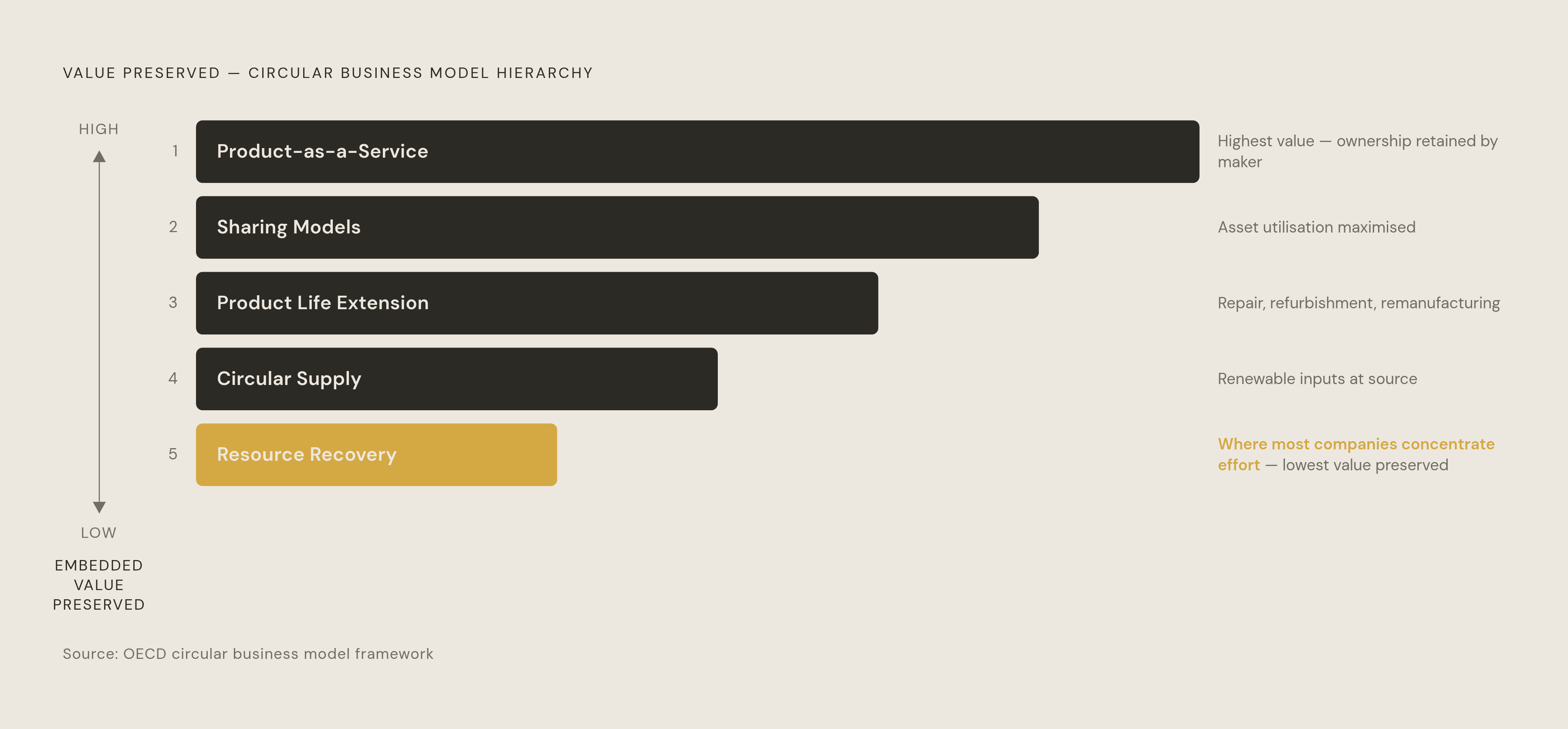
The OECD sorts circular business models into five distinct types, and each runs on a different value-creation logic, a distinction that goes deeper than a tactic layered onto the same underlying approach.
Circular supply swaps virgin inputs for renewable, bio-based, or recovered materials before the product even exists; the loop starts at sourcing. Resource recovery works the opposite end, pulling value out of waste streams once a product has reached its life's end. Product life extension, meaning repair, refurbishment, remanufacturing, upgrades, keeps the physical object in circulation longer, holding value in the thing itself rather than in its materials. Sharing models chase utilization, letting multiple users get access to one underused asset instead of each buying their own. Product-as-a-Service sells the outcome or the access, which lines up the seller's financial interest with how long the product actually lasts.
Order these five and a hierarchy falls out, and it's worth saying plainly which end of it matters more: recovery ranks as the weakest of the five, well behind the other four as an option among peers. Models near the top (PaaS, sharing, life extension) keep more of a product's embedded value, the energy and material already invested in making it, than resource recovery does at the bottom. Melting down an aluminum casing recovers the metal; it leaves the machining time, the tooling, and the design work that turned raw stock into a functioning part unrecovered. The European Environment Agency has flagged that real-world adoption clusters at the bottom of this hierarchy, recycling and recovery, rather than at the structurally harder, higher-value strategies up top. Everyone wants credit for circularity; fewer companies want to pay for the expensive kind.
How Product-as-a-Service changes the producer-customer relationship
Under PaaS, the customer pays for access or outcome rather than for ownership of a physical object, and the distinction carries real weight.
Once the producer keeps title to the equipment, durability becomes a line item on the producer's own balance sheet rather than the customer's problem. Planned obsolescence, the practice of engineering products to fail on a schedule, stops making financial sense, because the company footing the replacement bill is the one that built the thing.
Philips sells lighting as a service: it keeps ownership of the installed fixtures and takes them back for recycling or upgrade at end of use, which removes the upfront cost barrier for the buyer while keeping material stewardship squarely with Philips. Michelin runs a mileage-based service contract for truck tires that bundles in maintenance, so Michelin now has a direct financial stake in how long its own tires last on the road. The contract structure itself makes longevity the profitable choice, backed by financial incentives rather than by goodwill alone.
The design consequence follows naturally. A product built to be leased back, serviced, and eventually reclaimed has to be modular and repairable from the first sketch, not retrofitted for it later. Where the model runs into trouble is consumer markets, and this is the part PaaS boosters tend to skip over. B2B works because usage is measurable and contracts are manageable at scale; the average household is a harder customer to lock into a leasing relationship, and PaaS adoption on the consumer side has stayed thin as a result. Trying to force it there before the logistics catch up is the mistake to watch for.
What remanufacturing and life extension look like at industrial scale
Life extension isn't one thing; it happens in stages. Repair fixes what's broken. Refurbishment brings a used product back closer to new condition. Remanufacturing goes furthest, rebuilding a product to original specification using a mix of reused and new components. Each stage preserves a different slice of the value already locked into the object.
Renault's remanufacturing operation is the textbook case. Rebuilding components uses a fraction of the energy and water that new production requires and generates far less waste in the process, gains that are substantial rather than marginal. The line has also grown into a genuine revenue stream for Renault, which is the detail that matters most: life extension functions as a business in its own right, generating profit rather than merely absorbing cost. Caterpillar runs a similar operation, remanufacturing heavy equipment components and selling them to a more price-sensitive customer segment as a cost-competitive alternative to buying new. Philips does something comparable with medical equipment trade-in and refurbishment, opening up a second market of buyers who couldn't afford new units in the first place.
None of this happens without infrastructure most companies don't already have: reverse logistics to get the used product back, grading and sorting systems to separate what's usable from what isn't, and products designed from the start to come apart cleanly. That's exactly why remanufacturing has concentrated in sectors where component value is high enough to justify building all that (automotive, heavy equipment, medical devices) and stayed rare everywhere else. Remanufacturing a five-dollar kitchen appliance simply doesn't clear the math; the labor to take it apart costs more than a new one off the factory line.
Sharing and leasing models as a utilisation argument
Most physical things sit idle most of the time. Sharing models exploit that gap directly: concentrate use across more people instead of manufacturing more units.
Two versions of this exist. Platform-mediated sharing connects people to assets someone else already owns, tools, vehicles, spare rooms, without the platform itself owning any of it. Leasing with return keeps ownership with the producer while the product cycles through a sequence of different users over its working life.
Mud Jeans runs the leasing version on denim: customers lease a pair for a set term, then return it, swap it, or buy it outright, and the returns get resold as vintage or broken down into fiber for new jeans. The loop closes right where the customer stands. There's also a labor dimension worth noting: repair, refurbishment, and resale work tends to need more hands per unit than mass manufacturing does, which carries a genuine job-creation angle alongside the resource savings. The catch is scale. Sharing works cleanly when a product category is standardized and geographically concentrated, so the logistics of moving it between users stays cheap. Push toward custom products or a spread-out customer base, and the same model gets expensive fast, and this is precisely where a lot of well-meaning pilot programs quietly die.
Resource recovery at the end of the value chain
Resource recovery pulls materials back out of waste streams so they can go into new production instead of a landfill. It's necessary. It's also, by definition, working with what's left over after every higher-value strategy (repair, reuse, resale) has already had its shot, which is why treating recovery as the centerpiece of a circularity strategy gets the priority order backwards. Recovery works best as the fallback, well down the list of headline priorities.
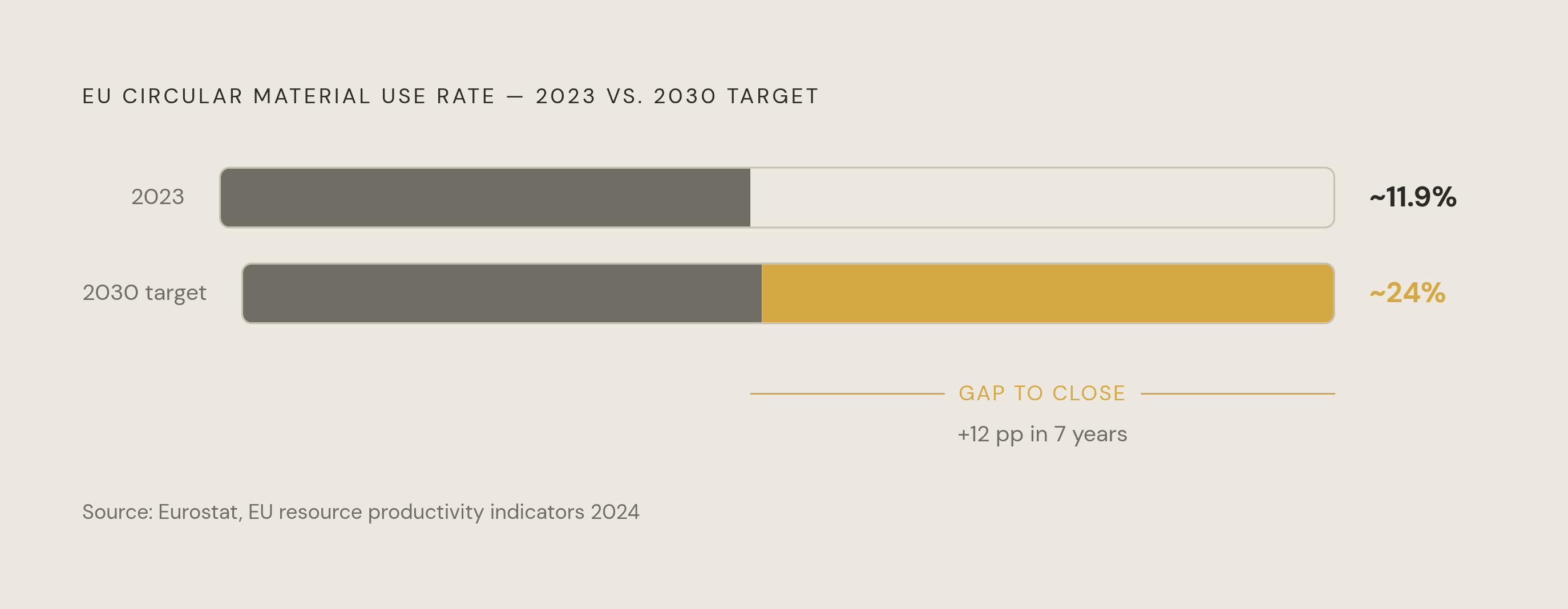
The gap between where this stands today and where policy wants it to go is wide. The EU's circular material use rate, the share of recycled inputs in total material consumption, sat just under twelve percent in 2023, against a 2030 target set at more than double that. E-waste tells the same story from a different angle: only a small share of global electronic waste gets collected and recycled properly, despite the recoverable material inside it (copper, gold, rare earths) carrying genuine, demonstrable value.
Unilever's packaging work shows both sides of this at once. Real, measurable progress on recyclable and compostable formats and on using post-consumer recycled plastic, sitting right alongside a broader industry pattern where the Ellen MacArthur Foundation's Global Commitment set 2025 plastics targets that the sector, taken as a whole, did not hit. This points less to a failure of intent than to a bottleneck in collection and sorting infrastructure: a truckload of mixed plastic waste still has to be sorted by resin type, PET separated from HDPE separated from polypropylene, before any of it becomes feedstock again, and that sorting step is where most systems break down, no matter how sincere the corporate pledge behind them.
Why most companies still sit at the bottom of the hierarchy
Here's the pattern the European Environment Agency keeps flagging: most companies doing "circular" work are concentrated in waste management and recycling, the bottom rung, leaving the higher-value strategies further up largely untouched. This isn't a temporary lag that catches up given more time. It looks structural, and pretending otherwise is the second-biggest mistake in this whole field, right behind confusing circularity with sustainability in the first place.
A cross-sectoral study of Swedish firms sorted the obstacles into five buckets: design, waste, service, platform, and nature-related barriers, each tied to a different circular model rather than one universal blocker everyone faces the same way. Three categories keep showing up regardless of sector. Economic barriers come first: circular investments front-load cost and pay back slowly, and specialized financing for that kind of bet is thin. Technical barriers follow close behind: reverse logistics, disassembly-friendly design, sorting infrastructure, none of which most companies have sitting around already built. Cultural and market barriers round it out: B2C customers are a more scattered, harder-to-shift group than B2B buyers, and moving someone away from "I own this" toward "I access this" is slower than any spreadsheet projection assumes.
What works in automotive remanufacturing doesn't just port over to fashion or electronics; the friction points differ by sector, so a generic playbook underperforms against something built for the specific industry. And the motivation gap explains a lot of the adoption gap: startups and diversifiers tend to move because of growth and customer demand, while full transformations inside existing companies get pushed more by resilience and regulatory pressure, per Geissdoerfer's research. Different motivation, different model, different pace.
The regulatory environment that is forcing the question
The ESPR, in force since July 2024, is the biggest near-term regulatory shift on this front, and it's a lot bigger than its predecessor rules ever were. Where energy labeling once covered appliances, ESPR's reach now extends to textiles, furniture, tires, chemicals, construction materials, and ICT electronics.
Two provisions matter most for how companies actually operate. The Digital Product Passport requires structured data on a product's materials, repairability, and end-of-life handling to travel with the product itself, rather than remaining buried in a supplier's internal spreadsheet. And a ban on destroying unsold apparel and footwear takes effect in mid-2026, aimed squarely at fast fashion's habit of burning or landfilling stock rather than discounting it. A broader EU Circular Economy Act is expected in the second half of 2026, stretching across packaging, automotive, chemicals, and construction.
One honest caveat: how much teeth ESPR actually has depends on how ambitiously the delegated acts underneath it get written and enforced. The regulation sets the frame; the outcome inside it still depends on implementation. And for companies outside the EU, the signal still travels. Similar frameworks are taking shape in other jurisdictions, and any company with EU customers in its supply chain picks up compliance obligations regardless of where its headquarters sits.
How to identify which model fits a given business
Start with one question: where in the value chain does the business actually have leverage, inputs, product life, utilization, or end-of-life? That answer points toward the model.
Some rough fits by sector. High-value durable goods, medical devices, industrial machinery, cars, have the strongest track record with life extension and remanufacturing, the Renault and Caterpillar model. Infrastructure and equipment with measurable performance output line up well with PaaS, in the mold of Schneider Electric's energy systems or Michelin's tire contracts. Consumer goods with standardized shapes and sizes suit sharing and leasing best, provided logistics costs stay reasonable. Packaging-heavy consumer goods point toward circular supply and resource recovery as the natural entry point, though Unilever's experience with the Global Commitment's missed targets is a reminder that entry point isn't the same as finish line.
Nobody has to jump straight to full transformation. Adding one circular offering alongside the existing business, the diversification route Geissdoerfer and colleagues describe, lets a company learn the mechanics before betting the whole model on it. And design sits underneath every path here: a product built without modularity, repairability, or material traceability baked in can't be retrofitted into a circular model after the fact, no matter how good the intentions are on the business side. The two decisions, business model and product design, have to be made together or neither one really works.
Research comparing circular and linear production under equivalent capital conditions has found circular approaches can outperform on profitability. The business case is there, and the biggest mistake a company can make is treating that case as optional rather than as the whole point. What it demands in return is patience most quarterly-earnings cultures don't have much of: real upfront investment and a longer runway than the next four reporting periods. Building a credible circular position takes a deliberate strategy behind it, something a sustainability page bolted onto an otherwise unchanged website cannot provide.