Cradle to Cradle vs Cradle to Grave Design
Circular design treats waste as inevitable; cradle to cradle treats it as a design failure.
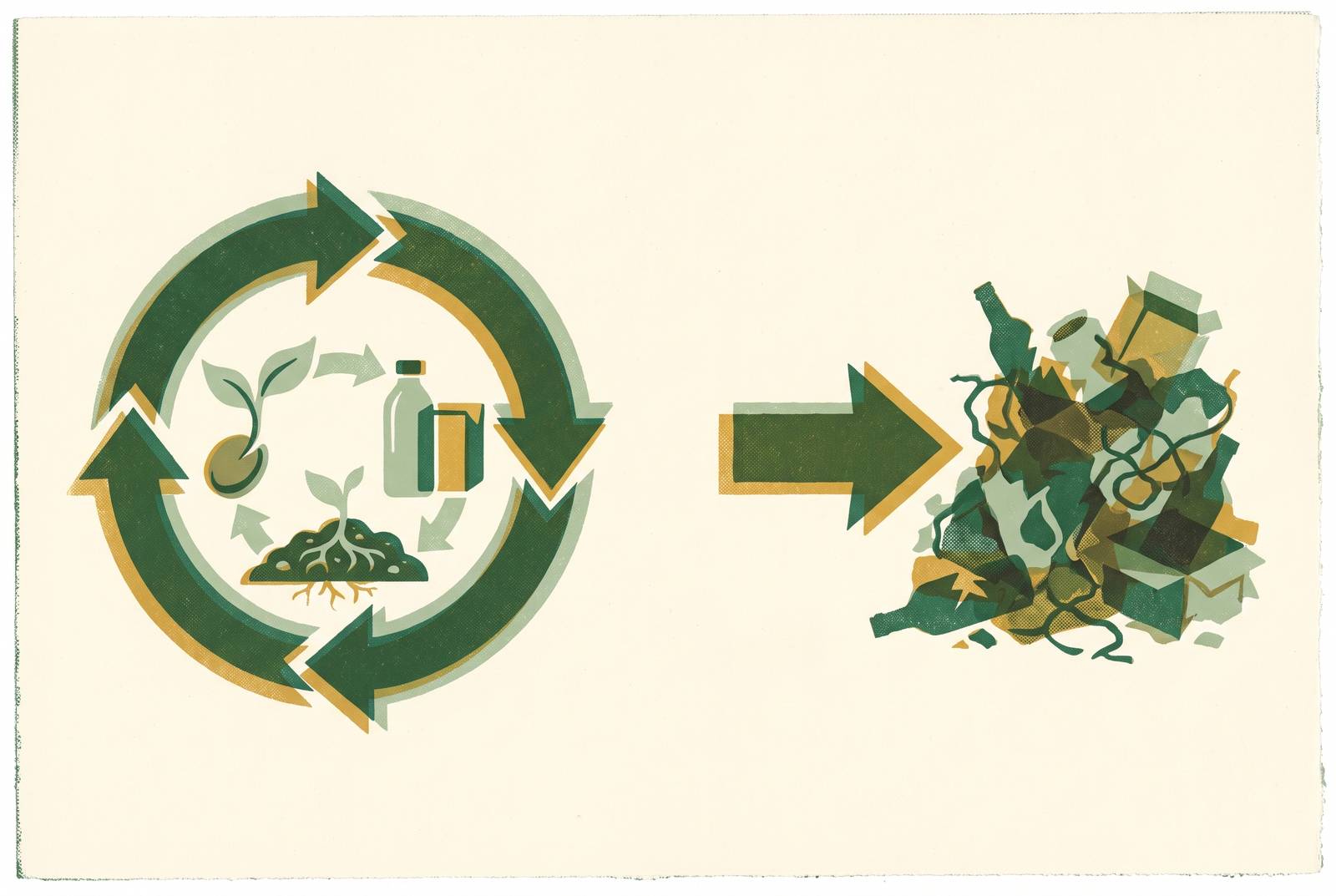
Cradle to grave and cradle to cradle answer the same question, where does a product's life end, with two completely different assumptions baked in from the first sketch. One treats disposal as the finish line. The other treats disposal as a design failure, and asks what the material becomes next instead of where it goes to die.
Why the linear model produces waste as a structural outcome, not an accident
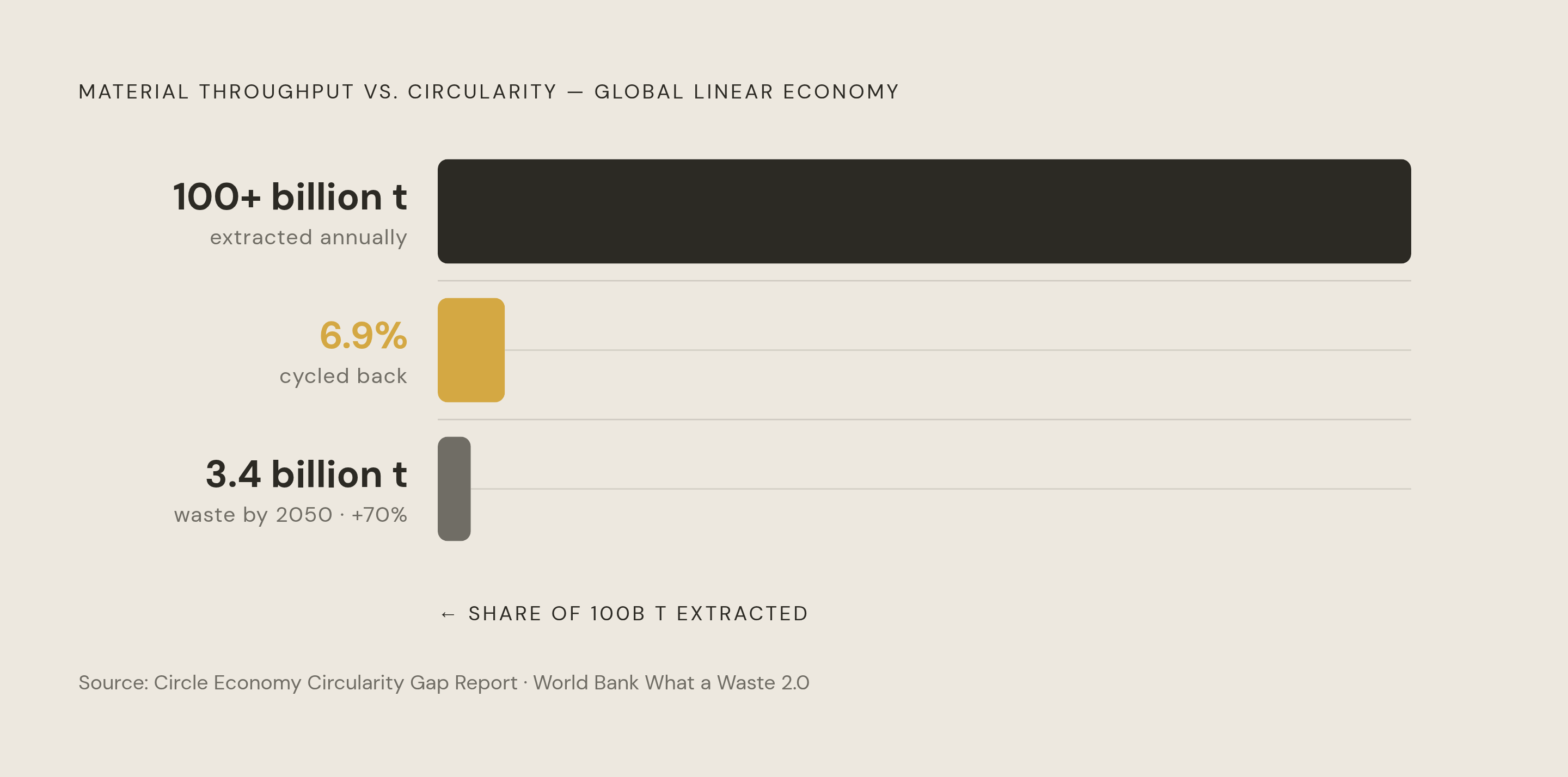
Start with the scale of it. The world pulls over 100 billion tonnes of raw material out of the ground every year, and only 6.9% of that ever gets cycled back into the economy, according to the Circularity Gap Report for 2025. That's not a rounding error. That's a system running at roughly 7% efficiency on the one metric that actually determines whether it can keep running.
The World Bank projects global waste volumes will climb 70% by 2050, hitting 3.4 billion tonnes a year. The OECD expects raw material demand to double by 2060. Put those next to each other and the picture gets uncomfortable fast: more stuff going in, more waste coming out, and the gap between the two just widening.
None of this is a failure of execution. Nobody forgot to recycle harder. It's what happens when products get designed with disposal built in as the terminal step, the way a novel gets designed with a last page.
Electronics make the problem visible in a way that's hard to argue with. The world produced 62 million tonnes of e-waste in 2022, up 82% from 2010, and on pace to hit 82 million tonnes by 2030. The ITU noted in 2024 that e-waste generation has grown five times faster than documented e-waste recycling. Five times faster. Recycling isn't losing the race, it's not even running the same race.
Textiles tell a similar story with a different mechanism. Up to 90% of discarded textiles end up in landfill despite being technically recyclable, and fast fashion's short use cycles just pour more volume into a pipe that was never sized for it. Across sectors the pattern repeats: linear design creates disposal pressure that no recycling infrastructure, built as it currently is, can absorb. This is the condition cradle to cradle design was built to answer, not by getting better at end-of-life triage, but by changing what a product is meant to become once its first life ends.
How cradle to cradle redesigns the material flow through biological and technical cycles
The structural move is simple to state and hard to execute: sort every material into one of two metabolisms, each with its own recovery logic.
Biological nutrients are organic materials safe enough to re-enter natural systems, consumed by microorganisms, returned to soil, absorbed back into living systems the way a fallen leaf feeds the tree next to it. The design rule here is that the material has to be free of anything, heavy metals included, that would build up and cause harm once it's back in the ground. A biodegradable package or a cotton shirt dyed with non-toxic pigment fits this category: designed to decompose and feed something, not just disappear.
Technical nutrients are the opposite case: high-value synthetics and mineral resources that can't safely biodegrade, so instead of returning to nature they circulate inside a closed industrial loop of production, recovery, and remanufacture. The design rule is disassembly. Components have to come apart cleanly, without degrading, so the material can be pulled back out at full quality. A smartphone's aluminum casing, designed to be recovered and reshaped into the next generation of phones, is the textbook version of this.
Here's where cradle to cradle actually parts ways with what most people picture when they hear "recycling." Conventional recycling mostly downcycles: a plastic bottle becomes a lower-grade plastic, which becomes a lower-grade plastic still, degrading a notch each time until it's not useful for much of anything. Cradle to cradle explicitly rejects that trajectory and aims for the opposite, upcycling, where material quality holds steady or even improves through each recovery pass. Michael Braungart's framing is that the goal isn't shrinking the linear cradle-to-grave flow, it's building cyclical metabolisms where materials gain intelligence over time instead of losing value with every pass.
Mixing the two cycles is treated as a design failure in its own right. A biodegradable material laced with synthetic additives doesn't quite belong to either loop, and it corrupts both: too contaminated for the compost, too weird for the technical recovery stream. Design-wise, that's the worst of both worlds, not a compromise between them.
The three principles that govern C2C design decisions
Three rules sit under all of this. First, waste equals food: nothing exits the system as permanent waste, every output has to function as an input somewhere, biological or technical, and that requirement shapes material choice and product architecture from day one, not as an afterthought bolted on at the end. Second, use current solar income: run the system on renewable energy rather than draining finite stock, applied to manufacturing and, where it's practical, to how the product operates once it's in someone's hands. Third, celebrate diversity: solutions get adapted to local ecosystems, cultures, and conditions instead of stamped out as one universal template, which is as much a social and economic principle as an environmental one.
These three aren't separable, and that's worth sitting with for a second. A product that closes its material loop beautifully but gets manufactured on a coal-heavy grid is only halfway to cradle to cradle. The framework wants all three principles working together, not one strong pillar propping up two weak ones.
The contrast with cradle-to-grave logic comes down to the question each framework asks. Cradle to grave asks what the impacts are at each stage. Cradle to cradle asks what each stage should contribute to the next one. One is measuring damage. The other is trying to generate value going forward, which is a fundamentally different design brief even when the physical product looks identical off the shelf.
Where C2C principles show up in actual products across industries
Theory is one thing. Here's where it actually lands on a shelf or in a factory.
Bang & Olufsen became the first company in consumer electronics to certify a product, the Beosound Level speaker, under Version 4.0 of the Cradle to Cradle Certified standard, built modular so it lasts longer and generates less e-waste at the back end.
C&A picked up Cradle to Cradle Certified Gold for organic cotton t-shirts in 2017 and denim jeans in 2018. Getting there wasn't quick: the certifying body spent approximately two years visiting factories, checking 100% of the materials and ingredients used throughout the supply chain. That's not a checkbox exercise, that's closer to a forensic audit stretched across two years.
Ralph Lauren introduced what it calls the industry's first Cradle to Cradle Certified Gold cashmere sweater, sold across both its Men's Purple Label and Women's Collection lines.
Nike has run an ongoing partnership to identify materials that qualify for its "Positive List," ingredients designed either to be safely metabolized by biological systems or perpetually recovered and reused in the technical loop. Case studies on Nike's cradle to cradle work go back to 2001, which puts this well outside the category of a recent marketing pivot.
Novo Nordisk became the first healthcare company to certify its packaging under the standard, marking a notable milestone for circular design in the healthcare sector.
Intertape Polymer Group has three separate product lines certified: Bubble Packaging at Silver as of April 2024, PaperSpace X-Fill at Gold as of August 2022, and NovaSeal Roof Underlayment at Silver as of August 2024. Three different products, three different certification dates, same underlying standard.
Early industrial case studies, dating back as far as 2001, cover Designtex, Herman Miller, Ford, and Nike, which puts a multi-decade track record behind the idea that this isn't some trend that showed up last year with a nice logo.
Government procurement is starting to lean on it too. Washington State's Department of Ecology picked Cradle to Cradle Certified as a qualifying program for its Safer Salons Partnership, offering reimbursement of several thousand dollars for eligible hair product purchases, with a pilot launching in late 2025. What ties all these examples together is range: electronics, fashion, footwear, healthcare packaging, industrial materials, state government. The framework isn't parked in one industry, even though each industry runs into its own material and supply-chain snags trying to apply it.
How the certification program structures and verifies C2C claims
McDonough and Braungart set up the Cradle to Cradle Products Innovation Institute in 2010 to push adoption and give the idea an actual certification structure instead of leaving it as a philosophy in a book. Cradle to Cradle Certified operates as a Type I environmental label, aligned with ISO 14020 and ISO 14024, voluntary and third-party verified, scoring across material health, material reutilization, renewable energy use, water stewardship, and social fairness.
Products earn Bronze, Silver, Gold, or Platinum across the five category scores. That structure matters more than it sounds: a product can't excel in one area while its other practices lag far behind.
Recertification comes due every three years under Version 4.0, and companies have to show measurable improvement to requalify, not just renew the same paperwork. Over 34,000 products worldwide now carry the certification. The standard itself keeps moving: C2C Certified Circularity was published October 15, 2024, effective January 15, 2025, covering product design, material sourcing, circular systems, packaging, and material health. Version 4.1 landed earlier, released May 2, 2024, effective July 1, 2024.
Worth being precise about what this certification actually verifies versus what a standard life cycle assessment measures. A cradle-to-grave LCA documents what a product does at each stage. Cradle to cradle certification verifies that a product is designed to do something different at end of life. One measures, the other designs. They're not rival scorecards competing for the same job.
What makes C2C genuinely difficult to implement at scale
None of this is easy, and pretending otherwise would be dishonest. Designing for disassembly means more intricate engineering than a conventional product needs, and composite materials, the kind bonded or laminated together for performance, are brutally hard to separate cleanly once the product reaches end of life.
Sourcing is its own headache. Finding materials that perform well and also qualify as safe for either the biological or technical cycle turns out to be genuinely hard, and a lot of what's sitting in current supply chains doesn't clear the bar without reformulating it from scratch.
Then there's the coordination problem, which might be the hardest one of all. Cradle to cradle only works if every actor in the chain, material suppliers, manufacturers, logistics partners, recyclers, operates on compatible systems. One weak link and the loop doesn't close, it just leaks. And the recycling and reprocessing infrastructure that would need to catch these products on the other end often isn't built for the complexity involved, particularly for anything with layered or composite material compositions. The design philosophy has, in a lot of regions, gotten ahead of the physical infrastructure meant to support it.
Cost is the blunt instrument version of all this. Initial investment in compliant design, certification, and supply chain restructuring is substantial, and that's a real deterrent for smaller manufacturers who don't have the balance sheet to absorb it while waiting for the payoff.
Even researchers sympathetic to the idea flag a harder truth underneath all of it. Danish researchers Anders Bjørn and Maria Strandesen have pointed out that fully closed-loop recycling, the kind cradle to cradle envisions in its purest form, is difficult to hit in practice, because some material loss happens in every recovery cycle. The gap between the ideal loop and the achievable one is a standing critique of the framework, not a footnote to dismiss.
And underneath the technical challenges sits a cultural one: companies have to redefine what counts as success, moving away from unit economics and throughput toward lifecycle stewardship. That's a governance problem as much as an engineering one. All of which explains why cradle-to-grave LCA still dominates the field: it measures real impact without requiring anyone to redesign the product first, which makes it useful for transparency even in cases where full transformation isn't feasible yet.
What the potential gain from closing the loop actually looks like
The upside, on paper, is large enough to take seriously. UNEP's Global Waste Management Outlook for 2024 estimates a circular economy model could generate a net gain of $108.5 billion a year by decoupling waste generation from economic growth, meaning the economy keeps growing without the waste pile growing in lockstep. The UN also projects that adopting a circular approach could pull municipal solid waste down from more than 4.5 billion tonnes a year to under 2 billion tonnes by 2050.
That gap between the 6.9% of materials currently cycled back and what circular design would actually require isn't purely a recycling-infrastructure shortfall. It sits upstream, in how products get designed before they ever reach end of life. Cradle to cradle's contribution is building recovery logic into the product at the design stage, which takes pressure off downstream recycling systems that were never sized for the volume or complexity of what's coming through now.
For a business weighing which framework to use, the honest answer is both, applied to different jobs. A cradle-to-grave LCA tells a company where its impacts actually sit. Cradle to cradle design changes what those impacts can be in the first place. One measures, one redesigns, and neither replaces the other.
The choice between linear and circular design is turning into a market-access question as much as an environmental one. Certification programs, government procurement rules like Washington State's Safer Salons pilot, and shifting consumer expectations are starting to build real structural pressure toward circular design, not just moral pressure. The foundational question, where does a product's life actually end, isn't an abstract one dressed up in sustainability language. Multiplied across the scale of global manufacturing, it decides whether the materials inside that product get to come back around, or whether they leave the system for good.