Designing Products for Disassembly
Design choices made before manufacturing determine whether products can be taken apart and reused.

A substantial share of a product's environmental impact is fixed during the design phase, before it ever reaches a customer. That fact inverts where most sustainability effort actually goes, and it is the argument this piece is built on.
Design Decisions and the End of a Product's Life
Most public attention to sustainability concentrates on what happens after a product dies: sorting bins, recycling plants, take-back programs. That attention is not wasted, but it is aimed at the wrong end of the timeline. By the time a product reaches a recycler, an engineer choosing a fastener or a materials scientist specifying a resin blend already fixed, years earlier, whether it can be taken apart, whether its materials can be separated, and whether its components retain any value. Research on product environmental impact backs this up directly: the design phase determines the larger share of a product's environmental footprint, far more than any later stage. A screw versus an adhesive bond is an environmental decision, a manufacturing footnote, whether or not the engineer making it thinks of it that way.
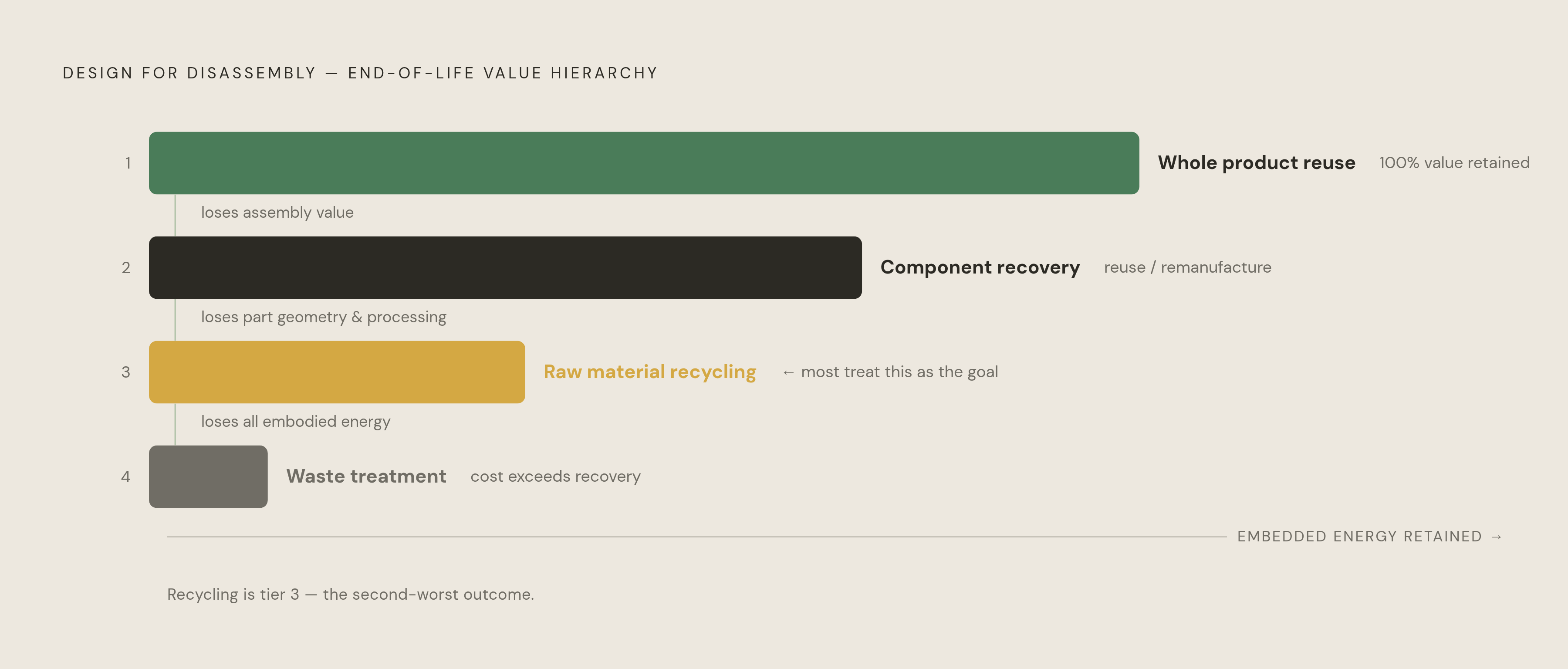
This reframing does not amount to a case against recycling programs, which remain necessary. Design for Disassembly, or DfD, imposes a value hierarchy on what happens to a product once its useful life ends, and that hierarchy puts recycling last, not first. The best outcome is reuse of the whole product. Failing that, recovery of individual components for reuse or remanufacture is the next best outcome. Only after both of those options are closed off should raw material recycling, melting a product down to recover its base materials, become the plan. Recycling is a backstop in this hierarchy, not a goal. Treating it as the goal is what leads manufacturers to build products that can only be recycled, when a different set of decisions at the design stage could have kept them, or their parts, in use.
How disassembly compares to recycling in energy efficiency
The value hierarchy above is not a matter of preference. It tracks energy cost directly. In most cases, taking a product apart uses less energy than grinding and melting its materials down for recycling, one industry analysis found, and the gap favors disassembly in case after case.
The logic is straightforward once stated. A component recovered whole, intact enough to be reused or remanufactured, keeps the energy that went into manufacturing it in the first place: the mining, refining, molding, and assembly embedded in that part do not have to happen again. Melt that same component down, and most of that embedded energy is lost. A replacement part then has to be manufactured from scratch, at full energy cost, to do the job the recovered part could have done directly. Recycling does not destroy value outright, but it throws most of the manufacturing energy away and starts over.
This has a cost consequence as direct as the energy consequence. For products never designed with end of life in mind, waste treatment often costs more than the value of whatever gets recovered from it. Harvesting valuable or critical components out of such a product is hard precisely because the fasteners resist separation or the materials were combined in ways that cannot be undone. That cost asymmetry turns DfD from an idealistic design constraint into a commercially sound one. A product built for disassembly costs less to process once it reaches end of life, and what comes out of that process, whether components or materials, is worth more. That efficiency requires specific engineering choices made well before the product ships.
The engineering decisions that make a product disassembly-friendly
Design for Disassembly is a short list of concrete engineering choices, each one either opening a path to recovery or closing it off, and each one teachable to any product team willing to apply it.
Fastener choice sits at the center of the list. Mechanical fasteners, screws, bolts, snap fits, can be removed without damaging the parts around them. Adhesives and welded joints cannot: getting past them usually means destroying something to reach what is behind it.
Material discipline matters nearly as much. Using a single material per component wherever possible, and molding material identification codes directly into plastic parts, keeps recovery options open. Mixing materials within one component, by contrast, creates a combination that cannot be pulled apart, defeating disassembly and recycling at the same time.
Modular architecture lets a single failed part be replaced on its own, rather than forcing the disposal of an entire unit because one piece in it broke. That modularity makes repair and remanufacture possible at the level of a single component, not only at the level of the whole product.
Standard tooling extends that same logic to who can do the repair. Specifying common, widely available fastener types and sizes means field technicians and independent repairers can get into a product without proprietary tools built to keep them out.
Disassembly sequence planning rounds out the list, and it is easy to overlook because it does not live in any single part. It concerns the order in which a product comes apart. A valuable component buried behind three others that all have to be destructively removed just to reach it is, for practical purposes, not recoverable at all, no matter how recyclable that component might be on its own.
A December 2025 study in Cleaner Production Letters by Hybel, Folkmann, and Ricard examined three LEGO mechatronic products, the Yellow Hub, the Large Angled Blue Motor, and the Super Mario Figure, and found clear consequences when these choices go unmade. Across those three products, the barriers to recovery included glued battery casings, hidden snap-fits, and soldered electronic clusters. Each of those choices blocked the recovery of a component that, absent that one decision, would have had real value.
Disassembly Mapping and Design Barriers
Knowing which engineering choices help or hurt disassembly is only useful if a design team can check, before a product ships, whether those choices were actually made correctly. Disassembly mapping is the method that does that checking. It traces, step by step, the full sequence of operations needed to recover a given component, and in doing so it exposes exactly where a design choice creates a blockage and where it clears a path, while there is still time to change the design.
The method starts by identifying target components, the ones with the highest recovered value, the heaviest carbon footprint in manufacture, or the most critical materials, and then works backward from there through the disassembly sequence to find what stands in the way of getting each one out.
The Cleaner Production Letters study put this to work on the three LEGO mechatronic products already discussed, producing disassembly maps that laid out the sequence of actions and target components for each, noting fastening types in some cases as well. These maps did not describe design barriers in general terms. They pointed to specific obstacles in specific products.
A parallel project at the University of Southern Denmark, run with Grundfos, Danfoss, and LEGO Group, tested a related idea: digital-twin design. A mathematical 3D model lets dimensions, surfaces, and junctions all be accounted for during the design process itself, so that decisions and tests relevant to end-of-life scenarios can be run at low carbon expense, before a single unit is manufactured. The model also stores materials-composition data that future design updates can draw on directly.
The case for doing this mapping early is a matter of what a barrier costs to fix at each stage. A barrier caught during mapping is a design change, often a trivial one. A glued battery casing found during mapping takes a note in a design review to fix. The same glued casing found at end of life takes hours of labor and specialist equipment to defeat, for a result that is worse anyway.
Disassembly as a Systems Engineering Problem
Getting every individual component right does not guarantee a product can actually be disassembled in practice. Disassembly has to be coordinated across several distinct levels of a product system at once, and decisions made at each level constrain what is possible at the levels below it.
A May 2025 review in the Journal of Cleaner Production by Formentini and colleagues frames this directly as a Disassembly Systems Engineering problem spanning five levels: component, product, subsystem, system, and system-of-systems, running from a single fastener up to the full life-cycle network the product moves through after it leaves the factory.
The number of people and organizations involved grows sharply as that scale increases. One engineer decides what fastener to use. A life-cycle network decision, by contrast, involves manufacturers, logistics partners, recyclers, and regulators all at once, none of whom have full control over what the others do.
That gap has a direct practical consequence. A product whose individual components are designed well for disassembly can still fail at the system level, if there is no infrastructure in place to collect it, no documented sequence a technician can follow to take it apart, and no economic incentive for a remanufacturer to bother recovering it. All three of those failures trace back to design-adjacent decisions that never got made.
The Nike ISPA Link trainers, built from modular parts held together by tension rather than glue, show that this logic extends well past electronics into fashion goods. They also show its limit: a disassembly-friendly object still needs a system willing and able to take it apart. Good design is necessary here, but it is not enough on its own.
That systems-level view explains the current interest in automated and robotic disassembly as a way to scale recovery. A 2026 CIRP conference paper applied graph-based decision-making models to optimize end-of-life triage decisions across a range of product types. But the limiting factor is not the sophistication of the robot. Products manufactured to be compact and tamper-proof, held together with strong adhesives, welded joints, or concealed fixings, make automated disassembly technically unworkable or too expensive to run, no matter how advanced the triage algorithm behind it is. The opportunity at the system level is only as good as the design decisions made years before any robot touches the product.
What the EU regulatory stack requires of product designers
What used to be a matter of engineering judgment is becoming, in covered product categories, a matter of law. Three overlapping EU regulatory instruments now set specific dates and specific requirements that design teams have to build into the earliest stages of development, not retrofit later.
The Energy Labelling Regulation, effective 20 June 2025, requires an A-to-E repairability score to be displayed on product labels for phones and slate tablets. Repairability is now a specification a consumer sees on the shelf, not a technical detail buried in a service manual.
The Right to Repair Directive carries a transposition deadline of 31 July 2026. It adds a legal duty to repair and extends the statutory guarantee by 12 months when a consumer chooses repair over replacement. Manufacturers have to make spare parts, repair tools, and technical documentation available to both consumers and independent repairers, with the specific documentation requirements set by the applicable Ecodesign regulations. The directive also bans software locks and other forms of hardware obstruction: manufacturers cannot use either to block or slow down an independent repair.
These rules do not stay inside Europe's borders. When a manufacturer redesigns a product to satisfy European repairability requirements, that redesign tends to show up in the same product sold elsewhere. Apple's Self Service Repair program, Microsoft's partnership with iFixit for Surface repair parts, and Google's expanding repair partnerships all trace back to this dynamic. Compliance in one market pulls design decisions earlier and more deliberately across every market the product reaches.
The Digital Product Passport as a Design-Stage Requirement
The Digital Product Passport takes DfD and adds a second obligation on top of the engineering one: a documentation obligation. Disassembly steps, material compositions, and spare-part codes now have to exist as structured data created at the design stage, not pieced together afterward from whatever records happen to survive.
Before this requirement, disassembly information, where it existed at all, tended to live scattered across internal engineering files, service manuals, or in the working knowledge of technicians who had taken the product apart by hand often enough to know its quirks. The DPP turns that scattered, often informal knowledge into a formal deliverable attached to the product itself.
That shift changes who inside a company has to be involved. DfD can no longer sit entirely with the engineering team. It now requires coordination between design, materials sourcing, documentation, and compliance functions from early in development, since all four groups touch some piece of what the passport has to contain.
The digital-twin work at the University of Southern Denmark with Grundfos, Danfoss, and LEGO Group already points toward what this will look like at scale: drawing and storing materials-composition data during the design phase is the exact upstream data practice the DPP is going to require broadly, once it takes effect.
For manufacturers selling into Europe, the passport also builds in an audit trail. If the disassembly steps recorded in a product's passport do not match how the product actually comes apart, the compliance exposure that follows is specific and direct, not a vague reputational risk.
The real barriers to adoption
None of the engineering above is unsolved. The barriers holding back wider adoption of DfD are economic and cultural, not technical.
The economic gap is the clearest of these. Despite substantial technical research and a growing base of expertise in how to design for disassembly, practical uptake across industry remains limited. For products not designed with end of life in mind, waste treatment still often costs more than whatever value gets recovered from it. The business case for DfD only closes once disassembly costs come down, recovered-component value goes up, or both happen together.
In electronics specifically, there is an unresolved tension between disassembly-friendly design and product aesthetics. Companies worry that building in DfD features will raise both design and production costs. Some go further and worry that visible modularity undermines the premium look that lets a product command a higher price. Without industry-wide benchmarks to settle what disassembly-friendly design should cost or how it should look, manufacturers weigh these tradeoffs individually, and adoption stays uneven across companies and product categories.
Sources
- Design for Disassembly: An analytical method for assessing target components for remanufacturing - ScienceDirect
- A review of disassembly systems for circular product design - ScienceDirect
- State-Augmented Graphs for Circular Economy Triage
- Frontiers
- EU Right to Repair Directive What Manufacturers Need to Know
- New Ecodesign Regulation for Smartphones and Tablets: a strategic opportunity for refurbishment - Recommerce Group - Le pionnier européen du reconditionné