EPR Regulations Across the European Union
EU rules shift producers from polluters to payers, but implementation gaps remain wide.
Extended Producer Responsibility means the companies that make and sell products, not the cities that eventually deal with the trash, pay for what happens to packaging, gadgets, and clothes once consumers throw them out. In the EU, that idea has grown from a single 1994 directive about packaging into a five-stream system covering packaging, electronics, batteries, vehicles, and, as of October 2025, textiles. The mechanism is simple in theory: a producer pays a per-unit fee that funds collection, sorting, and recycling infrastructure that used to come out of municipal budgets. The execution across 27 Member States is where things get complicated, and that gap between the shared legal floor and the messy reality on the ground is what this piece is trying to map out.
Start with the legal anchor. Article 8 and Article 8a of the Waste Framework Directive (2008/98/EC) set the baseline every national EPR scheme has to clear. Article 8a, bolted on during the 2018 revision, lists the minimum requirements: producer registration, reporting obligations, financial contributions, and oversight of the Producer Responsibility Organisations, or PROs, that actually run these schemes day to day. What that floor guarantees is a common skeleton across all 27 countries. What it does not guarantee is any agreement on fee levels, registration paperwork, or how hard a regulator will come after a company that misses a deadline. Those diverge, and they diverge by a lot, which later sections in this piece will get into with actual numbers rather than vague gestures at "variation."
One concept worth sitting with before going further: eco-modulation. Article 8a already embeds the principle that fees should track how recyclable or sustainable a product is, not just how many units got sold. A company selling a fully recyclable steel can and a company selling a snack pouch made of six laminated plastic layers should not, in theory, pay the same fee per item. That principle stays fairly abstract in the original Waste Framework Directive. It gets sharper teeth in every regulation that follows, which is a pattern worth watching as this piece moves stream by stream.
The five product streams EU EPR now covers, and how the architecture grew over time
Packaging came first, with roots stretching back to the mid-1990s. For a long stretch, EPR meant four pillars: packaging, electrical and electronic equipment (known as WEEE), batteries, and end-of-life vehicles. Then, with the October 2025 revision of the Waste Framework Directive, textiles and footwear joined as a fifth stream, confirmed and dated, not speculative.
Each stream runs on its own instrument, its own product definitions, its own collection or recycling targets, and its own compliance calendar. A company that sells electronics packed in cardboard and shipped with a spare battery is not dealing with one obligation; it is juggling three, each with different registration bodies and different reporting windows.
The more interesting shift is legislative form, not scope. The older streams (packaging, WEEE, the original battery rules) ran as directives, meaning each Member State had to transpose them into its own national law, with all the drift and local flavor that implies. The newer instruments, the Batteries Regulation and the Packaging and Packaging Waste Regulation (PPWR), apply directly and uniformly across the bloc without that translation step. That is a deliberate design choice, an attempt to stop the fragmentation that directives invite. Whether it actually works is an open question this piece will circle back to.
Worth a quick footnote: single-use plastics run under their own separate rules that touch packaging EPR obligations constantly in practice. A plastic cutlery set and a plastic packaging film can trigger overlapping rules depending on how they are classified and sold.
Packaging EPR: from a 1994 directive to a directly applicable 2025 regulation
Packaging is the oldest stream and, fittingly, the one that shows the clearest arc from loose directive to tight regulation. The original 1994 Packaging and Packaging Waste Directive did not actually require EPR schemes; it took the 2018 revision to bolt that obligation on, with a hard deadline of 31 December 2024 for every Member State to cover all packaging, industrial and commercial included, not just consumer packaging.
Then came the big one. The PPWR, formally Regulation (EU) 2025/40, entered into force on 11 February 2025 and starts applying from 12 August 2026. It replaces the old directive outright. Because it is a regulation rather than a directive, its core provisions apply the same way in all 27 Member States without a national transposition step in between. That is the single biggest harmonization move packaging EPR has seen since the concept existed.
Why now? Eurostat's 2023 data put EU packaging waste generation at 79.7 million tonnes, or 177.8 kg per inhabitant. That is a genuinely enormous number, though it is worth noting it was already 8.7 kg per capita lower than the year before, a small early signal that policy pressure is doing something. Plastic packaging alone generated 35.3 kg per person in 2023, of which 14.8 kg got recycled, a rate the PPWR's recyclability mandate is explicitly built to push higher.
The regulation's requirements are specific rather than aspirational. National registers of producers go live under Article 44 to monitor compliance. Article 46 sets up eco-modulation of EPR fees tied to recyclability performance grades. The Commission is due to adopt delegated acts on recyclability assessment criteria by 1 January 2028, with eco-modulated fees expected to actually apply around mid-2029. Packaging waste reduction targets are set against a 2018 baseline: 5% by 2030, 10% by 2035, 15% by 2040. All packaging is supposed to be recyclable by 2030. Deposit-and-return systems become mandatory for certain single-use beverage containers from 2029, and certain single-use plastics get banned outright from 1 January 2030, with defined exemptions carved out.
One structural addition worth pausing on: online marketplaces are now explicitly named as responsible actors when they handle packaging or logistics for third-party sellers. That extends EPR obligations well past traditional manufacturers into the platforms that move goods for other companies, a meaningful widening of who counts as "producer."
And the leaders-versus-laggards picture is already visible in the data. Per Eurostat's 2023 figures, Belgium, the Netherlands, Italy, Czechia, Slovenia, Slovakia, and Spain already recycle more than 70% of packaging waste, clearing the 2030 target years early. Another six countries sit above 65%. For those countries, the PPWR targets are basically a formality. For the countries sitting well under 65%, the same targets look like a genuine climb.
WEEE: a directive that set ambitious targets most Member States have not met
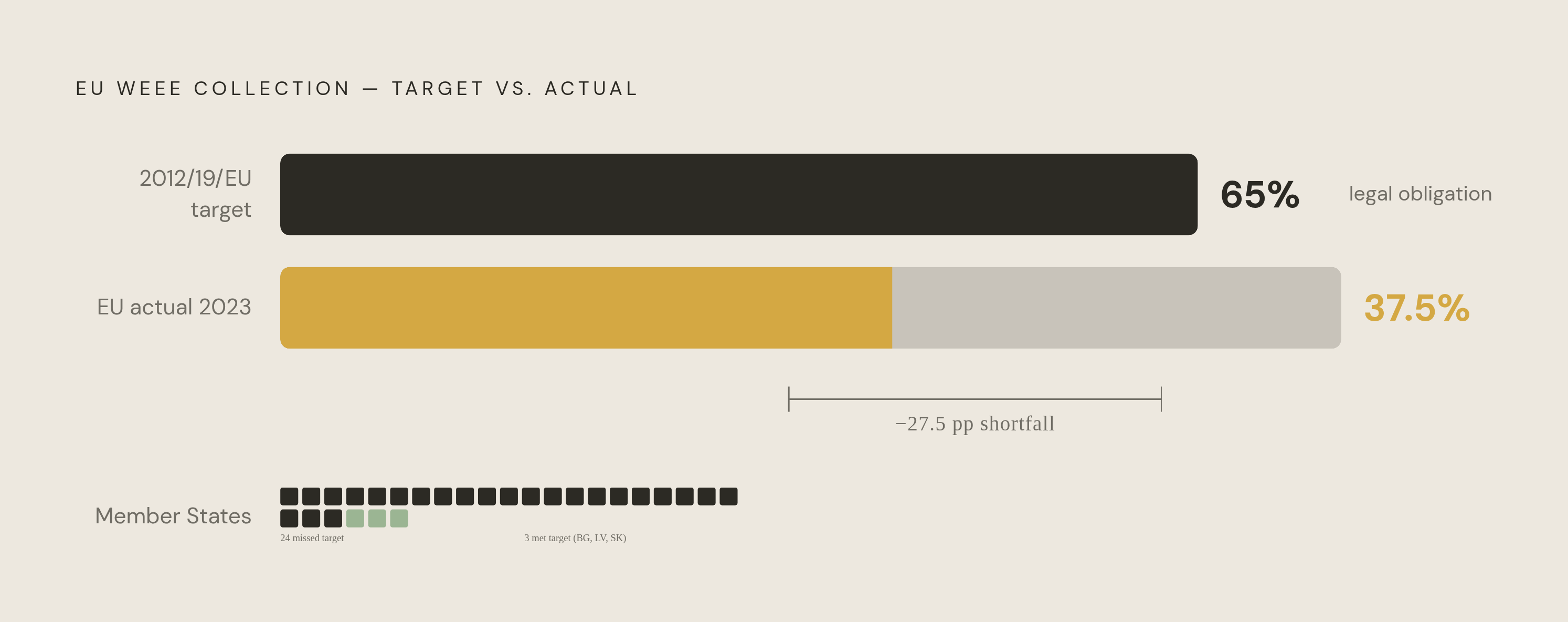
If packaging is the stream showing what tightening regulation looks like in motion, WEEE is the stream showing what happens when targets outrun reality. The governing instrument, the WEEE Directive (2012/19/EU), covers electrical and electronic equipment across multiple categories and sets a legal collection target of at least 65% of what was placed on the market over the previous three years.
The actual number, per Eurostat's 2023 data: 37.5%. Roughly half the target. Only three Member States, Bulgaria, Latvia, and Slovakia, hit the 65% mark in 2022, according to the European Commission. Twenty-four out of 27 countries missed their legally binding targets. That is not a close miss on the margins; that is most of the bloc failing a rule that has been on the books for over a decade.
Part of the problem is that the denominator keeps growing. More than 14.4 million tonnes of electrical and electronic equipment got sold across the EU in 2023, an increase of over 89% since 2012. Selling more phones, laptops, and appliances means the 65% target has to chase a bigger number every year, like trying to keep a fixed percentage of water in a bathtub with the drain slightly open and the tap running faster than it used to.
The other part of the problem is what happens after collection. Even the WEEE that does get collected does not necessarily get handled properly: 46% of collected WEEE is still not being properly treated, ending up as metal scrap or getting illegally exported instead of processed through certified recycling channels. Only 23% of recycling facilities meet the prescribed EU quality standards. Add in consumer hoarding of old devices and illegal export flows, and the measured collection number understates the real waste problem while overstating how close the system is to fixing it.
The Commission's 2025 evaluation flagged more gaps beyond the headline miss: not enough scope for new waste streams rich in critical raw materials, weak recovery of those materials, and EPR systems that stay fragmented country to country rather than converging. A WEEE Directive revision is expected under the forthcoming Circular Economy Act, which means anyone treating current WEEE obligations as a stable, finished rulebook is planning around a floor that is likely to move.
Batteries and end-of-life vehicles: two streams undergoing major regulatory resets
Two of the four original pillars are getting rebuilt from the ground up, and both moves follow the same script as packaging: directive out, regulation in.
Batteries first. Regulation (EU) 2023/1542 fully replaced the old Batteries Directive (2006/66/EC) starting 18 August 2025. Article 56 puts EPR obligations on all battery producers, including those who prepare batteries for reuse or repurposing, a noticeably broader definition of "producer" than the old rules used. Every company placing batteries on a given Member State's market has to register there, either directly or through what is called an EPR Authorised Representative. New elements show up that the old directive never touched: a battery passport for certain categories, tighter collection rate targets, and durability and performance requirements, with EPR obligations phasing in progressively across 2024 through 2027.
End-of-life vehicles are moving on a similar track, just slightly behind. The existing framework, the ELV Directive (2000/53/EC), focuses on preventing waste and improving environmental performance across a vehicle's lifecycle, alongside pushing reuse and recycling. On 18 June 2026, the European Parliament approved a new ELV Regulation, closing out years of negotiation. The Commission's preferred design brings in EPR requirements meant to raise ELV collection rates and cover treatment costs that cannot be clawed back from the resale value of recycled materials and parts. Like batteries and packaging before it, this is a directive-to-regulation swap, and the intent is the same: less national fragmentation, more uniform application.
Two streams, two resets, one clear pattern: the EU has decided directives were too loose a leash, and regulations are the tighter one.
Textiles: the newest stream, with a firm EU deadline but uneven national readiness
Textiles is the newest arrival and the one still finding its footing. The revised Waste Framework Directive entered into force on 16 October 2025, creating for the first time an EU-wide EPR obligation for textiles and footwear. Member States get 20 months to transpose the revision into national law and 30 months to get operational schemes running, which points toward live textile EPR schemes across the EU by late 2027 or 2028. Producers pay a per-item fee on what they place on the market, eco-modulated by circularity and sustainability criteria, the same logic already at work in packaging and batteries.
Except several countries did not wait for the EU deadline to show up. Some Member States moved early, establishing national textile EPR schemes ahead of the harmonized requirement.
That spread, early movers running live schemes while others sit and wait for the 2027-2028 deadline, is not a new story. It is almost exactly what happened with packaging EPR a decade earlier. For a producer, it previews the same compliance headache: adapting to national schemes that predate the EU-wide requirement, then reconciling those with whatever the harmonized version eventually demands.
How dramatically national implementation diverges despite the shared EU framework
Here is the part that turns theory into a spreadsheet problem. Every Member State runs its own PRO, its own registration process, its own reporting format, and its own fee schedule. A producer selling into ten EU markets is not filling out one form ten times; it is running ten separate compliance tracks that happen to share a legal ancestor.
The operating models themselves differ in ways that are not cosmetic. France and Germany, for instance, have built genuinely different national systems on top of the same EU floor, with distinct approaches to how PROs interact with waste management infrastructure.
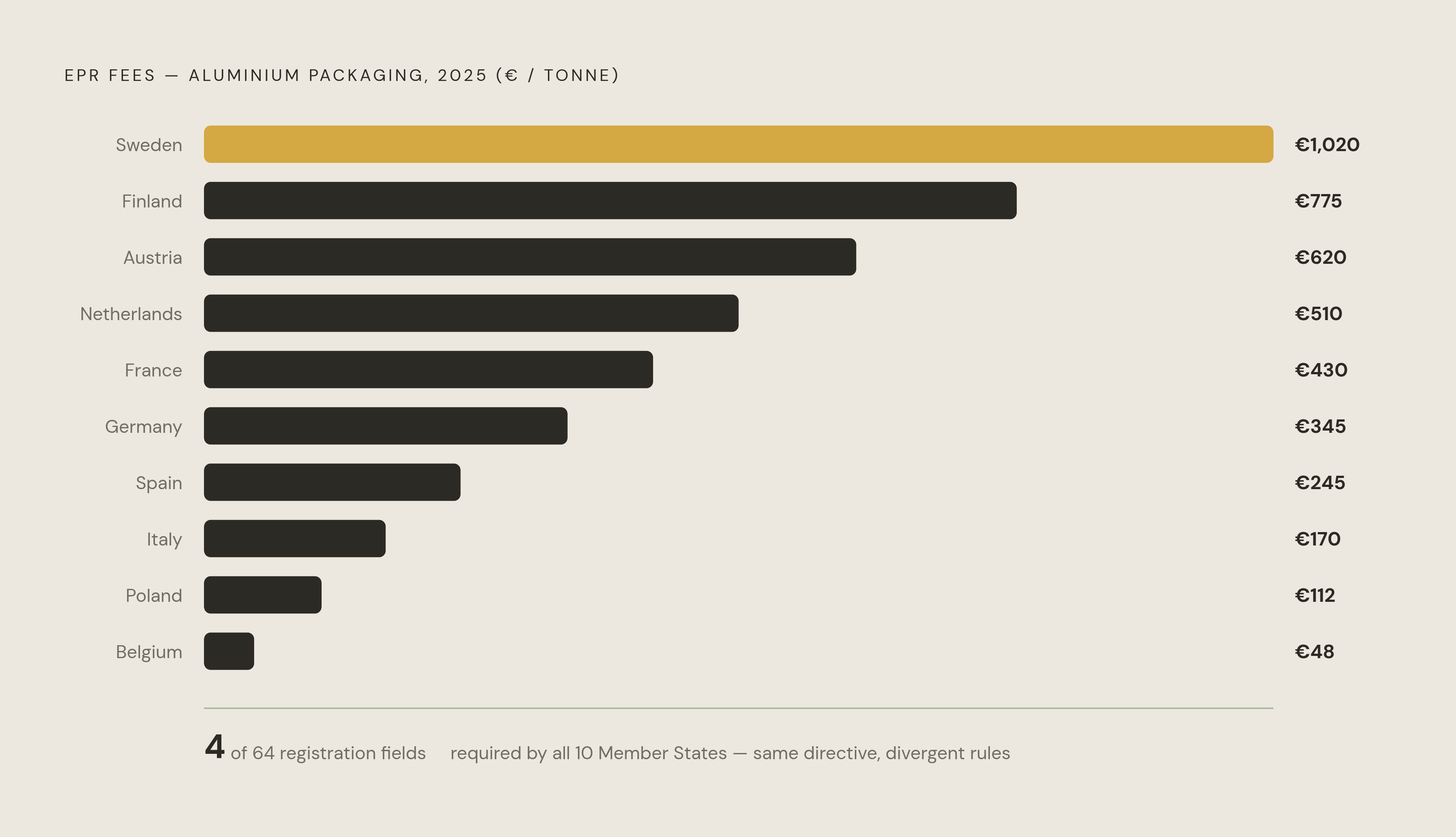
A March 2026 study walked through the actual registration process across ten Member States and counted 64 unique registration fields in total. Only 17 of those align with the PPWR's draft implementing act, roughly a quarter. The rest are national add-ons with no basis in EU law at all, meaning three-quarters of the paperwork a producer fills out exists because a specific country decided it should, not because Brussels asked for it. Fields required per country ranged from 11 in Belgium and Spain up to 21 in Sweden. Only four fields showed up as required by all ten countries surveyed. That is the harmonization gap in a single number: four shared fields out of 64 total.
Fees tell a similar story, arguably a louder one. Aluminium packaging fees in 2025 range from roughly €48 in Belgium to over €1,000 in Sweden, with most countries landing somewhere in between, according to country comparison data from netzerocompare.com. That is not a small spread; that is a factor of twenty between two EU members operating under the same framework directive.
France's CITEO scheme shows what eco-modulation looks like once a country takes it seriously rather than treating it as a checkbox. Glass packaging fees sit substantially lower than fees for hard-to-recycle plastics, and bonuses are available for using recyclate sourced from difficult waste streams. That is a real financial lever pushing product design decisions, not a symbolic sustainability gesture bolted on for a press release.
The PPWR's shift from directive to regulation is supposed to close this gap over time. But the March 2026 study makes clear that national additions are still showing up even as the regulation moves toward full application, which suggests the fragmentation shrinks gradually rather than disappearing the moment the PPWR's application date arrives.
What producers selling into multiple EU markets need to understand about compliance structure
A few operating realities fall out of everything above, and they are worth stating plainly rather than dressed up as strategy jargon.
"Producer" is defined broadly across every EU EPR stream. It covers manufacturers, importers, and distance sellers, not just the company whose name is stamped on the box. Registration has to happen in each Member State where products actually get placed on the market; there is no single EU-wide registration that covers all 27 countries at once, despite the PPWR's harmonization ambitions. Companies based outside a given Member State, or lacking a legal entity there, can appoint an EPR Authorised Representative to handle registration and reporting on their behalf, a common workaround for non-EU sellers and for EU companies expanding into new markets.
Reporting cadence and format differ by country and by stream, and the 64-field fragmentation documented in the Amazon-commissioned study is not a future risk; it is the compliance reality producers are already navigating. Fee planning has to account for where eco-modulation is headed, not just where it sits today. Packaging fees under PPWR are expected to reflect recyclability performance grades around mid-2029, which means product design choices made now, this year, will determine which fee band a product lands in once that system goes live. Batteries and textiles skip that lag; eco-modulation is built into both frameworks from day one.
Across all five streams, the direction is consistent: targets get stricter, the definition of "producer" gets wider, directives keep turning into regulations, and eco-modulation keeps getting less optional. A compliance strategy built to satisfy today's minimum obligations is, by construction, a strategy that needs revisiting on a rolling basis, not a one-time project. Mapping out which streams apply to which products in which markets before registration starts, rather than reacting country by country as deadlines land, is the version of this that avoids duplicate paperwork and avoids the fee surprises that show up when a product's recyclability grade gets assessed under a delegated act nobody read closely enough in 2026.