What EPR Means for Businesses
Producers nationwide now face packaging waste fees as EPR laws spread across states.
Extended producer responsibility flips the bill for packaging waste from taxpayers to the companies that made the packaging in the first place. Seven U.S. states have already passed laws requiring this, and the list is growing fast enough that "not my problem yet" is quickly becoming "not my problem, said no compliance officer ever." This piece walks through what EPR actually requires, who it applies to, what it costs, and why the answer to "does this apply to me" is a lot messier than most businesses assume.
Seven states have enacted packaging EPR laws, with more actively moving through legislatures
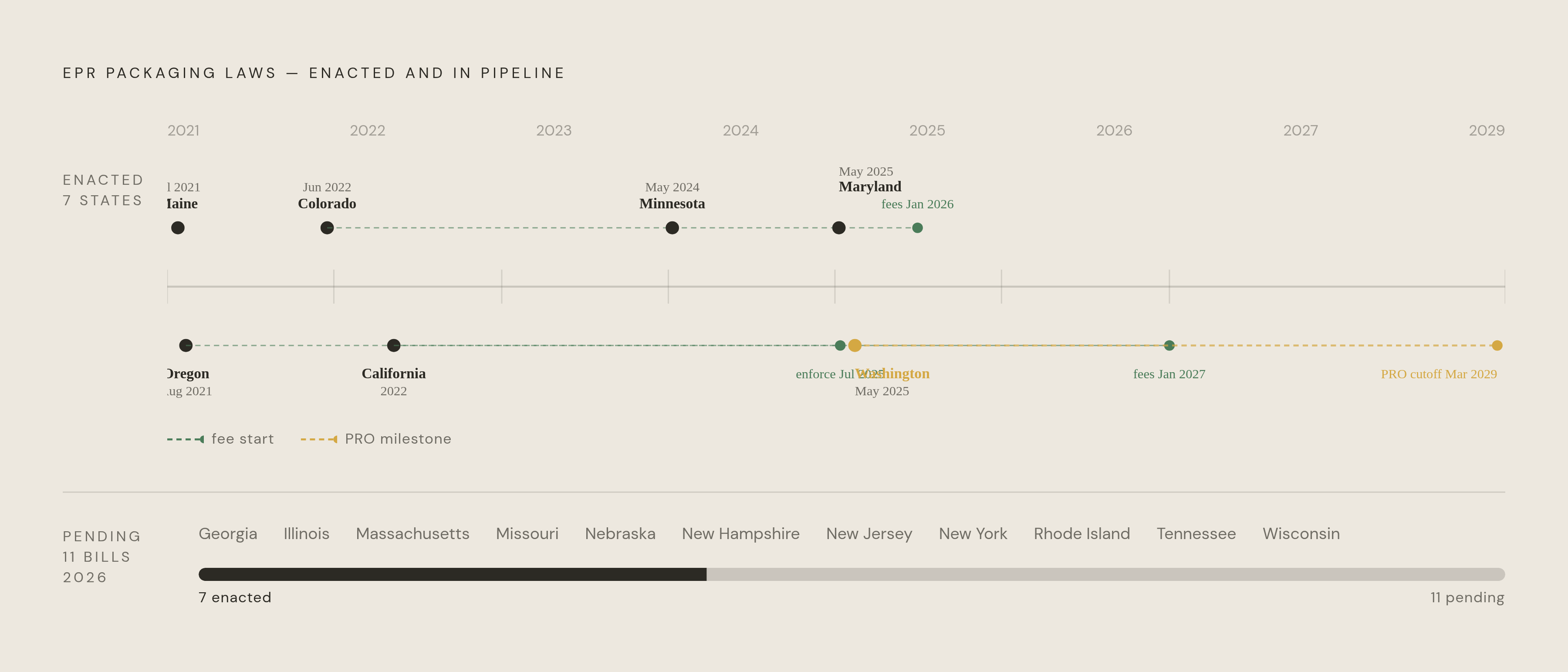
Maine got there first. LD 1541, signed July 12, 2021, set up a municipal cost-reimbursement model, meaning producers pay cities and towns back for what they already spend sorting and hauling packaging waste. It's a tidy approach, administratively speaking, but it wasn't the template other states picked up.
Oregon signed on less than a month later, on August 6, 2021, and did something Maine didn't: it required producers to fund and join a Producer Responsibility Organization, or PRO, a state-approved nonprofit that manages recycling on their behalf. That PRO structure became the model almost everyone since has followed. Oregon's program moved from planning into actual enforcement on July 1, 2025, which matters a great deal for the next section of this piece.
Colorado followed in June 2022 (HB 22-1355), largely mirroring Oregon, with fee obligations kicking in this coming January 2026. California's SB 54, also from 2022, is still having its implementation rules revised, with fees starting January 2027 and a recycling target of 65% by 2032. Minnesota signed its law in May 2024. Maryland followed in May 2025, with a notable twist: multiple PROs can operate at once there, rather than the single-PRO model most other states use. Washington rounded out the seven with SB 5284, enacted May 17, 2025, requiring producers to join a PRO in 2026, with a hard market-access cutoff for nonmembers after March 2029.
That's the enacted list, and it's not where the story ends. Bills are active right now in Georgia, Illinois, Massachusetts, Missouri, Nebraska, New Hampshire, New Jersey, New York, Rhode Island, Tennessee, and Wisconsin, all introduced for the 2026 session. No federal packaging EPR program exists to unify any of this, so the practical planning horizon looks something like: expect additional states to pass laws within two to three legislative sessions, and expect the first compliance obligations to land 12 to 24 months after enactment. Eleven more states with active bills is not a rounding error. That's a wave, and it's already cresting.
Whether your business qualifies as a "producer" under these laws is less obvious than it sounds
Here's the part that trips up more companies than the fee schedules do. EPR laws don't care where a business is headquartered. They care about who places covered packaging on the market inside that state, and physical presence isn't a requirement for being on the hook.
Most states use a tiered definition. The brand owner or manufacturer is primarily responsible. If neither can be identified, responsibility shifts to the licensee, importer, or distributor. Some states add a catch-all, pinning responsibility on the retailer or whoever made the first sale into the state. It's a chain of "well, if not you, then who," and it's built specifically so nobody slips through.
E-commerce gets called out explicitly, and this is where a lot of businesses discover they're producers without ever selling a single item off a shelf. Minnesota, Oregon, and Maryland all specify that packaging used in online or remote sales counts, with the party doing the packing and shipping treated as the producer of record. Colorado and Oregon extend producer definitions broadly to capture online sales and the packaging used to fulfill them. A company based in Texas with zero retail footprint in Oregon can still owe Oregon fees the moment it ships a padded mailer to a customer in Portland. That's not a loophole. That's the point of the design.
So the first move, before anything about fees or reporting, is figuring out producer status under each state's specific statute. Skip that step and everything downstream gets built on a wrong assumption.
What producers are actually required to do once they're covered
Once a business is a covered producer, the obligations follow a fairly consistent pattern across states, even if the specific numbers differ.
Registration comes first, followed by joining a state-approved PRO. Individual compliance plans exist on paper in most states, as an alternative to PRO membership, but they're widely considered impractical outside of the largest producers, given the complexity and cost of running one solo. Oregon and Minnesota didn't bother preserving the fantasy: they eliminated the individual-plan option entirely.
Annual fees follow, calculated on the quantity, weight, toxicity, or recyclability of the packaging placed on the market. Then come the reports: periodic filings broken out by material type, weight, and geography, documenting what packaging went out and what happened to it at end of life. Some states tack on consumer labeling requirements or third-party audits for good measure.
The Circular Action Alliance, or CAA, is currently the approved PRO administrator operating across multiple enacted states, including California, Colorado, Oregon, Minnesota, Maryland, and Washington. That concentration of states relying on one organization's cost model and methodology makes CAA's approach something close to a de facto national standard, whether or not that was the original intent. Some states have not yet finalized all PRO arrangements, so producers in those states are, for the moment, watching and waiting.
The scale here is not small. Over 1,700 producers submitted reports by Oregon's March 31, 2025 deadline, with more filing during the grace period after. That's a lot of spreadsheets, and behind each one is a company that had to figure out, often for the first time, exactly what its packaging was made of and how much of it existed. Companies need audit-ready data on material type, weight, recyclability, reusability, and compostability, for every state where they sell. If that sounds like it might require new inventory or logistics systems, it often does.
How EPR fees are calculated and what they will cost
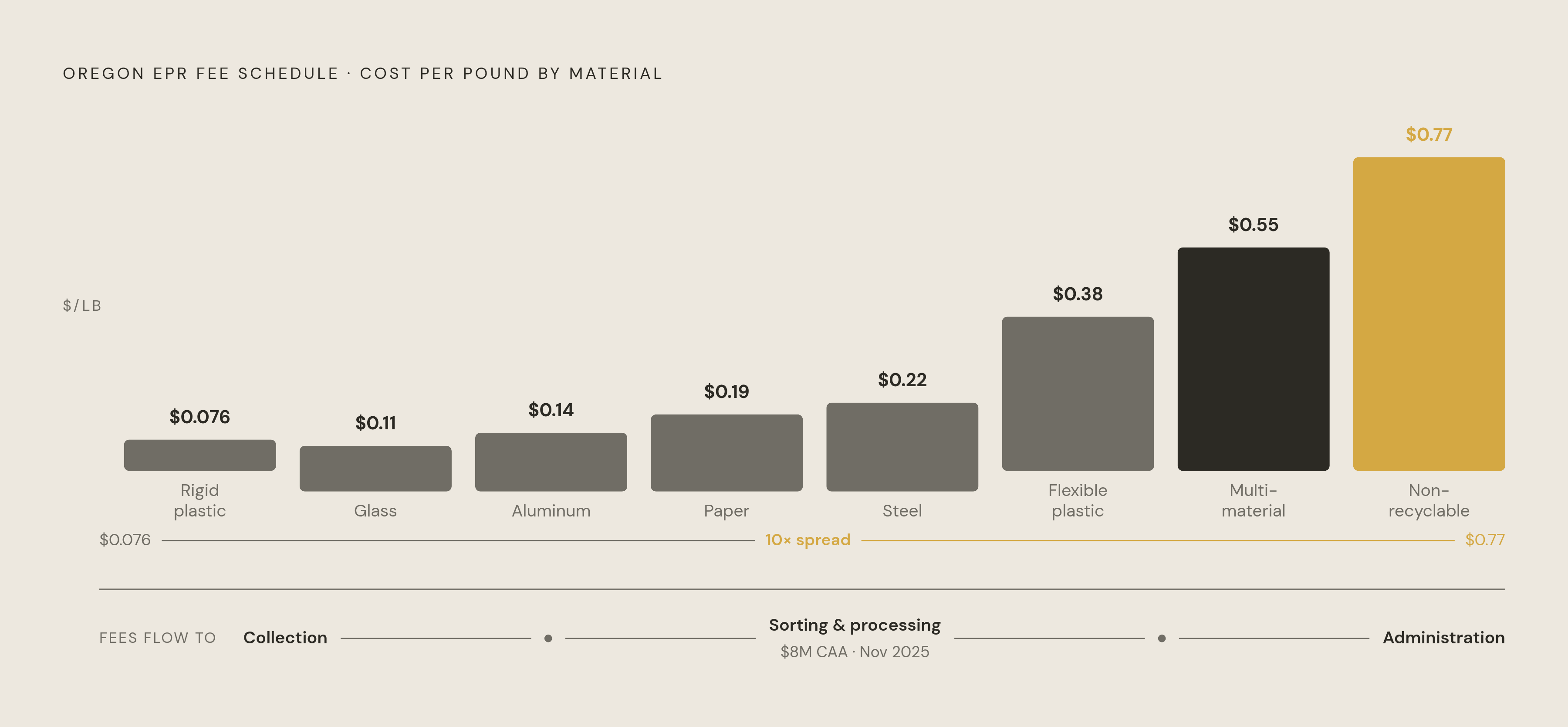
Fees break into three categories. Base fees are a flat per-weight charge on a material category, so the more packaging a company puts into the market, the more it pays; simple multiplication, no surprises. Modulated fees stack on top of the base, and this is where things get interesting: they're designed to reward packaging that's easier to recycle and punish packaging that isn't. Flat fees exist as a simplified option for small producers in most states, trading precision for administrative ease.
Oregon is currently the only state with a finalized fee schedule, and the range runs from $0.076 to $0.77 per pound of covered material, depending on what that material is. That's roughly a tenfold spread between the cheapest and most expensive categories, which tells you the material choice matters as much as the volume.
Those fees fund three things: collection, post-collection sorting and processing, and program administration. It's not an abstract pool of money sitting somewhere. In November 2025, CAA distributed $8 million to recycling sorting facilities to help fund infrastructure upgrades following Oregon's program launch, a fairly direct illustration of where producer fees actually go.
The modulated structure is really the whole game, strategically speaking. Packaging that hits recyclability, recycled-content, or material criteria pays less. Packaging that's hard to recycle, or uses hazardous substances, or skimps on recycled content, pays more. That means packaging redesign stops being a sustainability talking point and becomes a line item on the finance team's spreadsheet. States have also attached collective recycling targets to all this: California wants 65% by 2032, Colorado is aiming for roughly 45% by 2035, and Oregon has set a long-horizon target of 70% by 2050. Producers, collectively, are the mechanism for hitting those numbers.
What happens when businesses don't comply, and how enforcement differs by state
Penalties are not uniform, and the range is wide enough to make a compliance manager's blood pressure spike differently depending on zip code. Maine runs $100 to $10,000 per day, with escalation for repeat offenses. Oregon, which began actual enforcement on July 1, 2025, can charge up to $25,000 per day. Washington carries a maximum fine of $10,000 per violation for failure to join a PRO or comply with reporting requirements.
Money isn't the only consequence. Colorado and Oregon can simply bar non-registered producers from selling covered products in the state at all, which turns a compliance failure into a market-access failure. Washington's version of that same mechanism arrives a bit later, cutting off nonmembers after March 2029.
Underreporting comes with its own particular flavor of pain: fines, back fees owed retroactively, and the reputational mess of having gotten caught fudging environmental numbers in an era when that sort of thing tends to circulate. Enforcement itself splits between state agencies, which set the minimum program requirements and hand out penalties, and the PROs, which manage day-to-day compliance at the producer level.
Worth sitting with for a second: Oregon's enforcement isn't a future risk anymore. It started in July 2025. For any business selling into that market, this has already shifted from "something to keep an eye on" to "something happening right now."
Small businesses face a different compliance calculus under EPR
Most state statutes carve out small-producer thresholds, usually pegged to annual revenue or total packaging weight. California's exemption threshold suggests companies with less than $1 million in gross sales will be exempt.
Falling under the threshold doesn't mean walking away scot-free, though. Small producers in many states still have to file a report, just a simplified one, without the accompanying fee. It's less homework, not no homework.
And here's the wrinkle that catches people off guard: thresholds aren't consistent state to state. A company that's exempt in one state might be a fully covered producer in another, depending on how each state defines the cutoff and how much packaging that company ships into each market. There's no shortcut that lets a small business assume its size protects it everywhere at once; the analysis has to run state by state; This is, frankly, a design feature rather than a bug: uniform thresholds would let big multi-state shippers game the system by fragmenting operations, so each state guards its own definition. Small and mid-size businesses still absorb real costs here too, particularly around packaging redesign or navigating PRO membership paperwork, even when the fee itself ends up being modest.
Packaging EPR is part of a broader expansion of producer responsibility across product categories
Packaging isn't where EPR started, and it won't be where it ends. Twenty-five U.S. states already maintain electronics recycling programs, and the approaches vary enough between states that a single television model sold nationwide can face a different registration process, a different reporting format, and a different fee structure depending on where it's sold. Packaging EPR is walking straight into that same fragmented terrain, just a few years behind.
Textiles are next in line. Textile EPR legislation is advancing in California and other states, putting it on a timeline that's practically knocking on the door already.
Companies with any international footprint have a second front to track. The EU's updated Packaging and Packaging Waste Regulation has entered into force and is set to apply in the coming years. It requires all packaging on the EU market to be recyclable by 2030, using harmonized design-for-recycling criteria, and from 2030 packaging must meet defined recyclability performance standards. Eco-modulated fees become mandatory across all 27 member states, and producers have to register in national EPR registers in each member state where they sell. A single product in the EU can trigger obligations under packaging rules, the WEEE electronics directive, and battery regulations all at once. That layering is worth paying attention to, because it's a reasonably good preview of where U.S. multi-state compliance is headed as more categories and more states stack on top of each other.
EPR, in other words, is becoming a standard cost of doing business across categories and across borders. It's not a packaging quirk, and it's not a uniquely American one either.
Building a compliance infrastructure before more states go live
None of this is workable as a scramble two weeks before a deadline. The businesses handling EPR well are treating it as an operational build, not a legal fire drill, and that build breaks down into a few concrete moves.
Start by determining producer status in every state where the business sells, including the e-commerce and distributor relationships that often get overlooked. Then audit the packaging itself: material type, weight, recyclability, recycled content, for everything shipped, because that data is what drives both the fee calculation and the reporting requirement. Check small-producer thresholds state by state rather than assuming size provides blanket protection anywhere. Get in touch with CAA or the relevant PRO early, since CAA's role across five of the seven enacted states means its methodology and timelines are functioning as the compliance calendar for most large producers whether they like it or not. And look hard at packaging design against the modulated fee criteria each state has published or is developing, because redesigning packaging now is a structural way to lower EPR costs later, rather than just reacting to a bill after it arrives.
Monitoring doesn't stop once those five steps are done, either. With bills active in more than ten additional states heading into 2026, and first obligations typically landing 12 to 24 months after a law is signed, the legislative calendar itself functions as an ongoing compliance input, not a one-time check. Most businesses don't currently keep packaging records at the granularity these laws demand, and building that data infrastructure takes real lead time.
The companies that come out ahead here are the ones giving EPR compliance a clear owner, running regular internal audits, and folding packaging decisions into product development from the start, rather than treating the whole thing as a deadline-driven legal exercise handled once a year in a panic. Given how many states are still moving through this process, that distinction is likely to matter more, not less, over the next few legislative cycles.