Impact Measurement Tools for Sustainability Teams
Sustainability teams need four different tools, not one catch-all platform.

Sustainability teams now have dozens of platforms to choose from, and most of them solve completely different problems while sounding like they solve the same one. That's the actual bottleneck: not a shortage of tools, but a shortage of clarity about which measurement job each tool was built to do. Regulatory deadlines are converging fast enough that the old approach, a spreadsheet updated once a year and a PDF handed to the board, no longer covers what's being asked.
The regulatory picture has real teeth now. A regional reporting mandate already requires detailed environmental disclosures across the EU, and starting in 2026, China, Hong Kong, and Singapore are rolling out mandatory ESG reporting broadly aligned with a global sustainability standards body. Japan's version, the SSBJ standard, stays voluntary through 2026 before becoming mandatory for the largest listed companies in fiscal year 2027. At the same time, the EU's Omnibus simplification package is set to exempt a large share of companies from CSRD and CSDDD obligations, which sounds like relief until you notice that investors, lenders, and business partners haven't lowered their own expectations to match. Legal requirements are loosening in one direction while commercial pressure holds steady in the other. More than $40 trillion in assets under management now factor in sustainability criteria, and a majority of consumers, 73% by recent count, say they'll pay more for products that can actually back up a sustainability claim. Verdantix's 2026 predictions state that greenwashing scrutiny is only sharpening the demand for real evidence: "greenhushing," inconsistent CSRD reporting quality among early filers, and a rise in third-party verification services are all raising the bar for what counts as adequate proof.
The four distinct measurement jobs sustainability teams need to fill
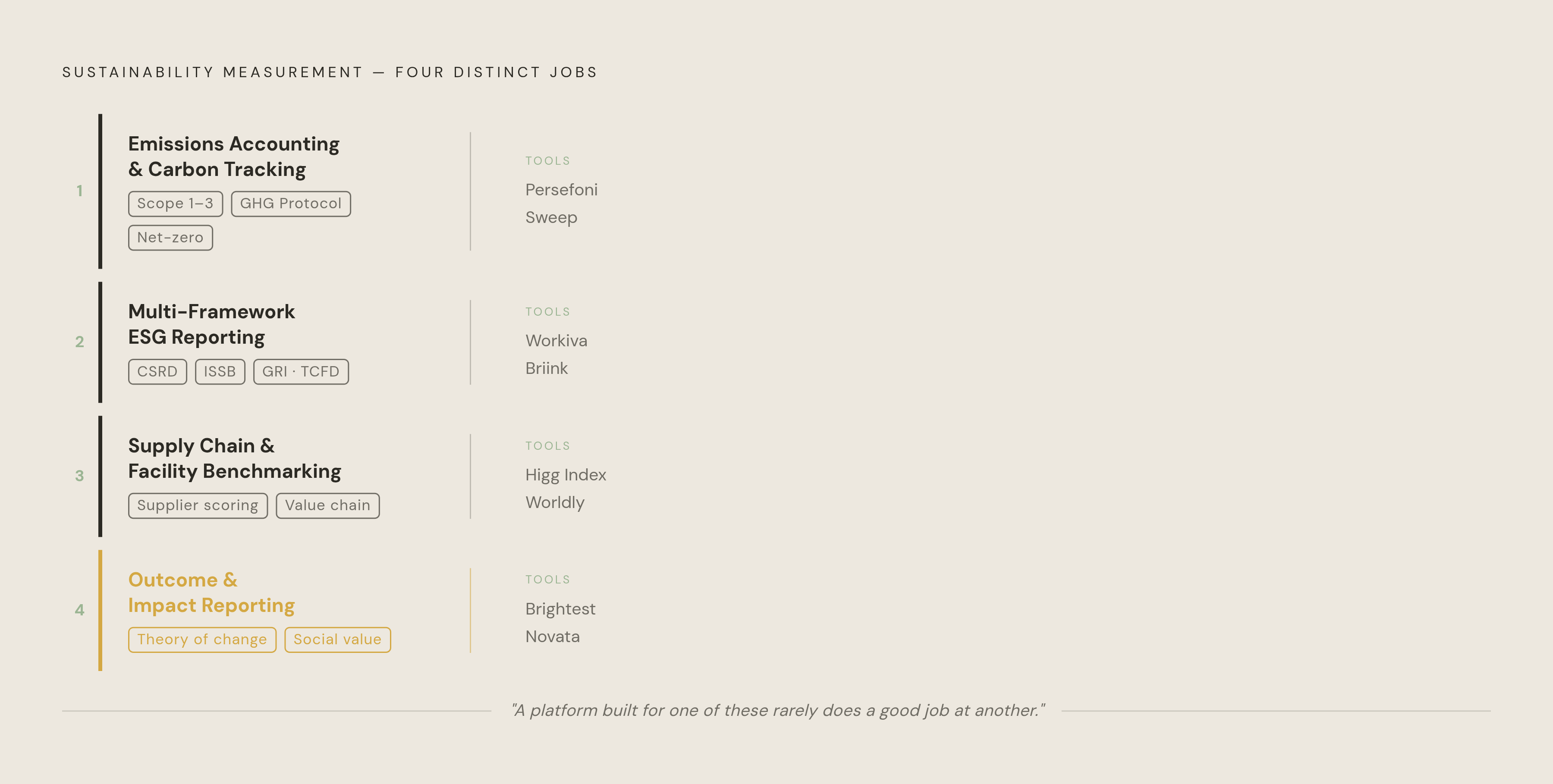
Most teams treat "impact measurement" as one job. It's actually four, and each one calls for a different kind of tool.
The first is emissions accounting and carbon tracking: Scope 1, 2, and 3 data, alignment with the GHG Protocol, and net-zero target setting. The second is multi-framework ESG reporting, covering CSRD, ISSB, GRI, and TCFD compliance, pulling data from scattered sources into something audit-ready. The third is supply chain and facility-level benchmarking: supplier engagement, facility-level environmental and social scoring, and mapping a value chain end to end. The fourth is outcome and impact reporting: program-level evidence, social value calculations, grantee reporting, and theory-of-change logic for funders and boards.
A platform built for one of these rarely does a good job at another. A carbon accounting tool isn't a supply chain benchmarking system, and a procurement social value tool won't get you anywhere close to a defensible Scope 3 number. Before comparing features, teams need to answer two questions: which frameworks must the output satisfy, and who actually reads the result, regulators, investors, procurement buyers, or an internal sustainability committee? Regulatory pressure is pushing especially hard on the multi-framework reporting category right now, since ISSB, CSRD, GRI, and TCFD coverage combined with automated carbon accounting and Scope 3 tracking is where most compliance risk sits. Teams operating in regulated jurisdictions should weight framework coverage above almost everything else.
Tools built for emissions accounting and carbon tracking
Persefoni is a carbon accounting platform designed for emissions tracking and climate disclosure. It's designed for self-service onboarding, so a team doesn't need deep framework expertise walking in, and the company's own blog states that as of January 2026 it supports regulatory-grade reporting and climate disclosure requests directly.
Sweep is an emissions tracking and reporting platform focused on value chain coverage. It added generative AI-powered CSRD compliance features back in March 2024, ahead of much of the market.
For teams earlier in the process, Open-climate.ai maps procurement data straight to emissions factors and outputs a spreadsheet ready to feed into a full carbon accounting platform. It's currently in early-access request stage, as of an August 2026 Trellis update. The UK ESG Institute's free carbon footprint calculator goes further than most no-cost tools by accepting detailed Scope 3 category breakdowns, and every emissions factor traces back to a named, regularly updated source, a detail that matters once auditors start asking questions. ChatNetZero is an AI chatbot focused on greenhouse gas emissions questions, and it discloses its own energy use per query, an unusual bit of transparency for a chatbot.
Choosing in this category comes down to how deep Scope 3 coverage needs to go, whether the tool aligns cleanly with the GHG Protocol, how much supplier data collection is built in, and whether audit-grade controls matter for regulatory filings. Organizations that implement proper tracking tools typically see environmental impact drop 15 to 30% within the first two years, with investment starting at roughly $50,000 for a small business using a specialized tool, scaling up significantly for enterprise-wide deployments.
Tools built for multi-framework ESG reporting and compliance
Workiva is built for teams drowning in disjointed data and manual processes, connecting cloud and on-premise sources into one picture rather than forcing analysts to reconcile spreadsheets by hand. Briink focuses on EU regulatory territory like the EU Taxonomy and CSRD, cutting down the manual translation work between raw numbers and what a framework actually requires. Ecometrica takes a wider view, covering impact reporting management, climate risk monitoring, and compliance together rather than specializing in a single framework.
Sedex's supply-chain regulation checker, launched August 2026, flags which of eight major regulations likely apply based on a company's profile, a useful first-pass filter, and ESRS Services has built a f... Sedex's supply-chain regulation checker, launched August 2026, flags which of eight major regulations likely apply based on a company's profile, a useful first-pass filter. An April 2026 Trellis writeup notes that ESRS Services has built a filterable directory of more than 300 ESG software providers, useful for anyone still in the shortlisting phase.
The real dividing line in this category is this: a platform was either purpose-built for ESG reporting or bolted onto a broader business intelligence suite as an afterthought. Purpose-built tools tend to scale better as disclosure requirements keep shifting under everyone's feet. And on the AI front: vendors across this category are embedding AI for near real-time sustainability data, but Verdantix's 2026 predictions flag a real risk here, missing governance and review processes will produce high-profile mistakes. Vendors should be asked directly what human review sits between an AI-generated number and a public filing.
Tools built for supply chain and facility-level benchmarking
The Higg Index, run through the Worldly platform, is the closest thing to an industry standard in apparel and textiles. As of 2026, more than 45,000 facilities across 97 countries use its modules, covering the Facility Environmental Module, Facility Social & Labor Module, Brand & Retail Module, Materials Sustainability Index, and Product Module. Results can be shared with supply chain partners or folded into CSRD and Integrated Reporting disclosures. The index has also drawn real criticism over data quality and transparency, particularly around how it compares fiber sustainability, so teams should understand where the underlying data comes from before using Higg results in anything public-facing.
Socialsuite works differently: it's an AI-powered benchmarking engine that compares corporate ESG disclosures against competitors on material topics, frameworks, and performance indicators, cutting out the manual work of building peer comparisons by hand. It's been positioned as a leading tool in this space as of March 2026.
Two sector-specific tools show what's possible when a platform stops trying to serve everyone. Contrails.org, published May 2026, forecasts contrail impacts for aviation, contrails account for 1 to 2% of human-caused global warming, and models reduction scenarios based on changes to flight paths and altitude, including an Impact Explorer tool built through a Google.org Fellowship. Sangrove focuses on fashion and apparel, quantifying emissions avoidable through better inventory planning, directly relevant to the EU's ban on destroying unsold apparel, accessories, and footwear, which takes effect July 19, 2026. And for real estate, the California Building Performance Pulse offers a free benchmarking dashboard covering more than 1.3 billion square feet of California commercial and multifamily property, pulling data through Measurabl's Quantum Cloud, which connects to Measurabl's Quantum Cloud, which tracks more than 23 billion square feet of real estate across more than 90 countries. It launched jointly through Measurabl and a regional building council chapter. Green Building Council's California chapter.
The choice here mostly comes down to altitude: is the benchmarking happening at the corporate disclosure level, peer against peer, which is Socialsuite's territory, or at the facility level with operational data, which is what Higg and Worldly are built for? Those two serve different audiences.
Tools built for outcome and impact reporting, social value, and grantee management
Brightest takes program activity data and turns it into evidence for impact reporting, supporting both qualitative and quantitative entries, with a focus on outcome indicators and report-ready outputs. It suits organizations that need consistent impact logic across multiple programs without rebuilding a spreadsheet from scratch every reporting cycle.
Novata is built for private markets, giving general partners and portfolio companies a customizable way to collect data, report, and generate insight across the full range of sustainability metrics. It also works for impact teams and foundations handling grantee reporting cycles.
Three UK-specific tools cover social value in slightly different ways. Fira's June 2026 review notes that Impact Reporting combines social value, ESG, and survey data in one system with UK context built in from the start, and its Local Needs Analysis feature stands out for place-based claims, with MeasureUp framework alignment cutting down manual translation work; it fits councils, housing bodies, and VCSE partnerships that need procurement-ready evidence. Social Value Portal aligns with the National TOMs framework and is widely recognized in UK procurement, which matters because buyers already familiar with TOMs face less friction adopting it, and its benchmarking layer supports contract-to-contract comparison. Thrive Social Value Platform positions itself less as a reporting layer and more as an auditable operating system for social value, useful where procurement requirements shift often and reporting has to roll up across a whole portfolio.
Outside the UK, CRANE (Carbon Reduction Assessment for New Enterprises) has been used by impact investors at Prime Coalition since 2020 to estimate emissions savings from early-stage climate tech, and it's now available free on the Koi platform with account creation. Sustainability Fusion, a framework introduced in July 2026, translates capital investment in sustainability, energy efficiency retrofits, new cooling systems, into financial metrics like added revenue or reduced cost, bridging the gap between sustainability evidence and the language corporate finance actually speaks.
Picking a tool in this category starts with the audience, since a UK procurement buyer calls for a TOMs-aligned tool, an impact investor is better served by CRANE or Novata, and an internal CSR board might get more value from Brightest or Sustainability Fusion.
Matching tool capability to measurement goal
Start by determining which regulatory frameworks the output needs to satisfy. CSRD, ISSB, GRI, TCFD, TOMs, and the GHG Protocol each push toward a different set of tool strengths, and no single platform covers all of them equally well.
From there, map the audience. Regulators and auditors need audit-grade controls and traceable data. Investors need disclosures aligned to a recognized framework plus benchmarking against peers. Procurement buyers need social value evidence delivered in a format they already recognize. Internal leadership usually wants scenario modeling and a translation of sustainability numbers into financial terms they can act on.
Data complexity matters too. A team managing relationships with dozens of suppliers needs platform-level supplier data collection, the kind Worldly or Sweep are built for. A team reporting on a single facility might only need a solid calculator and a structured template, nothing more elaborate. Several free tools, the UK ESG Institute calculator, Sedex's regulation checker, CRANE, Open-climate.ai, Contrails.org, and the California Building Performance Pulse, cover specific gaps before signing an enterprise contract, with no platform spend required. A full enterprise deployment isn't automatically the right answer just because it's available.
AI is showing up in every category now, data processing, benchmarking, scenario modeling, all of it. Nearly all vendors have AI at this point, so the useful question is what governance sits around AI-generated output before it lands in a regulatory filing or a public disclosure. It's what governance sits around AI-generated output before it lands in a regulatory filing or a public disclosure. Cost, too, deserves a hard look: with investment ranging from roughly $50,000 for a small business up to several million for global enterprise deployment, it's worth pressure-testing whether a free or low-cost specialist tool already covers the primary job before committing to something bigger. For teams that want human expertise rather than, or alongside, software, Trellis reports that Experts in Sustainability launched in September 2026 as a global network of ESG, climate, CSRD, and net-zero contractors available for project work, a small roster at launch that is likely to grow.
The reporting gap most platforms leave open: AI visibility for sustainability brands
None of the tools above answer a question that's becoming just as urgent as emissions tracking: does an AI system present your sustainability story when a buyer, investor, or regulator asks about it? ESG platforms measure how emissions are trending. They say nothing about whether a brand actually shows up when someone types a question into an AI assistant instead of a search bar.
The shift in how people find information is well underway. Over 60% of Google searches now end without a click to any third-party website, and AI-generated answers are pushing that number further. ChatGPT alone processes 2.5 billion prompts a day, and 65% of those function as search queries. A sustainability brand absent from those AI-generated answers is invisible at exactly the moment a buyer is putting together a shortlist.
That absence carries specific weight for sustainability teams. If someone asks an AI model which packaging brand is most sustainable and a company never gets named, that company has lost the moment entirely, not through any failure of its actual sustainability performance, but through failure to be legible to the systems now doing the recommending. Greenwashing scrutiny is only raising the stakes, since more buyers are turning to AI-assisted research specifically to verify claims before trusting them. As disclosure requirements standardize, the technical work of measurement and the narrative work of communicating it are becoming two separate disciplines. The metrics prove the story is true. Something else has to make sure the story gets heard.
Sources
- Corporate sustainability tools to use in 2026
- The Best Sustainability Reporting Software in 2026 - Persefoni
- Top Sustainability Benchmarking Software in 2026 | Best ESG Benchmarking Tools
- Higg Index - Wikipedia
- 10 Best Impact Measurement Tools for 2026
- 🌎 Top 10 Innovative Solutions for Tracking Environmental Impact in Supply Chains for 2026
- brightest.io
- worldly.io