Communicating Eco Design Credentials to Buyers
Buyers demand proof, not promises, to trust sustainable claims.

Buyers say they want sustainable products, and the data backs it up in hard numbers. Sustainability-marketed goods now hold a 25.4% share of the US CPG market, and shoppers report they'll pay 9.7% more for goods they believe are sustainably produced Most Eco-Friendly Decking Materials: 2025-2026 Certification Guide | BuildMat Insight. But wanting to buy green and trusting a specific claim on a specific package are two different things, and the gap between them is where most sustainability communication actually fails. Communicating Eco Design Credentials to Buyers. Communicating eco design credentials effectively means moving beyond vague sustainability language to verifiable, legible evidence (certifications, EPDs, lifecycle data, and transparent labelling) that gives buyers the confidence to act on their environmental values.
Buyers' harder questions about sustainability
The scale of concern reaches most of the market now. That's most of the market, not a small, values-driven segment. That's most of it.
People's responses to labels reveal how willing they are to act on that concern. Among Gen Z, the preference for socially and environmentally responsible brands is 62%, which suggests the demand curve is still climbing rather than flattening.
None of this means the average buyer takes a claim at face value, though. Demand is real and growing, but intent doesn't automatically turn into trust, and trust is the actual currency a brand needs to close a sale on sustainability grounds. The rest of this piece works through what it takes to make buyers believe you, since buyers already care. Environmental concern is widespread: 79% of global consumers remain concerned about environmental sustainability (Bain Consumer Lab, 2025), and 83% consider environmental impact before buying Marketing LTB 2026 green marketing statistics compilation Most Eco-Friendly Decking Materials: 2025-2026 Certification Guide | BuildMat Insight. 66% say carbon footprint labelling is good for consumer choice (Carbon Trust international consumer research), while 61% say eco-friendly labels make them more likely to buy Marketing LTB 2026 green marketing statistics compilation Most Eco-Friendly Decking Materials: 2025-2026 Certification Guide | BuildMat Insight.
The credibility gap: why "eco-friendly" no longer lands on its own
That's close to universal suspicion, and it means every unsupported sustainability claim, however honest, now lands inside a climate of default distrust. The suspicion is not static either. Concern about greenwashing specifically, among consumers who already lean toward buying sustainable products, jumped from 8% in 2022 to 43% in 2025, more than a fivefold increase, making it the second-biggest barrier to buying from a sustainable brand, close behind cost Sustainable Jungle consumer surveys.
The behavioral research backs up why this matters commercially. Structural equation modeling on greenwashing's effects found a significant negative pull on consumer trust and on brand loyalty alike. That last figure in particular should give any marketing team pause: buyers are no longer passive recipients of a green claim, they're auditors.
The instinct this produces in a lot of companies is to go quiet. Say less, claim less, avoid the regulatory and reputational risk of getting it wrong. GlobeScan's research found only 36% of consumers saw sustainability messaging from brands in 2025, down from 49% two years before. Call it greenhushing. It's understandable, but it's the wrong move, because 82% of consumers say sustainability efforts actually do improve brand trust, provided the effort is authentic. The lesson is to talk differently. It's to talk differently, with evidence that can survive scrutiny instead of taglines that can't. 91% of consumers believe at least some brands engage in greenwashing (WhatTheyThink, 2025). 57% of consumers distrust greenwashing claims, 68% want independent verification, and 54% research a brand's sustainability claims before purchasing Marketing LTB 2026 green marketing statistics compilation Sustainable Jungle consumer surveys.
Where enforcement of regulators' disclosure requirements begins
Regulators have stopped waiting for brands to fix this themselves. The EU's Ecodesign for Sustainable Products Regulation, known as ESPR, entered into force on 18 July 2024, and it extends sustainability obligations well past energy-related products to cover nearly every physical product sold in the EU. The regulation splits into two kinds of requirement: performance rules covering things like recycled content and durability, and information rules, which at minimum mean a Digital Product Passport and disclosure of substances of concern.
The rollout is staged by product category, and the European Commission's 2025 to 2030 Working Plan, adopted in April 2025, lays out the order. Iron and steel are first, with indicative adoption in 2026. Textiles, apparel, and tyres follow in 2027, alongside aluminium. Furniture comes in 2028, and mattresses in 2029. Alongside this, a ban on destroying unsold consumer goods starts applying to large apparel, accessories, and footwear companies from 19 July 2026, extending to medium-sized companies in those sectors from 19 July 2030, with small and micro-enterprises exempt.
Separately, the EU's Greenwashing Directive, formally the Empowering Consumers for the Green Transition Directive, bans generic environmental claims and offset-based "climate neutral" labelling from September 2026, with member states set to enforce those environmental claims rules from 27 September 2026. The earlier, more sweeping Green Claims Directive proposal, which would have mandated third-party pre-verification of every voluntary claim, got paused, and the Commission signaled its intent to withdraw it in June 2025, citing the administrative load it would put on small businesses. That withdrawal does not mean the pressure eases, though: the ECGT bans and the Greenwashing Directive's enforcement move ahead regardless.
Outside the EU, the direction of travel is the same. Even where one specific directive got shelved, the baseline for what counts as a legitimate claim has moved up substantially, and vague language now carries commercial risk and legal exposure in roughly equal measure. In the UK, the CMA Green Claims Code sets expectations for claims to be accurate, clear, and evidence-supported. In the US, the FTC Green Guides are the cornerstone framework for environmental marketing claims.
Life Cycle Assessment as the data foundation any credible claim must rest on
Before a brand can make a claim worth defending, it needs to know where its product's impact actually comes from. What LCA does, in practical terms, is tell a design team which phase of a product's life is driving most of its impact, so investment goes where it actually counts instead of where a team assumes it should go.
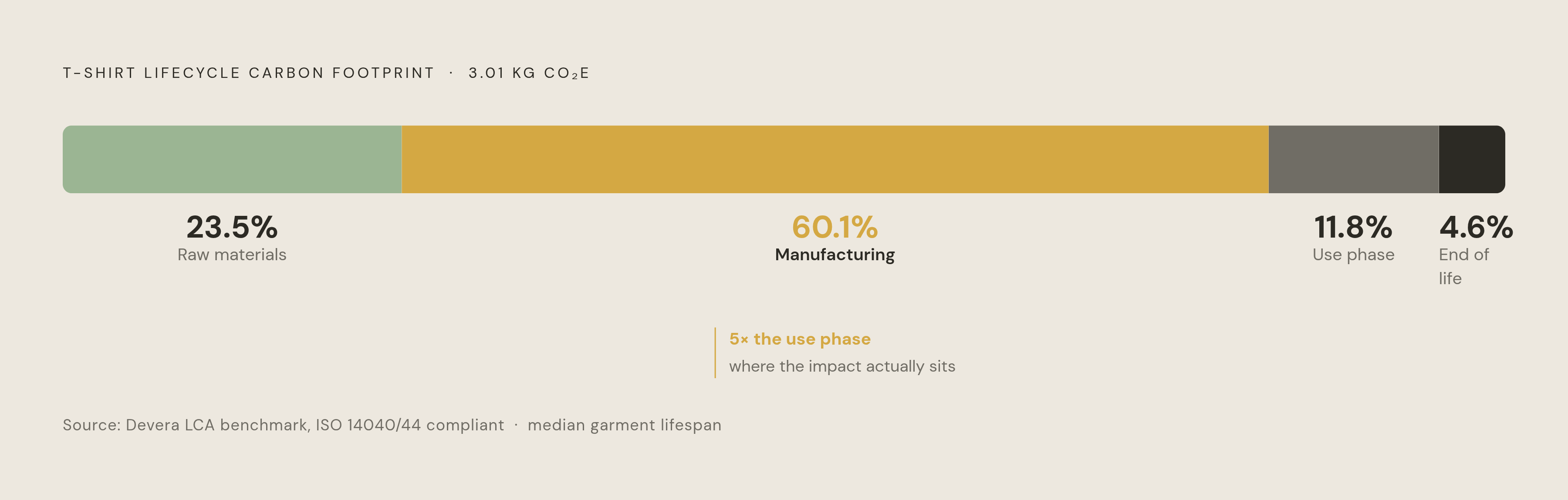
A t-shirt benchmark built to ISO 14040/44 standards makes the point concrete. Raw materials added another 23.5% Devera ISO 14040/44-compliant LCA benchmark for a t-shirt. The use phase, every wash cycle over the garment's life, came out to just 11.8% Sustainable Jungle consumer surveys Devera ISO 14040/44-compliant LCA benchmark for a t-shirt. A brand chasing the wrong lever here, spending years improving instructions for how consumers should wash and dry the shirt, would be optimizing a phase that barely moves the number, while the real impact sits back at the mill.
Knowing precisely where emissions originate, whether that's raw materials, manufacturing, packaging, or use, is the prerequisite for a claim that holds up both to a skeptical buyer and to a regulator checking the substantiation behind it. Manufacturing alone accounts for 60.1% of the product's median 3.01 kg CO₂e footprint, according to a Devera ISO 14040/44-compliant LCA benchmark for a t-shirt.
Environmental Product Declarations: turning LCA data into a buyer-readable format
An EPD takes the LCA and turns it into something a buyer can actually read and compare. It's a report summarizing a product's environmental impact across energy and resource use, emissions, and waste, spanning manufacturing, distribution, use, and end-of-life. Crucially, it doesn't get published on the brand's say-so. An EPD has to be verified by an independent third party before it's registered and published through a programme operator, under ISO 14025, and the operators running these registries include The International EPD System, Smart EPD, IBU, UL, PEP ecopassport, INIES, and EPDItaly.
The commercial reasons to have one stack up quickly. Verified EPD data opens the door to green building certifications like BREEAM, LEED, and DGNB, where specifiers typically require an EPD stating material impact clearly before a product qualifies. In procurement, buyers increasingly use EPDs to weigh one product against another, and RFP sustainability criteria now state EPDs as a requirement. In marketing, sectors including electronics, automotive, and textiles use EPDs to support verifiable claims about product environmental performance. And the same granular LCA data behind the EPD feeds directly into a company's broader decarbonization targets: each round of reporting builds on the last, so the effort compounds rather than resetting each time.
Construction shows where this is headed across the wider economy. Buy Clean policies in California, Colorado, Oregon, and Washington already use EPDs to assess and cap embodied carbon in public construction projects. And the revised EU Construction Products Regulation, in force since 7 January 2025, requires companies to disclose EPD-based performance data through a Declaration of Performance and Conformity, communicated via the Digital Product Passport. In a market flooded with unsupported "eco-friendly" language, the EPD is what gives a buyer an actual number to compare against, rather than a feeling to trust or distrust. EPDs must be updated every five years, as they are living documents, not one-time declarations.
Eco-labels: what makes a certification signal credible rather than noise
Labels are supposed to be shorthand. In practice, there are more than 450 eco-labels operating globally, a figure the Ecolabel Index puts forward and that a Jönköping University thesis cites, and that volume turns the label landscape into something closer to noise than signal for most buyers. Research published in the Journal of Strategic Marketing found that a lot of these labels tell only part of the story, covering farming practices, or packaging materials, or transportation emissions in isolation, without ever adding up to the product's full footprint. Natalina Zlatevska's work at the University of Technology Sydney, published in the same journal, describes labels as heuristic shortcuts buyers use to skip a harder evaluation, but notes that having too many of them defeats the purpose and obscures more than it clarifies.
A study out of Jönköping International Business School, run in May 2026 with 127 participants, finds that eco-labels function as cognitive anchors. Eco-labels function as cognitive anchors: they reorganize how a buyer weighs different quality attributes even when the underlying attribute scores barely shift. Of four dimensions tested, material integrity, durability, longevity, and sensory comfort, only sensory comfort showed a statistically significant effect from the label's presence. That tracks with Cue Utilization Theory: a label adds the most value on the qualities a buyer can't verify by picking the product up and checking it themselves.
Not every label carries equal weight with buyers, either. FSC, Cradle to Cradle, Carbon Trust, OK Compost, and BPI Certified Compostable are among the marks recognized on packaging today. Starting 27 September 2026, EU rules will only permit a sustainability label if it's based on a certified scheme or set up by a public authority. A brand's self-designed badge stops being legally usable in that market. A conference paper from Springer Nature and INGEGRAF looked at what makes a label actually work as a trust signal rather than visual clutter, pointing to placement, legibility, recognizability, and the credibility of the underlying scheme, though the paper is upfront that this area still needs more research. Given all that, the practical filter for choosing a label comes down to a short list: does it cover the part of the lifecycle where the product's impact is concentrated, is it independently verified, does the target buyer actually recognize it, and is it legal to use where you're selling.
The Digital Product Passport: moving sustainability proof from packaging to the product's permanent record
The Digital Product Passport takes the label idea and gives it permanence. It's a structured digital record tied to a physical product through a data carrier, usually a QR code, a barcode, or some other digital identifier, and it holds verified information on materials, environmental impact, certifications, and lifecycle data. Where a printed label is fixed the moment it's printed, the DPP updates as the product and its supply chain change, functioning less like a document and more like a living record attached to the product itself.
The infrastructure for this is arriving fast. The EU's DPP Registry launched on 20 July 2026, and the technical standards behind it are being published now. Textiles have moved furthest along: the Joint Research Centre published the first complete preparatory DPP content specification for textile apparel, covering 49 data points across four categories. The date that matters most for compliance teams is 19 July 2026, when full ESPR application kicks in alongside the DPP Registry going live; the data infrastructure has to already be built before enforcement reaches a given product category. From 2027 onward, industry is expected to adopt digital labelling systems like GS1 Digital Link through the GS1 Sunrise 2027 initiative, an industry-led effort rather than an EU mandate, but one that's expected to line up with ESPR and DPP requirements as they expand.
What the DPP actually solves is the dual trap brands have been stuck in: claim too much and risk penalty, claim too little and lose the advantage. Structured, standardized, verifiable data embedded in the product itself sidesteps both problems, because the transparency lives in the record, not in marketing copy someone has to take on faith. The market is scaling accordingly. Gartner projects the DPP market will grow at a 24.43% compound annual rate through 2034. The brands that treat this as paperwork to file will end up boxed in by fragmented data systems down the line. The ones that build it as communication infrastructure from the start will move faster every time a new disclosure requirement lands.
Framing verified claims so buyers can understand and act on them
Having the LCA, the EPD, and the DPP data does not automatically mean a buyer understands any of it. That gap, between credentials that exist and credentials a buyer can actually parse, is where a lot of the investment described above quietly goes to waste.
Regulators have already set the floor here. Claims need to be specific, backed by data, and verifiable, and generic terms like "eco-friendly" or "sustainable" without something behind them stop being legally safe in the EU from September 2026, with the CMA Green Claims Code and FTC Green Guides applying similar scrutiny in the UK and US respectively. But compliance is the minimum bar, not the goal. Buyers have told researchers what would actually move them: 68% want independent verification, so naming the certifying body clearly, rather than tucking it into small print, does real work.
Carbon Trust's guidance to marketers on this point is direct: say more about climate progress, not less, once a company has evidence that holds up. A carbon footprint label, treated as a visible, consistent brand asset across packaging, digital channels, and campaigns rather than a one-off compliance stamp, does more to build trust over time than any single claim can on its own. The throughline across LCA, EPDs, eco-labels, and the Digital Product Passport is the same idea in four different formats: evidence that can be checked beats language that can't, every time a skeptical buyer is deciding who to believe. 66% want transparency about materials and sourcing (a traceability narrative, not just a logo) Carbon Trust international consumer research.