Contamination Reduction Strategies in Municipal Recycling
Fixing recycling contamination requires design changes, not just messaging.

Contamination in municipal recycling is a system failure that happens to involve resident behavior, not a behavior problem with recycling symptoms. Contamination rates have historically run between 17 and 25 percent depending on region and collection system, and that material does more than sit uselessly in a cart. It raises processing costs, wears down equipment at the materials recovery facility, gives buyers grounds to reject whole loads, and introduces real fire and safety hazards when batteries, propane cylinders, or sharps end up in collection trucks and sorting lines. Local governments absorb this twice: once when recyclable material gets landfilled anyway because it arrived contaminated, and again in the higher processing costs for whatever is left. Both effects push rates and operating budgets upward. Raftelis senior consultant Harold Mitchell and vice president Jennifer Porter point to a University of California Berkeley analysis that puts the added cost of contamination at hundreds of millions of dollars a year across the U.S. recycling system. Market shocks like China's National Sword tightened what buyers will accept, so contamination now threatens recycling revenue directly, and that link between program cost and program survival did not exist when contaminated loads simply found a buyer anyway.
The causes sit in both behavior and design. Resident confusion about what belongs in the cart, rushed sorting, and "wishcycling," the habit of tossing something in the recycling bin on the hope that it's recyclable, drive most contamination. But those habits do not form in a vacuum. Mitchell and Porter make the point directly: the fixes that work start at the cart, where habits take shape, rather than at the facility, where cleanup is expensive and already too late. Because contamination is structural and behavioral at the same time, a program that spends its whole budget on one dimension, more posters, say, or a stricter fine schedule, leaves the other dimension exactly where it was. That's the case for treating this as an operational challenge with several moving parts, not a single lever to pull.
Communication design versus messaging volume
Mass outreach campaigns tend to underperform because they arrive untimed and impersonal, disconnected from what any resident actually put in their own cart. Cart-level feedback closes exactly that gap. Mitchell and Porter draw the contrast directly: a generic brochure competes with junk mail, but a "Nice job" tag on a clean cart reinforces good habits in the moment, and an "Oops" tag on a contaminated cart delivers a specific, low-drama correction tied to that resident's own bin, on that resident's own collection day. The reason it works is structural: it's timely, it's personal, and it points at a concrete, recent action.
Convenience itself functions as a form of communication. Clear labels on the cart lid, a one-page sorting guide or a refrigerator magnet, a kitchen caddy for food scraps, consistent bin placement and better signage in multifamily buildings: all of these reduce the friction between knowing the rule and following it, so correct sorting becomes the path of least resistance rather than something a resident has to remember to do. Programs get more out of narrow, repeated campaigns aimed at a single chronic contaminant than from broad "recycle right" messaging. Mitchell and Porter cite examples like "keep recyclables loose" or "peel stickers before composting," instructions specific enough that a resident can act on them the next time they're standing at the bin. Route-level or neighborhood challenges, paired with a modest prize for the cleanest carts, shift the social norm so that sorting well feels like something the neighborhood notices.
Maryland's experience shows what happens when outreach runs ahead of design. The Maryland Department of Legislative Services names consumer confusion as one of the primary challenges facing the recycling stream, alongside dated infrastructure and market swings. Confusion persists there because outreach alone cannot fix a program where the rules themselves are unclear or inconsistent. Federal money now backs this kind of targeted work directly: the EPA's Consumer Recycling Education and Outreach grant program, funded through the Infrastructure Investment and Jobs Act and cited in ASTSWMO's 2026 Recycling Position Paper, funds public education and outreach specifically to make residential recycling programs more effective.
Why a tiered enforcement ladder works
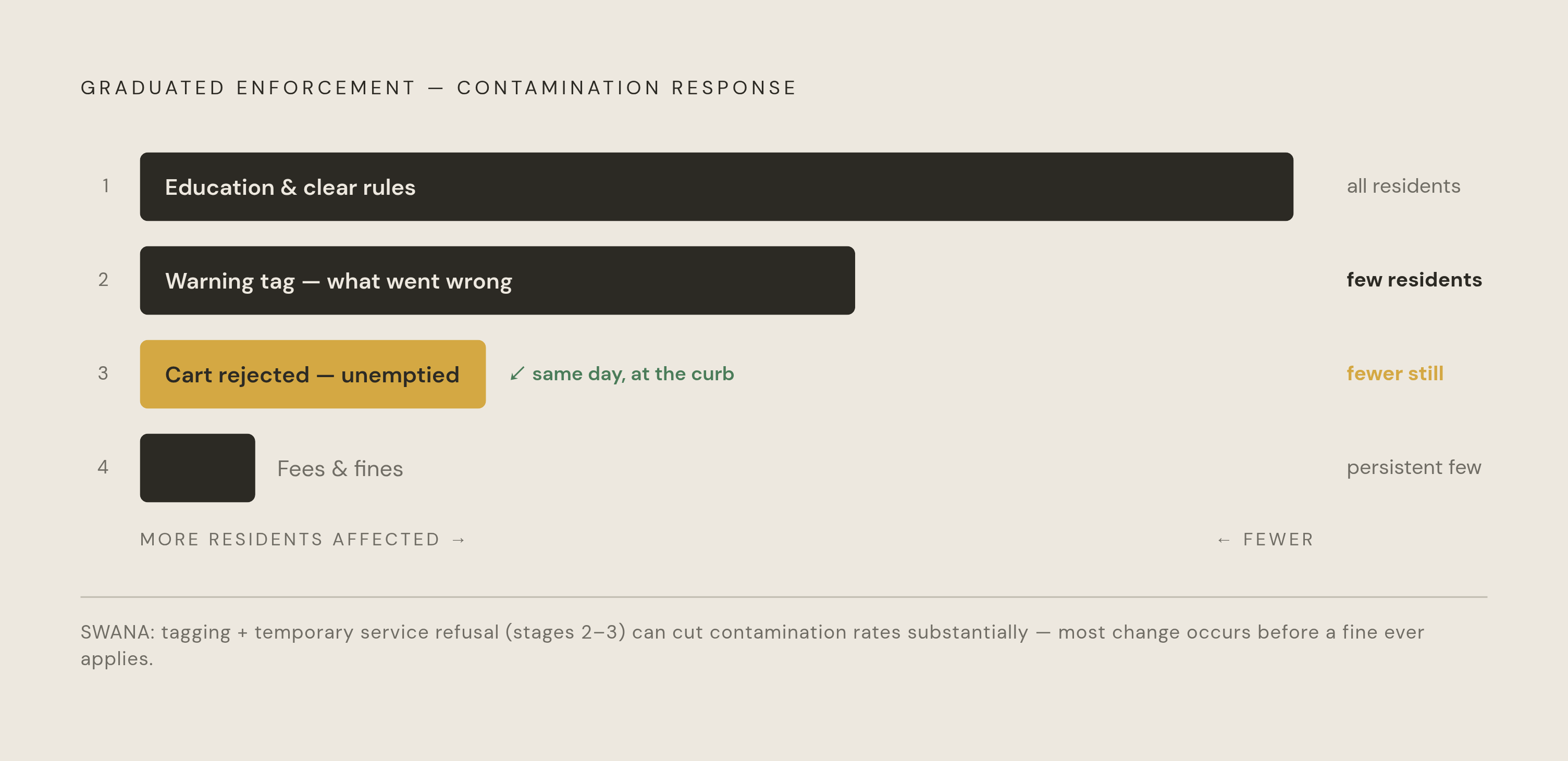
Positive reinforcement builds a culture of good sorting, but it does little to stop the resident who ignores every tag on the cart lid and keeps contaminating the load. A graduated enforcement structure closes that gap, but it doesn't punish everyone for the behavior of a few. Mitchell and Porter lay out the ladder in order: education and clear rules first, then warning tags that spell out what went wrong, then cart rejection, where the hauler leaves a severely contaminated cart unemptied, and finally fees, fines, or service charges for residents who keep reoffending after all of that.
The sequence matters for two reasons. It gives residents several chances to fix the problem before a penalty ever applies, and it gives municipal staff a playbook they can apply the same way to every resident, which matters both for fairness and for defending the program politically when someone complains. An unemptied cart is a consequence a resident notices the same day, sitting at the curb, rather than a letter that shows up a week later after the behavior has already repeated. SWANA's Applied Research Foundation found that tagging combined with temporarily refusing service can cut contamination rates substantially, which is consistent with the idea that immediate, visible consequences change behavior faster than delayed ones. ASTSWMO's 2026 Recycling Position Paper places this kind of enforcement design inside a larger national framework, and it names reduced contamination in the recycled materials stream as one of five strategic objectives in the EPA's National Recycling Strategy.
The strongest objection to this structure is that fines add administrative burden but don't necessarily outperform cart rejection on its own. That objection mistakes where the ladder's value actually sits. Most of the behavior change happens earlier, at the warning-tag and cart-rejection stages, and the fine functions as a last resort for the small number of residents who ignore everything before it, not as the primary tool doing the work. Residents sometimes push back because they feel watched, and you need to take that reaction seriously. If a program frames enforcement in the same coaching tone as the cart-tag system, rather than as surveillance, it tends to meet less resistance.
How collection system design shapes contamination
Before any cart gets tagged, the collection system itself has already set the baseline contamination rate a program has to work against. Choices about what streams get collected, what containers residents use, and how pricing works all raise or lower contamination levels before outreach or enforcement ever enters the picture. The National Academies' 2025 report observes that the volume and mix of materials moving through the municipal solid waste system shift over time as consumer products and packaging change. A program built around the material mix of a decade ago drifts out of alignment with what residents are actually buying and discarding now, and that drift opens new paths for contamination that no amount of resident education addresses directly.
Pricing structures carry their own risk. Pay-as-you-throw systems can push residents toward better diversion, but Mitchell and Porter note that this only works if the pricing is paired with strong education and active monitoring. Left on its own, a per-bag or per-bin trash fee gives residents a reason to hide household garbage inside the recycling or organics cart, a design interaction that makes contamination worse when nobody anticipated it. Multifamily buildings need their own accommodations entirely, indoor containers, clearer signage, and bin placement residents can count on, because a shared bin removes the personal feedback loop that makes something like cart tagging work in a single-family neighborhood. Nobody's name is on a dumpster.
Standardizing what counts as recyclable is itself a design decision, not a footnote to one. Inconsistent accepted-materials lists from one jurisdiction to the next are a direct driver of resident confusion, and the ASTSWMO 2026 Position Paper names standardized measurement and expanded data collection as one of the five strategic objectives needed to build a more resilient national system. A resident who learns the rules in one county and then moves across the line into a county with a different list is not confused out of carelessness. The rules they learned correctly in one place become a source of contamination in the next, and that's a structural problem education cannot fully solve on its own. The Maryland Department of Legislative Services report backs this up directly, naming dated or inadequate infrastructure alongside consumer confusion as co-equal challenges facing the stream.
What MRF-level technology can and cannot recover
Once contaminated material reaches the materials recovery facility, sorting technology can catch and redirect a meaningful share of it, but the economics of installing that technology vary sharply by program size. California Waste Solutions upgraded two Bay Area MRFs in September 2026: the Timothy MRF in San Jose added Pellenc optical-sorting capacity, and the 10th Street MRF in Oakland added EverestLabs AI scanners. At the Oakland facility, the EverestLabs system identifies and logs items moving down the container line toward disposal, counts what it sees, and tracks material flow so operators can see where recoverable material is slipping through and getting lost. The National Academies, in its 2025 report, projects that new AI-driven air, optical, and mechanical sorting systems may let MRFs approach much higher overall capture rates in the near future, while noting that these systems will likely require a significant financial outlay to install.
That financial outlay creates the equity problem. Smaller and rural municipalities without access to grant funding can't adopt the same sorting technology as a large urban MRF, so facility-level safeguards against contamination exist unevenly across the programs that need them most. That's the central limit of any technology-first strategy: it concentrates the capacity to catch contamination in well-funded programs, while under-resourced programs are left depending on upstream behavior change and enforcement with no facility-level backstop. Federal SWIFR Political Subdivision grants are built to address this gap directly, and the ASTSWMO 2026 Position Paper reports that these grants had gone through two funding rounds as of December 2025, aimed at improving or adding critical recycling infrastructure for local jurisdictions that could not otherwise afford it.
Sensor-based sorting does more than sort, though. The data it generates, where material is lost on the line, what keeps showing up that shouldn't, feeds back into decisions made upstream in collection design. The facility becomes a source of information that can improve how carts, routes, and accepted-materials lists are designed.
How Extended Producer Responsibility shifts contamination costs upstream
A policy framework that shifts packaging end-of-life costs moves the financial burden of end-of-life materials off municipalities and taxpayers and onto the companies that make the packaging. That shift changes what manufacturers have an incentive to do. When a producer has to pay for collecting and recycling its own packaging, it has a direct financial reason to use materials that are easier to process and to avoid combinations, like mixed-material pouches or hard-to-separate laminates, that create contamination problems at the MRF. Contamination becomes a design cost the manufacturer has to account for before the product ever reaches a shelf, rather than purely a cleanup cost for the municipality.
EPR does not take the place of the operational work described above. Programs still need the enforcement ladder, the cart-level communication, and the facility-level safeguards regardless of what policy exists at the state level. What EPR does is reduce, over time, the volume of hard-to-sort material entering the stream in the first place, which makes every one of those operational tools more effective because they're working against a cleaner starting mix. The ASTSWMO 2026 Position Paper lists "Enhance Policies to Support Recycling" as one of the five strategic objectives in the National Recycling Strategy, and EPR stands as the most prominent state-level policy tool in that category as of 2026.
Why the most durable programs combine all four interventions
Each of the four layers, communication design, tiered enforcement, collection system design, and facility-level technology, solves a failure the others cannot touch on their own. Clear cart-level communication reduces contamination that happens by accident or confusion, but it does nothing for the resident who understands the rules and ignores them anyway. Enforcement stops that chronic violator but offers no help to a resident who genuinely doesn't know what belongs in the bin. Collection system design sets the baseline contamination rate a program has to manage, but it cannot fix a communication strategy that's vague or infrequent. Facility technology catches material that slips past all of the above, but it can't replace preventing contamination at the source, especially when that technology is funded so unevenly across different-sized programs. Mitchell and Porter put the overall principle simply: communities that make lasting progress on contamination tend to combine incentives that build a positive culture, enforcement that creates real accountability, and education that keeps the rules simple and consistent.
Federal funding now backs all four of these layers at once, which argues for running them together. The ASTSWMO 2026 Position Paper notes that EPA's SWIFR and REO grant programs cover infrastructure, data collection, state-level planning, and public education and outreach, a set of categories that lines up directly with the four intervention layers described here. All 56 eligible states, territories, and the District of Columbia requested SWIFR State funding in the program's first round, which suggests that multi-layered investment is treated as the standard approach now, not an upgrade some programs can skip.
For a program manager deciding where to start, the practical move is diagnostic. Figure out which layer is weakest, confused residents, chronic violators who ignore warnings, a collection system mismatched to current material flows, or a facility that's letting too much slip through, and put the next dollar there first. The goal from there is coverage across all four layers over time, because a program that's strong in three of them still leaves the fourth open as the place where contamination gets back in.
Sources
- Waste Management and Recycling: Challenges, Actions, and Trends
Cited for Maryland's experience with consumer confusion, dated infrastructure, and market volatility as co-equal challenges facing the recycling stream.
- Read "Municipal Solid Waste Recycling in the United States: Analysis of Current and Alternative Approaches" at NAP.edu
Provided projections on AI-driven MRF sorting systems and observations about shifting material volumes as consumer products and packaging change over time.
- astswmo 2026 recycling position paper
Supplied details on EPA's National Recycling Strategy objectives, SWIFR and REO grant programs, EPR policy framing, and the two funding rounds of Political Subdivision grants.
- Solid Waste Infrastructure for Recycling Grants for Political Subdivisions
Identified as the source for the Federal SWIFR Political Subdivision grants designed to help under-resourced municipalities fund recycling infrastructure.