Waste Data Management Systems for Large Enterprises
Enterprises need connected data systems to turn waste operations into audit-ready ESG evidence.
Waste data management systems for large enterprises have become ESG reporting infrastructure as well as tools for scheduling pickups. Their value depends on whether they can turn facility-level activity into evidence that regulators, investors, and assurance providers can examine. That requires a connected architecture for capturing waste data, preserving its lineage, and reporting it consistently across the enterprise.
Why waste data has become the bottleneck in enterprise ESG reporting
Investors and regulators increasingly expect enterprises to prove what each facility generated, diverted, and disposed of. Corporate sustainability commitments add pressure to substantiate those claims. Pickup confirmation is no longer sufficient evidence. A service record establishes that collection occurred, but it does not by itself establish the material collected, its classification, or its destination. Waste reporting now depends on records that support scrutiny beyond the operations team.
CSRD places waste reporting within ESRS E5, while GRI, TCFD, and ISSB address waste metrics on voluntary or materiality-conditional terms. GRI requires its waste disclosures when waste is a material topic, and TCFD treats waste metrics as relevant where applicable. These distinctions affect which disclosures an enterprise must produce. They do not remove the need for defensible underlying data when waste enters a report.
The pressure also extends beyond large public issuers. Customers who must meet reporting requirements ask for information through contracts, questionnaires, and supply-chain due diligence. A supplier can therefore face reporting demands even when it is not directly subject to the same disclosure mandate. The resulting bottleneck is the enterprise’s ability to assemble reliable evidence across facilities, rather than its ability to write a sustainability narrative.
Why spreadsheets and siloed hauler data cannot meet that standard
Most enterprises have waste information, but it sits in disconnected records maintained by different parties. Facilities use different haulers, invoices arrive digitally or on paper, and local teams maintain their own spreadsheets. Collection workflows vary across the organization. As a result, no single record describes the enterprise’s waste profile with consistent categories and supporting evidence.
The weakness is not merely administrative inconvenience. Financial data has decades of standardized accounting rules and ERP infrastructure behind it, but ESG waste data is still far less developed. Many U.S. companies still manage ESG data in spreadsheets. In waste operations, a service confirmation may depend on driver attestation rather than sensor verification, and the same stream may be categorized differently by site or vendor. Consolidating those records does not resolve their differences.
Those differences become consequential when an enterprise claims diversion. A contaminated load or a miscategorized stream can invalidate the associated bin count as evidence for a sustainability report. The event needs a traceable, verifiable record. An aggregated estimate cannot establish what happened to a particular container when the underlying classification is unreliable.
A facility team can identify a messy waste area, but comparing dozens of plants, haulers, invoices, and service schedules requires information that local records do not consistently provide. Spreadsheet reconciliation may produce a company total while leaving its components unauditable. The apparent completeness of the report can therefore conceal gaps in the evidence.
What a waste data management system actually consists of at enterprise scale
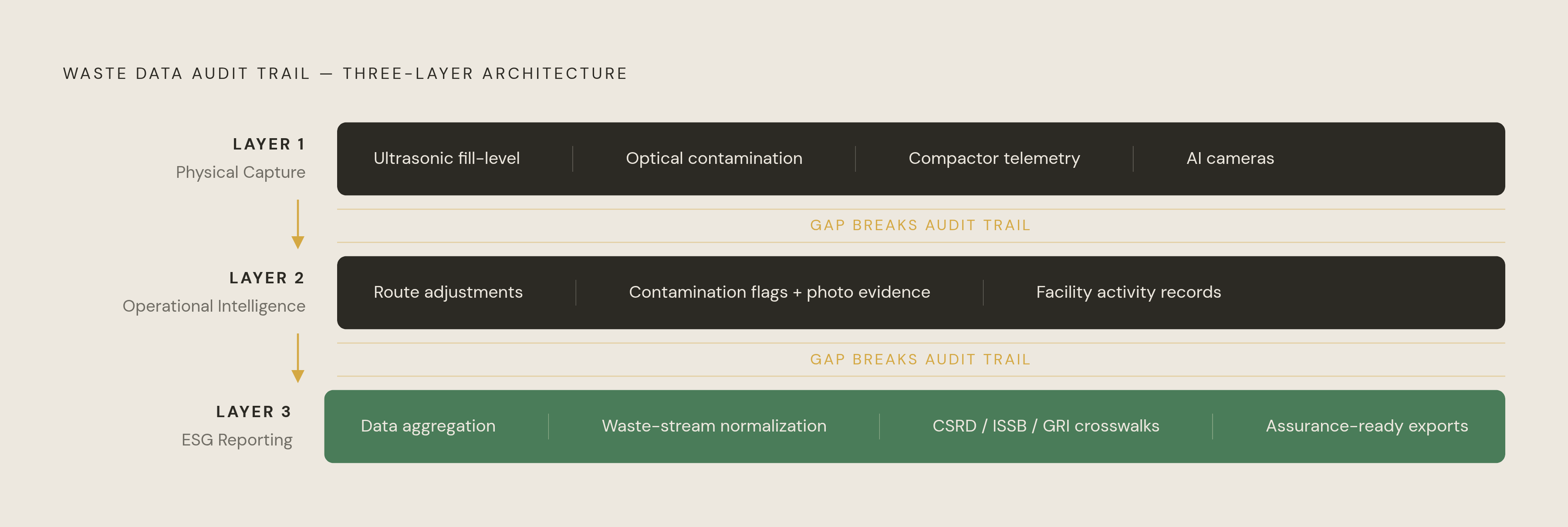
An enterprise-grade system comprises three interlocking layers, which are physical data capture, operational intelligence, and ESG reporting infrastructure. Each performs a different evidentiary role. Capture establishes conditions at the source, operational tools connect those conditions to service activity, and the reporting layer normalizes records for disclosure. A gap between these layers interrupts the audit trail.
Dual-sensor bins use ultrasonic sensors to read fill levels and an optical deep-learning layer to scan the contents for contamination. Recycle Track Systems (RTS) operates the Pello sensor platform, which captures fill levels, contamination events, bin location, and temperature. At Citi Field, Pello flags contamination when it occurs, allowing correction before a full truckload reaches a materials recovery facility. The value extends beyond an individual bin. A shared sensor network supports comparisons across facilities, while compactor and container telemetry adds continuous records of fill level, compaction rate, and service confirmation.
Operational intelligence links those observations to decisions about collection and patterns in how waste is generated. RoadRunner Recycling uses its patented Waste Metering™ technology to track fullness, contents, contamination, and service activity with AI-powered cameras in containers. Its daily operational information gives waste experts a granular record of facility activity. AMCS supports mid-day route changes when trucks fall behind or new requests arrive, while Vision AI flags contamination and retains photo evidence. Efficiency is a co-benefit of this more detailed record.
The reporting layer makes operational records usable for disclosure. It aggregates data, normalizes waste streams across sites, maps requirements, and prepares exports for assurance review. Central ESG data hubs use framework crosswalks to reduce reconciliation across CSRD, ISSB, and GRI. Automated compliance systems also connect documentation and proof of performance to report generation. For e-waste, that unified record can support overlapping obligations from state EPR annual reporting, federal contractor CMMC 2.0 media protection assessments, and corporate ESG disclosure.
How these systems connect to the enterprise technology environment
A waste platform needs links to enterprise systems to bring the company’s records together. Manual exports into financial and sustainability reporting workflows recreate the reconciliation burden that digitization was intended to remove. Integration is therefore part of the evidence architecture. It connects waste activity to the organizational structures against which an enterprise reports.
ERP integration supplies the most important organizational link. SAP, Oracle, and similar platforms hold facility master data, cost center structures, and financial records. Without that connection, attributing waste activity to facilities remains manual. The waste platform’s facility identifiers must correspond to the enterprise structure, or a technically detailed service record may still be difficult to place within a corporate disclosure.
EHS integration connects that record to broader environmental compliance. ERA EHS Software, Intelex, and SafetyCulture are illustrative examples of this category of platform. The connection brings waste information into workflows covering TRI reporting, RCRA generator classification, and biennial reporting. Waste streams can then be managed within the same compliance environment as air and water emissions.
Those connections require standard APIs to work within a central data hub. A platform’s feature breadth cannot compensate for inaccessible data. API openness, ERP connectivity, and export capability therefore belong in both the architecture assessment and the deployment plan. Digital Product Passports add a forward-facing requirement under the EU Ecodesign for Sustainable Products Regulation, with rollout by product group from 2027 onwards through 2030 and beyond. They also require integration to cover the flow of materials for each product across its lifecycle, alongside disposal records.
The real implementation challenges enterprises face after selecting a platform
A capable platform does not repair unreliable source data automatically. Inconsistent practices across sites and territories, limited digitalization, and methodological differences between standards remain upstream problems. Sensors introduce maintenance requirements of their own. Battery life, distributed hardware upkeep, and integration across IoT vendors and legacy systems can interrupt the flow of usable records. Contamination and categorization errors also need correction before they become part of the compliance record.
Implementation scope is consequently broader than software configuration. Core modules usually take 4–12 weeks to set up, but multi-site deployments and complex migrations take much longer. Driver training, historical data transfer, route imports, and billing integration can all precede go-live. Hardware changes the investment profile as well. Smart bins and AI cameras cost a lot upfront, with ROI usually reached over an eighteen-to-twenty-four month period, so approval often needs backing from teams beyond sustainability.
Compliance, tracking, and logistics tools often need to work together because one platform does not cover all three equally well. Once those workflows become deeply embedded, switching vendors can require data migration, rewritten integrations, and user retraining over months or years. Renewal pricing becomes a structural exposure. Cybersecurity, data ownership, interoperability, and scalability therefore influence the enterprise’s long-term dependence on the system.
These are solvable problems when implementation planning addresses them explicitly. Enterprises should negotiate portability and export rights before deployment, then phase the rollout rather than assuming uniform readiness across facilities. Data governance should assign ownership, standardize waste categories, and define how discrepancies are resolved. Validating data quality at each stage gives the enterprise a basis for expansion, rather than allowing local inconsistencies to spread through a larger platform.
What auditable ESG reporting actually requires from a waste data system
An auditable system provides time-stamped evidence for every material waste stream at each facility, using consistent methodology. Company totals alone do not supply that evidence. Volumes, diversion rates, and disposal methods need attribution to facilities or operational units so that reported figures can be examined at their source. Sensor and operational records therefore need facility identifiers aligned with the ERP structure. That mapping must stay accurate as facilities open, close, or restructure.
Proof of performance adds the next requirement. Scale tickets, certificates of recycling, and certificates of destruction establish more than an aggregate diversion percentage can show. Each document needs a link to the relevant service event, including its date, hauler, container, and material type. Real-time documentation avoids reconstructing that relationship retrospectively from estimates.
Hazardous waste introduces more specific compliance functions. Platforms that serve manufacturers need built-in support for drum tracking, lab pack management, and RCRA generator classification. RCRA e-Manifest requirements apply to manifested shipments from Large Quantity Generators and Small Quantity Generators, while federal biennial reporting applies to Large Quantity Generators. These are distinct obligations. A platform’s compliance capability depends on supporting the requirements that apply to the enterprise’s streams and generator status.
Assurance also requires an account of how data changed. External reviewers need to know where a figure originated, how it was calculated, and what controls governed the process. An audit log of transformations supplies that lineage. Multi-framework exports must keep reported figures linked to the records that support them when placing totals into different templates.
Annual or quarterly reports assembled from invoices provide snapshots, while ongoing ingestion from sensors and operational tools supports a rolling compliance view. Gaps can be visible in the rolling compliance view while correction is still possible. Facility attribution, event-linked documentation, applicable hazardous waste functions, transformation logs, and continuous monitoring therefore form concrete evaluation criteria for enterprise buyers and ESG program managers.
How enterprises should approach platform selection and build toward regulatory readiness
Enterprises should begin selection with their dominant exposure. The starting point may be regulatory depth under RCRA and TRI, disclosure breadth under CSRD and GRI, or coordination across facilities. Manufacturers with regulated chemical streams should prioritize native generator classification, drum tracking, and e-Manifest functions. Enterprises focused on ESG disclosure should put more weight on framework exports and readiness for assurance review. Those facing both should plan for an operational platform focused on compliance that sends data to an ESG data hub focused on reporting.
Integration criteria should come before feature breadth. API availability, ERP connector maturity, and contractual portability determine whether the selected tools can participate in that architecture. Enterprises should have export rights in the contract before they sign. Sustainability and operations teams should evaluate these requirements jointly because the reporting team depends on evidence created through operational workflows, while operations must maintain the processes that produce it.
Teams should agree on governance before their collection practices are set. Each facility needs a waste data owner, a shared taxonomy of streams, and a process for resolving differences between hauler records and internal records. Deployment should begin with facilities facing the most immediate regulatory exposure and expand only after data quality is validated. The first reporting cycle should serve as a calibration exercise, rather than be treated as proof that every workflow is settled.
Assurance providers should also participate before system design is finalized. Their needs for lineage, methodology documentation, and control evidence should guide how the system is set up while changes are still practical. Retrofitting an audit trail is significantly more expensive. With the 2027 CSRD reporting cycle as a concrete planning deadline, sustainability and operations teams need to decide together whether their architecture can produce a facility-level record that a third-party auditor will accept.