Extended Producer Responsibility Laws by State
Seven states now have EPR laws on the books, each with different rules for the same product.
Extended producer responsibility, or EPR, is spreading fast through U.S. packaging law, and it works by moving the cost of dealing with packaging waste off municipal budgets and onto the companies that put that packaging into the market in the first place. Seven states now have comprehensive packaging EPR laws on the books, each with its own deadlines, covered materials, and small producer exemptions, which means a company selling the same box of cereal nationwide could be dealing with seven different sets of rules for what looks like one product. This piece walks through each state's law, then closes with a comparison of who gets exempted and why the exemption thresholds themselves tell you something about how each state defines "small."
Why seven states in four years signals a structural shift, not a regional experiment
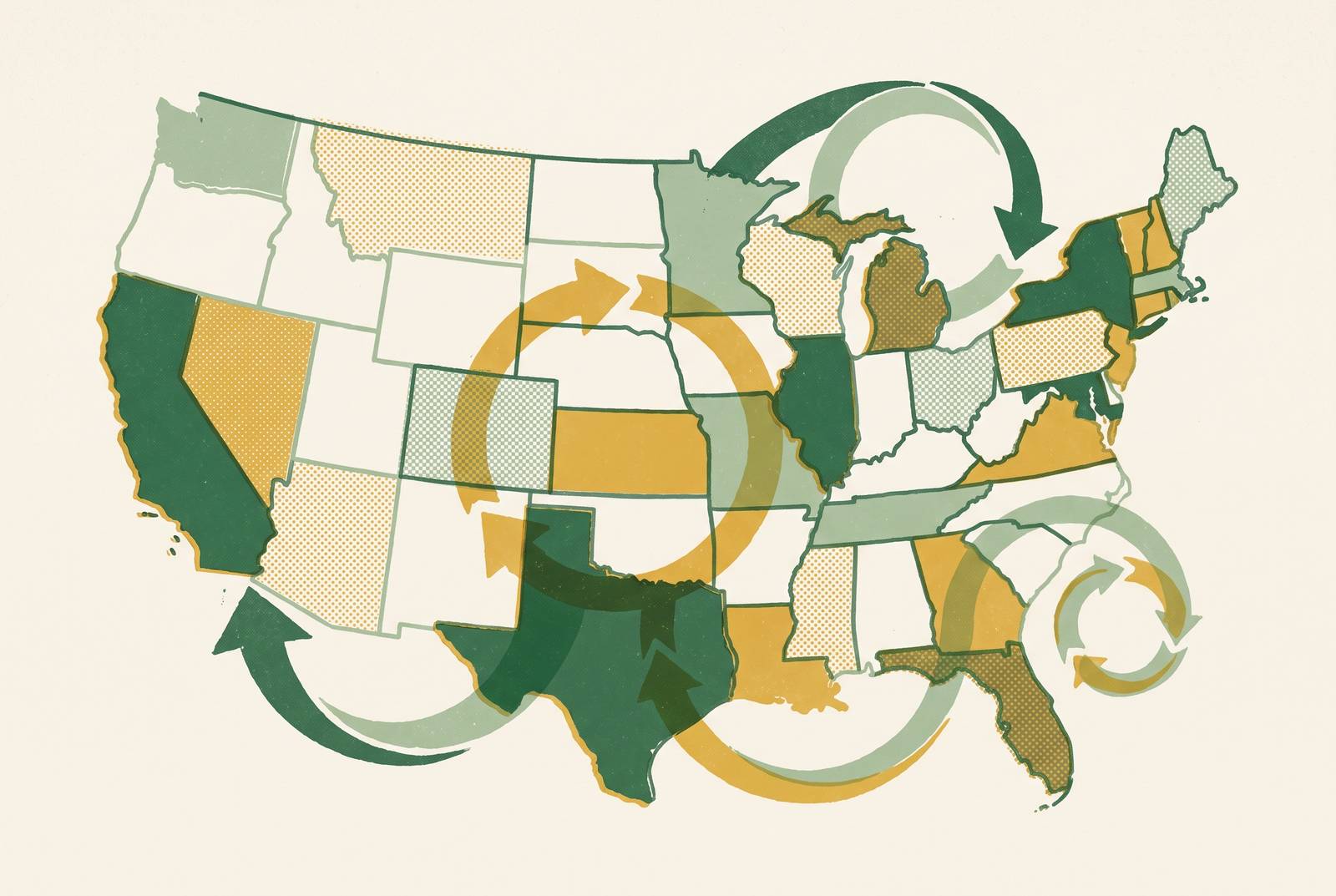
Before 2021, zero states had a comprehensive packaging EPR law on the books. As of October 1, 2025, seven do: Maine, Oregon, Colorado, California, Minnesota, Maryland, and Washington. That's not a slow trickle of pilot programs. That's a legislative wave that built momentum in under half a decade, and roughly one in five Americans now live somewhere subject to packaging EPR rules.
Zoom out further and the picture gets busier. Nearly 20 states plus D.C. have considered packaging EPR bills at some point, and 2025 alone saw multiple states introduce or reintroduce legislation, including Illinois, New Jersey, North Carolina, New York, Massachusetts, Rhode Island, and Tennessee, among others. Hawaii went a different route, enacting HB 750 on May 27, 2025, which orders an EPR needs assessment through the Department of Health, with a scoping study due to the legislature by the end of 2027. Rhode Island passed a similar needs-assessment law in June 2025. Neither is a working EPR program yet, but both are the paperwork equivalent of a state clearing its throat before it speaks.
Here's the pattern worth sitting with: these laws increasingly resemble each other. States drafting new bills seem to be borrowing directly from Maine's or Oregon's language, then tweaking scope, deadlines, and exemptions to fit local politics. That family resemblance is convenient for producers trying to build one compliance system, right up until it isn't, because the differences that remain (a $2 million revenue exemption here, a 1-ton threshold there) are exactly the details that determine whether a small brand owes anything at all. Producers selling in more than one state can't treat this as a checklist to complete once. It is closer to a moving target that adds new states almost every legislative session.
Maine: the first mover, still building its program
Maine got there first, passing LD 1541 (officially "An Act to Support and Improve Municipal Recycling Programs and Save Taxpayer Money") in July 2021. The model is municipal reimbursement: instead of building new recycling infrastructure, producers pay into a fund that reimburses local governments for the recycling costs they already carry. It's less a new machine and more a new bill-splitting arrangement for an old one.
Coverage is broad. Most consumer packaging counts, regardless of material, plastic, paper, glass, metal, cardboard. Paper functions as packaging under the law rather than sitting in its own separate "printed paper" bucket, which is a distinction some other states draw and Maine doesn't bother with. Draft rules set long-range targets that sound almost aspirational by design: a 90% collection rate for readily recyclable packaging by 2040, and a 60% cut in total packaging (by both unit count and weight) by 2050. Twenty-five years is a long runway, but it's also long enough that nobody currently working on compliance will be around to see whether it worked.
Small producer exemptions kick in below $2 million in annual revenue, or under 1 ton of packaging sold into Maine, or for producers pulling more than half their revenue from salvaged goods. Every producer, regardless of size, also gets a pass on the first 15 tons of packaging used for perishable food like bakery items, meat, poultry, seafood, dairy, shell eggs, and fresh produce.
Rules were adopted in December 2024 and subsequently amended in early 2026, but the program has hit real turbulence since. Maine issued an RFP in June 2026 looking for a Stewardship Organization to run the show, and when that RFP closed in August 2026, it had drawn zero proposals. None. The state is now reassessing its options, and producer registration and reporting dates remain unset. Full implementation was originally penciled in for 2027, a six-year gap between enactment and go-live that already looked long by regulatory standards. Now even that timeline is in question. It's a useful reminder that passing a law and running a program are two very different accomplishments, and Maine, despite its head start, is proof that first doesn't always mean fastest. Noncompliance penalties range from $100 to $10,000 per day, escalating for repeat violations, though enforcement obviously depends on a program actually existing to enforce.
Oregon: enacted second, went live first
Oregon passed its law shortly after Maine, on August 6, 2021, under SB 582, the Plastic Pollution and Recycling Modernization Act. But Oregon skipped the multi-year stall and became the first state to actually flip the switch, going live on July 1, 2025.
Oregon's law covers three categories where most states cover one: packaging, printing and writing paper, and food serviceware. It's also the state that put the Producer Responsibility Organization requirement into the American packaging EPR vocabulary in the first place. PRO membership is mandatory in Oregon, full stop, there's no option to comply on your own outside the collective structure.
The mechanics moved on schedule. Producers reported their packaging data by March 31, 2025. The first round of fees came due that July, timed to the launch of a new uniform statewide recycling list, meaning every jurisdiction in Oregon now recycles the same list of materials rather than the patchwork that existed before. Circular Action Alliance, the PRO operating in Oregon, had its Program Plan approved by the Department of Environmental Quality in February 2025, with an amendment in September 2025 adding detail on "Bonus C" incentives for reusable and refillable packaging designs.
Eco-modulation, the practice of charging higher fees for hard-to-recycle materials and lower fees for recyclable, reusable, or compostable ones, was built into Oregon's fee structure from day one rather than phased in later. The state's long-range target is 70% of plastic packaging being recyclable by 2050. Penalties for noncompliance run up to $25,000 per day, and they went into effect the same day the program launched, so Oregon is currently the only one of the seven states where producers face live fees and live penalties simultaneously. Whatever friction shows up in Oregon's rollout over the next few years will likely shape how regulators in the other six states calibrate their own enforcement.
Colorado: first to require producer registration, fully operational as of 2026
Colorado passed HB 22-1355, the Producer Responsibility Program for Statewide Recycling Act, in 2022, and it became the first state to actually require producers to register before anything else happened. That registration deadline landed October 1, 2024, with Circular Action Alliance again serving as the designated PRO.
The scope is wide. Colorado's law covers most consumer packaging plus a broad sweep of paper products: printed paper, newspapers, magazines, flyers, brochures. The definition of "producer" reaches further than most states too, pulling in companies that package products for online sales and companies that manufacture the packaging materials themselves, not just the brand names on the label.
Registration wasn't optional in practice. Starting July 1, 2025, producers cannot sell or distribute products in Colorado without participating in the PRO. Initial supply data was due by July 31, 2025, and the first producer fee invoices go out beginning January 2026, with the billing and payment schedule to be confirmed through the PRO's administrative process. Full program implementation lands in June 2026.
Colorado's eco-modulation system is designed around four goals: less new packaging overall, better recyclability, more post-consumer recycled content, and more reusable or refillable containers. The enforcement stick here goes beyond fines: the state can suspend a producer's ability to sell products in Colorado at all until compliance is restored, which turns a compliance failure into a market-access problem overnight. One quirk worth flagging for anyone building a compliance team: Colorado's registration rules carry nuances around corporate structure that compliance officers should verify directly with the PRO before assuming a single registration covers the full corporate family.
California: the largest market, the most ambitious targets, and the highest stakes penalties
California passed SB 54, the Plastic Pollution Prevention and Packaging Producer Responsibility Act, in 2022, and given the size of the state's consumer market, it's the law most national producers can't afford to treat as an afterthought. Regulations took effect May 1, 2026 after approval by the Office of Administrative Law, and sales restrictions on non-compliant producers take effect January 1, 2027.
Coverage extends past what most other states touch. Single-use packaging of any material and single-use plastic food serviceware are both in scope, and so is secondary and tertiary distribution packaging, the pallets, wraps, and shipping materials that move goods through the supply chain rather than sitting on a store shelf.
Three targets anchor the law, all due by 2032: every piece of single-use packaging sold in California needs to be recyclable or compostable, 65% of single-use plastic packaging needs to actually get recycled, and total single-use packaging volume needs to drop by 25%. CalRecycle estimates more than 5,700 producers fall under this law. Circular Action Alliance is California's sole approved PRO, and the dollar figures involved dwarf anything in the other six states: CalRecycle is set to collect $500 million a year from producers through the PRO between 2027 and 2037, with total EPR fee revenue forecast somewhere between $1 billion and $2 billion annually.
Penalties reflect the scale. Failing to register, report, or pay fees can cost a producer up to $50,000 per day, the steepest per-day number of any enacted state. California layered on a second law worth knowing about too: SB 343, the "Truth in Labeling" act, bans recyclability claims (including the chasing-arrows symbol) unless the material meets CalRecycle's published statewide recyclability criteria. Producers have to self-substantiate that claim; CalRecycle publishes the criteria but doesn't sign off on individual products one by one. So greenwashing compliance runs on a parallel track alongside EPR compliance, and a producer can be fully square on one front while exposed on the other.
For any brand selling in all fifty states, California's 2032 recyclability standard functions as a practical design floor. Meet that bar and most other states' current requirements fall in line behind it, which raises an interesting question for compliance planning: does it make more sense to build fifty state-specific packaging strategies, or one packaging strategy that clears California's bar and calls it done?
Minnesota: law passed, PRO selected, rulemaking still in progress
Minnesota's Packaging EPR Act became law on May 21, 2024, covering packaging (food packaging included) and paper products. One feature sets it apart from the pack: Minnesota requires PRO participation for compliance, a structure that has particular implications for importers and distributors who might sell packaged goods without ever having a direct relationship with whoever actually manufactured the packaging.
Like Oregon, Minnesota requires PRO membership, there's no solo compliance path. Circular Action Alliance was selected as Minnesota's PRO in February 2025, and the producer deadline to designate a PRO (January 1, 2025) has already come and gone. The PRO itself has to register with the Minnesota Pollution Control Agency by July 1, 2026.
Where the Pollution Control Agency's rulemaking stands should be confirmed as the process moves forward, since the specific fee structures and reporting mechanics producers will actually deal with haven't been finalized yet. Minnesota's long-range goal is for producers to cover 90% of net recycling costs by 2031. In short, the law exists, the PRO exists, but the fine print producers need to actually plan around is still being written.
Maryland: the newest framework law, with multiple PROs allowed
Maryland signed SB 901, the Packaging Producer Responsibility Act, on May 13, 2025, with most provisions effective June 1, 2025 (a few sections excluded). It covers packaging materials and paper products, and it does something none of the other six states do: it allows more than one PRO to operate in the state at the same time.
That's a meaningfully different structure. Rather than one designated organization handling every producer in the state, Maryland producers could eventually choose between competing PROs, the way a driver picks between different insurance companies rather than being assigned one by the state. Circular Action Alliance has already been designated as one PRO in Maryland, though it may not be the only one for long.
The timeline stretches out further than most: PROs register with the Maryland Department of the Environment by July 1, 2026; PROs (and producers not covered by an approved PRO plan) submit first producer responsibility plans by July 1, 2028, with updates required every five years after that. Producers can't sell, import, or distribute covered materials in Maryland without operating under an approved plan. Penalties run $5,000 to $20,000 per violation, with room to escalate for repeat offenders.
Maryland's runway to full operation, 2028 for first plans, is longer than what Oregon or Colorado gave producers. But that doesn't mean nothing happens before then: registration-stage obligations start arriving in 2026, so "longer runway" doesn't mean "nothing to do until 2028."
Washington: the seventh state, residential-only scope, phased cost reimbursement through 2031
Washington rounds out the list of seven, enacting SB 5284, the Recycling Reform Act, in May 2025. Its scope is narrower on one axis: packaging and paper products are covered across the economy, consistent with the broad scope other states have adopted, so a producer whose packaging only ever moves through commercial or industrial channels may not be covered at all.
Producers get a choice of compliance path in Washington: join or form a PRO to meet their obligations. Eco-modulation provisions are built in as well.
The early timeline moves fast. Each producer has to appoint a PRO by January 1, 2026, and PROs must register with the Washington Department of Ecology by March 1, 2026, with the first annual supply data report due from producers on May 31, 2026. Initial compliance deadlines under the program itself begin in 2028.
What makes Washington distinct is how explicitly it phases in the actual cost burden. The PRO's fee-setting timeline is still being established under the program's rulemaking process. Producers then reimburse 50% of net recycling costs starting February 1, 2029, stepping up to 75% by February 1, 2030, and reaching 90% by February 1, 2031. No other enacted state lays out its cost ramp in such precise, graduated stages, which makes Washington's schedule a useful reference point for any finance team trying to model multi-year EPR cash flow rather than getting hit with the full bill in year one.
How small producer exemptions vary across the seven states
Every one of these seven laws carves out some kind of break for small producers, but "small" means something different depending on which state's line you're standing behind. That's the detail that trips up more compliance teams than any recyclability target, because a producer can be fully exempt in one state and fully obligated in the next while selling the exact same product.
Maine draws its exemption around $2 million in annual revenue, or under 1 ton of packaging sold into the state, or majority revenue from salvaged goods, plus a universal 15-ton carve-out for perishable food packaging that applies no matter a producer's size. Colorado's exemption mechanics may differ in structure from other states, and producers should verify the specific thresholds that apply through the PRO's registration and reporting process. California, given its target of catching more than 5,700 producers, tends toward the narrowest practical exemption of the group, matching its posture as the state with the highest penalties and the most ambitious targets. Maryland and Minnesota are both still finalizing rules that will define their exemption thresholds precisely, so producers operating there are, in effect, planning against a target that hasn't fully landed yet. Washington's residential-only scope functions as its own kind of built-in exemption, since business-to-business packaging never enters the equation regardless of company size.
The upshot: a small producer with $1.5 million in revenue might sail under Maine's threshold, get caught by California's broader net, and never even trigger Washington's law if its packaging only moves through commercial channels. There's no single number to memorize here. Each state's exemption reflects its own theory of who counts as "small enough not to bother regulating," and those theories don't agree with each other, which is exactly the kind of detail that turns "one compliance strategy" into "seven separate homework assignments."
Sources
- Extended Producer Responsibility Packaging and Greenwashing Laws Expand, Targeting Plastic Reduction and Recycling Management | Insights | Greenberg Traurig LLP
- Seven States and Counting: The 2025 Guide to EPR Packaging Compliance - Insights - Proskauer Rose LLP
- Packaging EPR Laws in the U.S.
- Extended Producer Responsibility (EPR) and What It Means for Greeting Card Publishers - GCA