AI-Powered Sorting Technology in Recycling Facilities
Robots and cameras work together to sort waste more accurately than humans or machines alone.

AI-powered sorting technology in recycling facilities combines computer vision, sensor fusion, and robotic actuation to identify and divert materials faster and more accurately than manual or conventional mechanical sorting. Its significance is architectural. When those layers operate as an integrated system, a materials recovery facility can move beyond sorting individual objects to monitoring and adjusting recovery across the whole operation.
Why manual and conventional mechanical sorting set a ceiling that MRFs cannot sort their way past
A materials recovery facility, or MRF, separates incoming waste into material streams that can be recovered, leaving a residue stream for disposal. Its task is not simply to move material quickly. It must tell valuable material from contamination as objects in all sorts of conditions pass along a conveyor. Manual sorting leaves that decision to workers who face noise, dust, contamination hazards, and fast-moving belts. Those conditions make it hard to keep doing the job well throughout a shift, even when enough staff are on hand.
High staff turnover makes it harder still because facilities keep having to train new sorters as experienced workers leave. SWANA’s 2026 statement on Bureau of Labor Statistics data placed waste and recycling collection fifth among civilian occupations for its fatality rate in 2024. That finding covers collection rather than sorting, but it shows the safety risks faced by the wider sector.
Mechanical equipment removes some dependence on human judgment, but it introduces a different limit. Magnets, fans, and water flotation sort material into broad groups based on its physical properties. Increasing line speed does not help them reliably distinguish degraded, contaminated, or mixed-composition objects, while increasing headcount does not eliminate fatigue or exposure. Recoverable material continues to escape into residue because the sorting architecture lacks the information needed to separate it.
What computer vision actually does when it looks at a conveyor belt
Computer vision changes the basis of the sorting decision from broad physical properties to learned recognition of individual objects. High-speed cameras mounted above the conveyor capture items as they pass. An AI model processes each image within milliseconds and assigns a material classification. That decision must arrive while the item remains within reach of the sorting equipment. Perception and throughput are therefore linked from the outset.
The model learns from labeled images of real waste objects rather than relying only on fixed rules about size or color. This training exposes it to the irregular forms found in waste streams, including crumpled packaging, dirty surfaces, and partially covered items. Real waste rarely presents a clean outline. Recognition must work with those variations as well as when an object looks like an intact example under controlled conditions. The breadth of the training data gives the model a basis for classifying objects whose appearance has changed.
That approach differs from traditional optical sorting, which applies fixed spectral rules. An AI vision model generalizes from learned patterns, allowing it to handle some objects that simpler rules reject or misclassify. This changes what the system can infer from an image, while leaving a clear engineering requirement. Classification must be both accurate and fast enough to support a physical sort before the belt moves the object beyond recovery.
Why one sensor type is not enough — and how sensor fusion fills the gaps
Visual recognition still depends on the information a camera can capture. RGB cameras show shape and color well, but the cues they get from black plastic, transparent films, and contaminated surfaces can be weak or misleading. Appearance alone is not a complete material signature. A system that relies on it has predictable blind spots, even when its image model is well trained. Sensor fusion fills those gaps by bringing together measurements that add to one another before classification.
Hyperspectral near-infrared imaging adds information about molecular composition, including polymer type and paper grade, to what can be seen from an object’s appearance. UCY Technologies combines RGB cameras, hyperspectral imaging, and inductive sensors in its platform. Its AI integrates all three data streams. The classification therefore draws on a more complete description of the object than any single sensor provides.
UCY also trains models on each customer’s actual material stream rather than using a static model trained only on generic datasets. What the system must tell apart depends on the contamination at a facility and how much the incoming material varies. Site-specific training connects the combined sensor input to those conditions. As a result, differences in sensor coverage and training help explain why deployments can produce different purity outcomes despite all being described as AI sorting systems.
How robotic actuation translates a classification decision into a physical sort
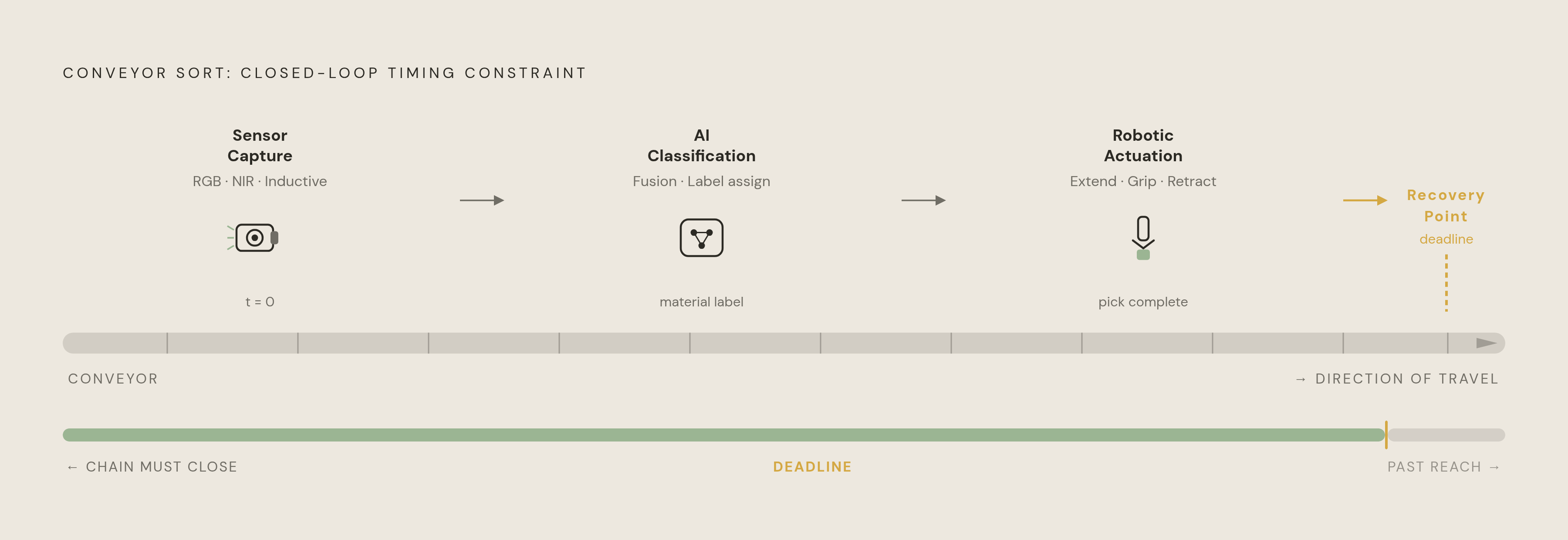
A correct classification has value only if the system can turn it into a successful separation. Robotic arms positioned along the line act on both the material classification and the object’s tracked position. The arm must extend, grasp, and retract before the object passes its recovery point. Timing is the central constraint in this chain. Vision processing and actuation speed must be designed together because a late decision cannot produce a timely pick.
The grasp itself depends on the material. Suction, claw, and hybrid grippers address different handling requirements because a crumpled aluminum can and a wet cardboard sheet do not respond to the same grip mechanics. Multiple arms can serve one line, with each assigned to a target category. This allows several streams to be sorted simultaneously. Systems capable of recognizing loose batteries, small electronics, and vapes can also direct their removal into a fireproof container, separating a hazardous task from routine material recovery.
AMP’s November 2024 announcement with Waste Connections described a Commerce City, Colorado, facility planned for commissioning in early 2026. The announced AMP ONE™ design places actuation within continuous material and purity monitoring across the line rather than treating each robot as independent equipment. It also replaces multiple screens and has real-time self-optimization, including jam detection.
What facility-scale integration changes compared to deploying individual sorting robots
An individual sorter improves a particular point on the line, but its local decisions do not provide a view of the entire facility. A bottleneck elsewhere can remain outside that view. Facility-scale integration connects information from different stages so that the system can identify inefficiencies and adjust operating parameters across the process. The distinction is between improving one machine and managing interactions among machines.
Machinex’s MIND platform demonstrated that distinction at IFAT Munich 2026 by aggregating data from conveyors, sorters, screens, and balers. The platform identifies inefficiencies and adjusts operational parameters in real time, learning how the facility performs as a whole. At the same event, TOMRA presented a natural language AI agent that allows managers to query throughput or contamination data in plain language. Managers need less skill with dashboards to get the data.
The AMP system extends that approach into both software and contracting. Its design detects jams or performance drops and supports throughput improvements through software updates that leave existing hardware in place. Under the announced Commerce City deal, AMP runs and maintains the facility through a pay-per-ton contract. That ties vendor revenue to system performance and changes how an operator evaluates capital risk. The model is emerging rather than widespread, but it shows how integrated technology can change the purchase decision as well as the sorting process.
What the performance record shows when these systems run at industrial scale
Commercial-scale AI sorting systems outperform manual baselines in speed, accuracy, and contamination control. A robotic arm can execute thousands of picks per hour without fatigue across shifts, while a trained human sorter handles a fraction of that volume. Speed alone does not establish the economic case. Accuracy determines how much contamination reaches a bale, and commodity buyers can discount or reject contaminated output. Reliable separation therefore affects the value of recovered material as well as the amount processed.
AMP’s Waste Connections system is specified to have high recovery rates, with guaranteed performance and software that improves throughput. That places performance within the commercial contract rather than leaving it as a claim about laboratory conditions. Greyparrot’s residue-line monitoring shows how much more could be recovered by finding large amounts of recoverable material in streams sent to landfill. This exposes a loss that occasional manual sampling cannot describe continuously. Judging how well a system recovers material must take account of what it misses as well as what it sorts.
The results are not uniform across deployments. Prototypes in controlled environments work much less well than commercial systems, so results from industrial use are the basis for judging what the systems can do. Strong outcomes also cluster at large, well-funded facilities. Smaller operations and sites with older infrastructure can face a wider gap between advertised capability and achievable performance, especially during the first year as models calibrate to the local material mix.
How AI analytics is extending beyond the sorting floor into packaging design and policy
The same item-level recognition used to guide sorting also produces evidence about what enters a facility, what is recovered, and what is lost. Traditional sorting did not generate that continuous, granular record. Aggregating the data across facilities makes it possible to examine how packaging performs in real recovery systems alongside its intended design. The operational record becomes a design input. This extends the value of AI beyond the equipment that makes the physical separation.
Greyparrot’s Deepnest data revealed that removing label sleeves makes bottles significantly more likely to be recovered in sorting facilities. For brand owners, that evidence links choices made before a product is sold to what happens after it is thrown away. The data does not require those two stages to be treated as separate problems.
That link also helps provide the evidence needed under Extended Producer Responsibility schemes. Deepnest gives brands information from real sorting facilities to inform compliance and exposure to EPR fees. An ongoing record of material flow can take the place of occasional manual sampling and help show where materials are lost. This establishes a role for sorting analytics in policy evidence without assuming that regulators have adopted a particular system.
Where the access gap sits and what it means for who benefits from this technology
The ability to generate those gains does not make them equally accessible. A full AI sorting system costs more than many smaller municipalities can readily pay. Older conveyor layouts, inconsistent facility designs, and existing mechanical equipment also create integration work that adds cost and extends commissioning. Commercial maturity does not remove these constraints. Large-throughput facilities are better positioned to absorb them, which helps explain where strong results currently concentrate.
Kingston University’s NORAH initiative, announced October 9, 2026, addresses a related information barrier. Innovate UK funded the initiative at £3.6 million as part of a broader government program. Operators currently lack independent evidence about how robotic systems will perform with their particular materials and layouts. NORAH will test technologies using real waste streams and combine the results with economic modeling of investment requirements and payback periods. It aims to support a large number of organisations and facilitate operational deployments by 2030.
Independent testing can help operators decide where to invest, while new pay-per-ton contracts help with upfront costs by leaving the vendor to run and maintain the facility. Confirmed deployments at scale remain limited, however, so that model is not yet a broadly available answer. Making these systems more widely available will take deliberate help through testing infrastructure, new ways to finance them, or public subsidy. Without it, the structural gains from integrated AI sorting are likely to consolidate recycling capacity among large private operators, leaving municipal systems behind. The distribution of recovery gains depends on sorting accuracy and on who can finance and integrate the architecture.