Consumer-Facing Recycling Label Standards Compared
Different standards address where recycling claims actually match what infrastructure can handle.
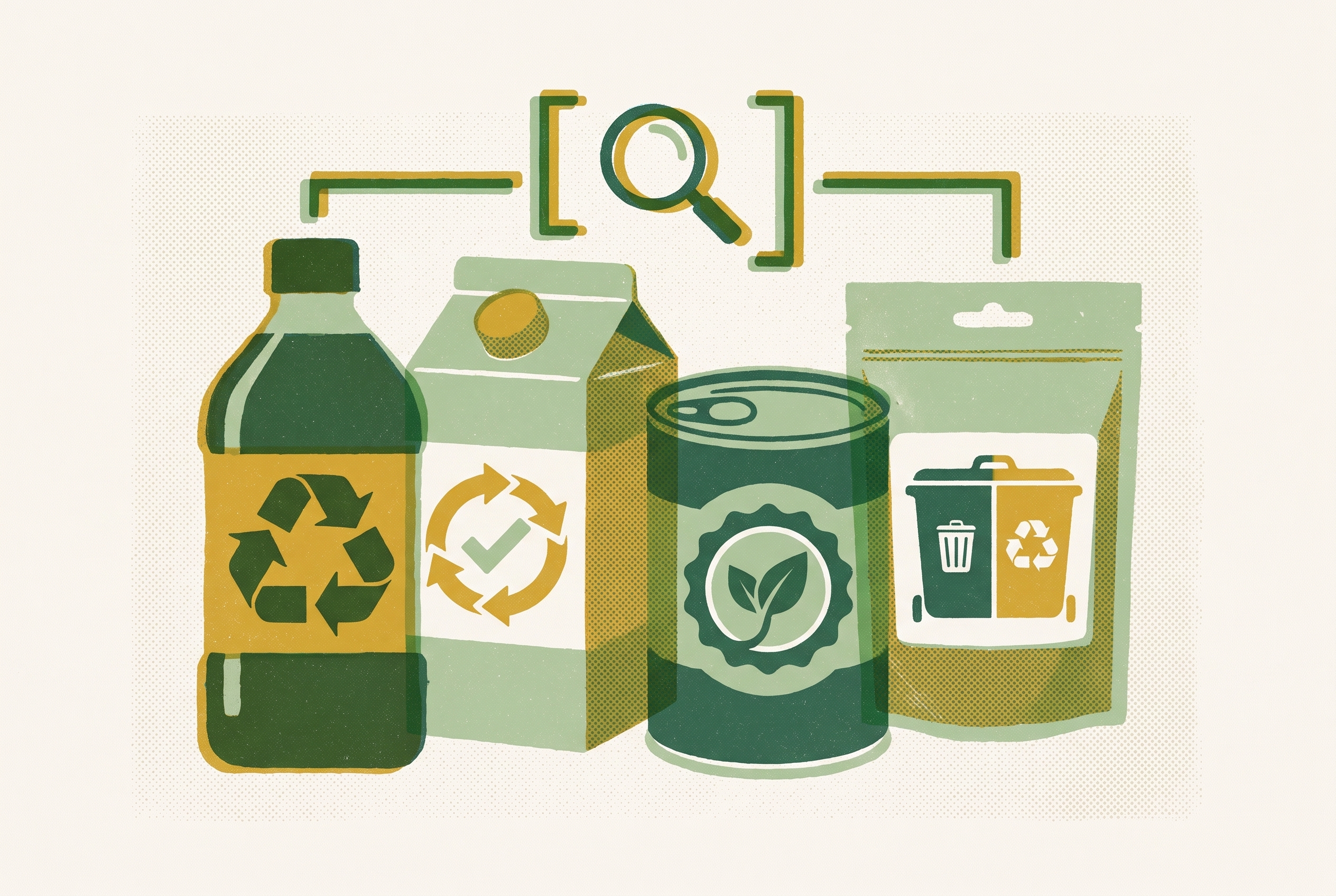
Consumer-facing recycling labels range from voluntary industry programs to mandatory government-backed rules. Their value depends on what they assess, which market they cover, and whether disposal instructions reflect available infrastructure. Comparing regional standards, including those in the UK and EU, shows why an approved label is evidence of a defined assessment whose applicability depends on where the packaging is sold.
Why recycling labels exist and why they so often mislead
Recycling labels proliferated before infrastructure existed to support their implications. The resin identification code’s chasing-arrows symbol illustrates the mismatch. It identifies polymer type, but consumers widely interpret it as a guarantee of recyclability. When consumers use that symbol to sort packaging, non-recyclable material goes into the recycling stream and causes contamination.
The problem extends beyond the sorting bin. When a label promises more than collection systems can do, it makes consumers seem responsible in place of producers and makes it seem normal to keep producing plastic. Environmental groups welcome clearer labels but argue that they leave this pattern in place. The standards that follow address the narrower but essential task of making claims correspond more closely to available recycling systems.
How How2Recycle works and what membership actually requires
How2Recycle’s February 2025 Guidelines for Use require brands to join, pay setup fees and annual dues, and send detailed data on their packaging before they can get approved artwork. Those submissions cover material type, adhesives, inks, and closures at the packaging-type level. The system assigns four designations, namely Widely Recyclable, Check Locally, Store Drop-Off, and Not Yet Recyclable, according to collection infrastructure.
Those assessments can change in either direction. The January 2025 guidelines show aluminum and steel aerosol cans downgraded to Check Locally in the US. PP beverage cups, by contrast, were upgraded to Widely Recyclable after a cross-sector infrastructure collaboration brought curbside acceptance above the required threshold in more than half of US households. How2Recycle designs its labels to follow FTC Green Guides guidance and tells members when laws that affect the labels change. Its remit nevertheless has a boundary, because it cannot advise on claims outside its own labeling system.
How2Recycle's label redesign and what the 2025–2026 transition means for brands
Consumers could interpret chasing arrows as permission for curbside recycling even when the accompanying designation said otherwise. The How2Recycle Pro label replaces those arrows on the Store Drop-Off designation with imagery emphasizing the collection location. QR codes also connect consumers to localized guidance powered by data from The Recycling Partnership.
The transition followed a defined sequence through 2025–2026. New guidelines were released in January 2025, followed by the mid-2025 launch of refreshed Pro and How2Recycle Plus designs. The February 2025 guidelines placed the start of the legacy-label phase-out in August 2025 and set February 1, 2026 as the last date for approval of any proof using legacy labels. For brands, the change reaches beyond artwork. It is part of the program’s alignment with tightening state and federal labeling rules, including California SB 343 effects on eligibility first announced in July 2025.
What the FTC Green Guides actually require and why their 2012 vintage matters now
The FTC Green Guides establish the federal test for an unqualified recyclable claim. Recycling programs accepting the packaging must be available to a substantial majority, defined as at least 60 percent of consumers or communities where the item is sold. The Guides are nonbinding guidance under Section 5 of the FTC Act. A misleading claim can expose a brand to an unfair or deceptive practices action, but the Guides do not establish a per-violation penalty structure. Their legal role differs from a mandatory labeling scheme.
The last major revision was in 2012. That predates the dominance of single-stream recycling, the emergence of flexible film as a major packaging format, and direct state legislation on recyclability criteria. As of late 2026, changes in commission leadership and a broader deregulatory posture have slowed revision, leaving updated Guides unfinished. A national brand may calibrate claims to federal guidance that does not reflect current infrastructure, yet still face challenges under California law or the EU framework.
California SB 343 — what the law required and what the July 2026 injunction did to it
California SB 343 prohibits recycling symbols or claims on plastic packaging unless it meets strict recyclability criteria assessed by CalRecycle. That sets a higher bar than FTC guidance. The law required label changes for non-recyclable packaging by October 4, 2026, making it the first state law with a hard deadline for removing recycling claims. Its influence also reached voluntary labeling. How2Recycle announced eligibility changes in July 2025, and its August 2026 guidelines identify certain paper and plastic package formats whose attributes fail California’s criteria as ineligible for Widely Recyclable labels.
Enforcement became uncertain before that deadline arrived. A federal court issued a preliminary injunction on July 14, 2026, pausing Attorney General enforcement of SB 343. The preliminary ruling did not provide the settled national benchmark that many brands had expected California to supply. Instead, it weakened the role of the law as a de facto national floor just as its removal deadline approached. Brands that had already reformulated packaging or changed labels for California compliance consequently entered the pause in a different position from those awaiting legal clarity.
The proposed federal Truth in Labeling Act and what a binding national standard would change
The Truth in Labeling Act of 2026 proposes a statutory answer to US fragmentation. It would require recycling programs and end markets to be available to at least 60 percent of consumers or communities where covered material is sold, with a lower 40 percent threshold permitting a qualified claim. The proposal uses the FTC’s substantial-majority threshold but would make the requirements part of binding federal law. Its scope also extends beyond recycling claims. It would regulate the terms “compostable,” “reusable,” and “refillable,” addressing a broader set of circular packaging representations.
A federal statute would preempt the state patchwork that SB 343’s injunction has left incomplete. Passage, however, is not assured, and the timeline is unannounced. The strongest industry objection is that a claim can meet a national availability threshold and still mislead consumers in places where few have access to recycling.
The UK OPRL scheme and how Simpler Recycling is reshaping it
The UK OPRL scheme uses a binary label indicating whether to recycle packaging to tell consumers what to do at disposal. More than 800 organisations support the voluntary program in UK markets. Its authority is now being reinforced by Simpler Recycling legislation. Defra and PackUK released version 1.1 of their Recyclability Assessment Methodology, or RAM, in April 2025. RAM grades packaging Red, Amber, or Green, with corresponding modulated EPR fees applying from 2026, Year 2 of the pEPR scheme.
The link between collection rules and instructions is concrete. OPRL announced that all carton packaging for food, drink, and other liquids would carry its “Recycle” label from 1 April 2026, including aseptic and chilled cartons, in keeping with Simpler Recycling legislation. The UK’s delay in broader labeling alignment is a deliberate strategy to coordinate with the EU. As a result, UK brands must wait until the EU’s Implementing Act sets out the relevant visual system before they can fully plan their artwork.
The EU Packaging and Packaging Waste Regulation — what is already in force and what is still delayed
The EU Packaging and Packaging Waste Regulation, or PPWR, applies from 12 August 2026 across all member states, including imported packaging. On recycled content, it prioritizes PET, PP, and HDPE as materials with established recyclability and high market volume. EPR fees may be modulated according to recycled-material content and the sustainability of the recycling technologies involved.
The PPWR establishes recyclability Grades A, B, and C based on design-for-recycling criteria, but those grades do not apply until 2030. The Implementing Act defining consumer-facing pictograms was pushed from August 2026 to the second quarter of 2027. That missing specification prevents global brands from finalizing EU artwork programs and explains the UK’s decision to hold back alignment. The PPWR also aims to limit national environmental labeling obligations, including schemes introduced in France, Italy, Spain, and Portugal, so that such requirements do not restrict packaging’s free movement across the EU.
What the three simultaneous delays — California, EU, FTC — mean for brands operating across markets
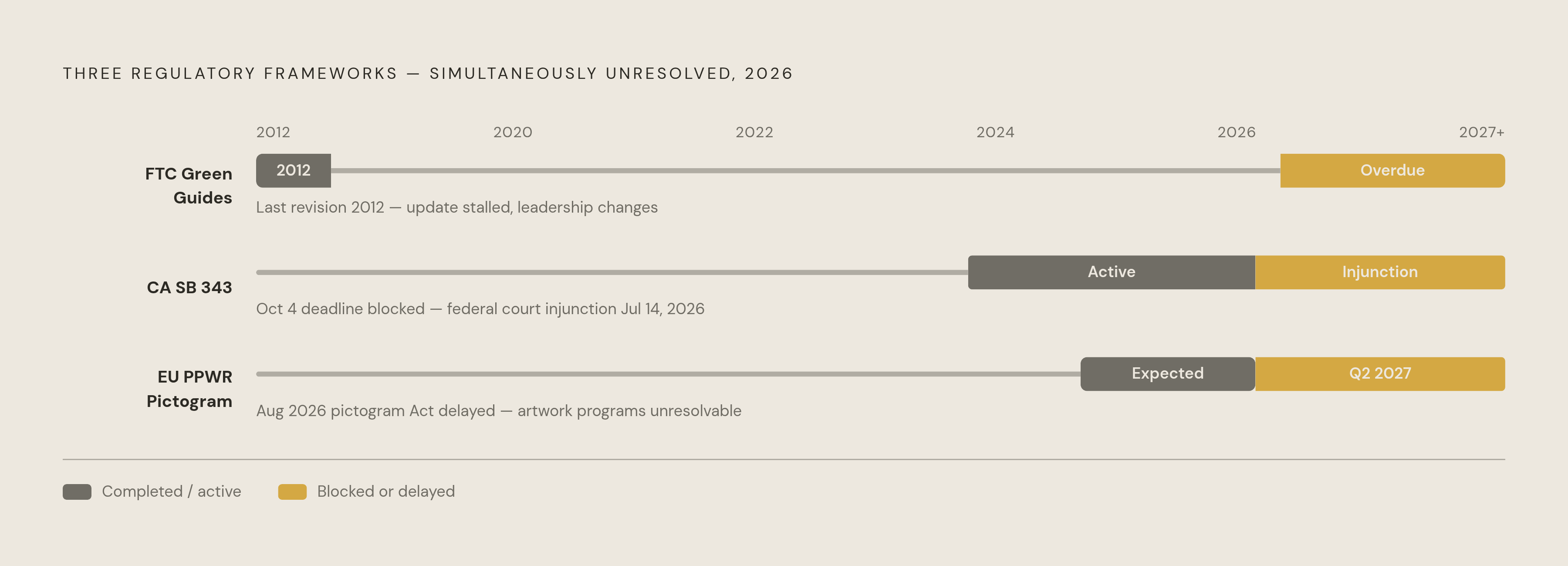
A producer selling into the US, UK, and EU faces distinct frameworks that remain unsettled as of late 2026. The gaps have different legal causes. California’s injunction pauses enforcement of the most demanding US standard, while the EU’s delayed Implementing Act leaves the future pictograms undefined. The FTC’s unfinished revision leaves the 2012 guidance in place as other jurisdictions move further.
The resulting vacuum is one of coordination. Federal deceptive-practices exposure remains relevant even while guidance is being revised, and a preliminary injunction does not settle the future of California’s requirements. Brands that have invested in How2Recycle membership, OPRL participation, or SB 343-compliant artwork are better positioned than those that waited. Yet maintaining parallel label systems imposes costs that fall disproportionately on smaller producers. Waiting for convergence does not remove the obligation to support claims made today.
How brands and consumers can accurately interpret on-package recycling claims today
For brand teams, the practical lesson is to assess each claim against its market and independently verified infrastructure. How2Recycle membership and the Pro format provide the most granular US/Canada verification path currently available, with collection-based designations updated twice a year. OPRL provides the most consumer-recognized UK signal, backed by RAM-graded EPR modulation from October 2026. EU artwork requires a different timing decision. Brands should track the Implementing Act expected in the second quarter of 2027 and avoid finalizing label artwork until the pictogram system is defined.
For consumers, specific instructions are more reliable than generic symbols. A How2Recycle designation such as Widely Recyclable or Store Drop-Off communicates more than unqualified chasing arrows, while an OPRL “Recycle” label reflects the UK assessment framework. Where available, QR codes linking to localized guidance address differences in municipal acceptance. The absence of a third-party verified label is also informative, though it does not itself establish that a package is unrecyclable. Claims based only on resin identification codes or self-declared language remain the least reliable signal because they have not gone through the defined assessment that makes a recycling label useful as evidence.
Sources
- Guidelines for Use - 02 2025 07 2025 Abbreviated
Provided details on membership requirements, the four designations, and the legacy-label phase-out timeline described in the How2Recycle sections.
- Guidelines for Use - 08 2026 01 2027 Abbreviated
Provided the January 2025 designation changes, including the aerosol can downgrade and PP beverage cup upgrade, and the August 2026 ineligibility criteria tied to California SB 343.
- White Paper Summarizing Existing Labeling and Voluntary Programs
Provided background on the landscape of voluntary labeling programs and their relationship to federal environmental claims guidance.
- SB 343 Accurate Recycling Labels: California Labeling Guidance for Plastic Packaging - Association of Plastic Recyclers (APR)
Provided details on California SB 343's recyclability criteria and labeling requirements for plastic packaging assessed by CalRecycle.
- Mislabel It, Pay for It: California’s Tough New Rules on Recycling Symbols - Procopio
Provided context on California SB 343's enforcement mechanisms and the legal consequences of non-compliant recycling claims.
- Our survey proves that recycling claims on plastic packaging are greenwashing
Supported the argument that recycling labels shift responsibility to consumers while allowing continued plastic production.